

652
Climatic Geomorphology
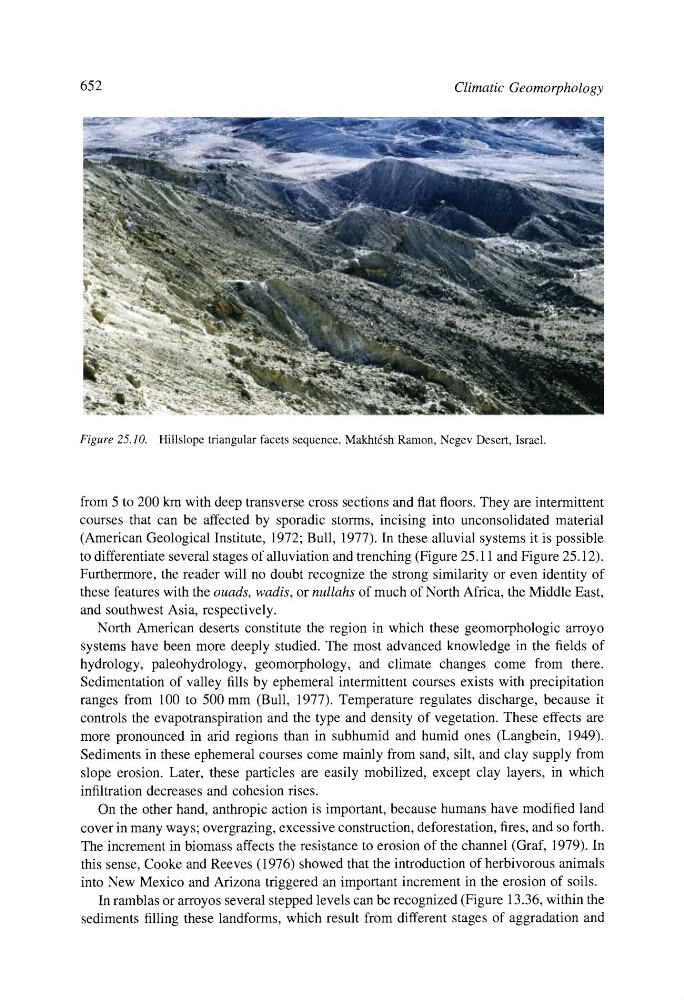
Figure 25.10. Hillslope triangular facets sequence. Makht6sh Ramon, Negev Desert, Israel.
from 5 to 200 km with deep transverse cross sections and flat floors. They are intermittent
courses that can be affected by sporadic storms, incising into unconsolidated material
(American Geological Institute, 1972; Bull, 1977). In these alluvial systems it is possible
to differentiate several stages of alluviation and trenching (Figure 25.11 and Figure 25.12).
Furthermore, the reader will no doubt recognize the strong similarity or even identity of
these features with the ouads, wadis, or nullahs of much of North Africa, the Middle East,
and southwest Asia, respectively.
North American deserts constitute the region in which these geomorphologic arroyo
systems have been more deeply studied. The most advanced knowledge in the fields of
hydrology, paleohydrology, geomorphology, and climate changes come from there.
Sedimentation of valley fills by ephemeral intermittent courses exists with precipitation
ranges from 100 to 500 mm (Bull, 1977). Temperature regulates discharge, because it
controls the evapotranspiration and the type and density of vegetation. These effects are
more pronounced in arid regions than in subhumid and humid ones (Langbein, 1949).
Sediments in these ephemeral courses come mainly from sand, silt, and clay supply from
slope erosion. Later, these particles are easily mobilized, except clay layers, in which
infiltration decreases and cohesion rises.
On the other hand, anthropic action is important, because humans have modified land
cover in many ways; overgrazing, excessive construction, deforestation, fires, and so forth.
The increment in biomass affects the resistance to erosion of the channel (Graf, 1979). In
this sense, Cooke and Reeves (1976) showed that the introduction of herbivorous animals
into New Mexico and Arizona triggered an important increment in the erosion of soils.
In ramblas or arroyos several stepped levels can be recognized (Figure 13.36, within the
sediments filling these landforms, which result from different stages of aggradation and