

Climate change in arid and tropical humid regions
649
Gerson, 1982; Gerson and Grossman, 1987; Schmidt, 1989a,b, 1994; Arauzo et al.,
1996a). Furthermore, the free face has to be thin to avoid an excessive accumulation of
detritus (Schmidt, 1987), allowing the rapid destruction of the cornice and retreat of the
slope. On the other hand, the alternation of hard and weak layers below the free face makes
difficult the formation of talus flatirons.
Once the factors favouring talus flatirons are indicated, it is necessary to know their
causes. Koons (1955) interpreted the features from the discontinuous balance between
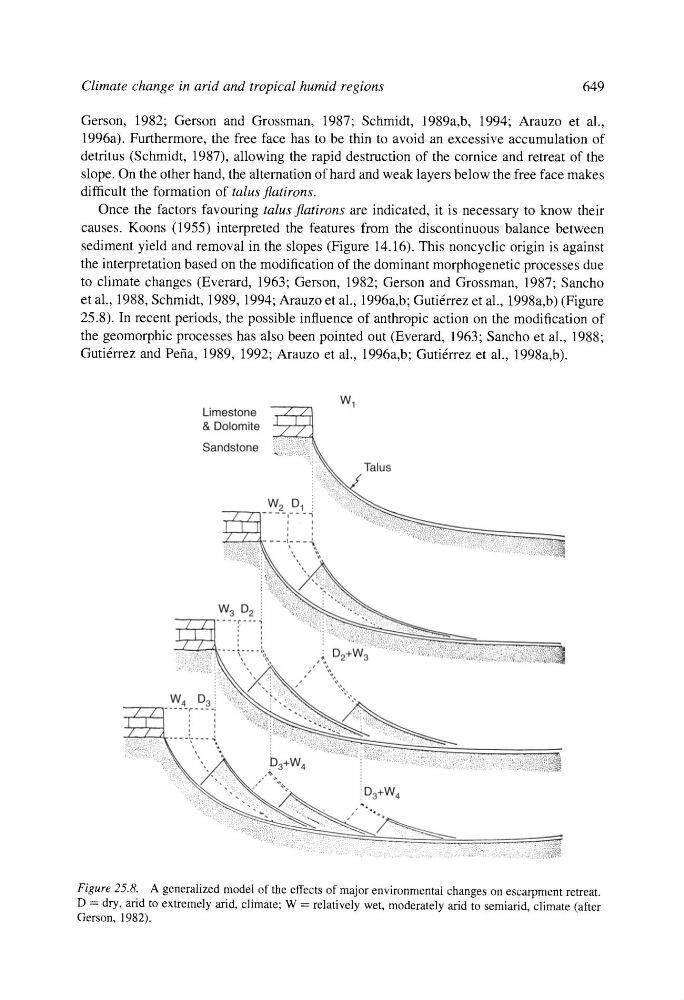
sediment yield and removal in the slopes (Figure 14.16). This noncyclic origin is against
the interpretation based on the modification of the dominant morphogenetic processes due
to climate changes (Everard, 1963; Gerson, 1982; Gerson and Grossman, 1987; Sancho
et al., 1988, Schmidt, 1989, 1994; Arauzo et al., 1996a,b; Guti6rrez et al., 1998a,b) (Figure
25.8). In recent periods, the possible influence of anthropic action on the modification of
the geomorphic processes has also been pointed out (Everard, 1963; Sancho et al., 1988;
Guti~rrez and Pefia, 1989, 1992; Arauzo et al., 1996a,b; Guti~rrez et al., 1998a,b).
Figure 25.8. A generalized model of the effects of major environmental changes on escarpment retreat.
D -- dry, arid to extremely arid, climate; W = relatively wet, moderately arid to semiarid, climate (after
Gerson, 1982).