

Climate change in arid and tropical humid regions
647
The oscillations in temperatures and precipitation that occurred during the Holocene
(the last 10,000 years) have been of low magnitude (+ 2~ and 10-20% in precipitation)
(Lamb, 1977). Even so, these variations have affected the intensity of many
geomorphologic processes, which control the morphologic stability of the landscapes,
especially in fluvial systems (Knox, 1984).
1.1.1. Hillslopes and their evolution
The best typical profile of hillslopes in arid regions can be recognized in sequences of
stratified rocks. This profile consists of a free face at the top, a slope covered totally or
partially by detritus in the middle, and a basal concavity from where a pediment develops
(King, 1962).
In a study of the hillslopes of a great part of the territory of the USA, the influence of the
climate on the evolution and morphology of the profiles is stated (Toy, 1977). In order to
minimize the influence of the geology and the structure, the author carried out the analyses
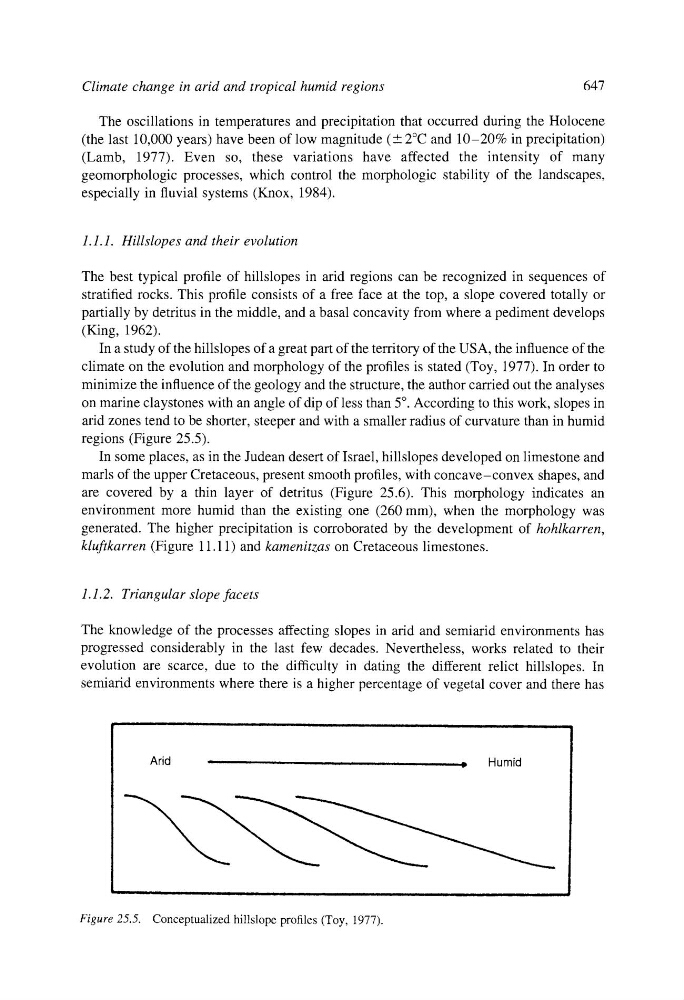
on marine claystones with an angle of dip of less than 5 ~ According to this work, slopes in
arid zones tend to be shorter, steeper and with a smaller radius of curvature than in humid
regions (Figure 25.5).
In some places, as in the Judean desert of Israel, hillslopes developed on limestone and
marls of the upper Cretaceous, present smooth profiles, with concave-convex shapes, and
are covered by a thin layer of detritus (Figure 25.6). This morphology indicates an
environment more humid than the existing one (260 mm), when the morphology was
generated. The higher precipitation is corroborated by the development of hohlkarren,
kluftkarren (Figure 11.11) and kamenitzas on Cretaceous limestones.
1.1.2. Triangular slope facets
The knowledge of the processes affecting slopes in arid and semiarid environments has
progressed considerably in the last few decades. Nevertheless, works related to their
evolution are scarce, due to the difficulty in dating the different relict hillslopes. In
semiarid environments where there is a higher percentage of vegetal cover and there has
Arid
......................
~ ..........
;
Humid
Figure 25.5. Conceptualized hillslope profiles (Toy, 1977).