

622
Climatic Geomorphology
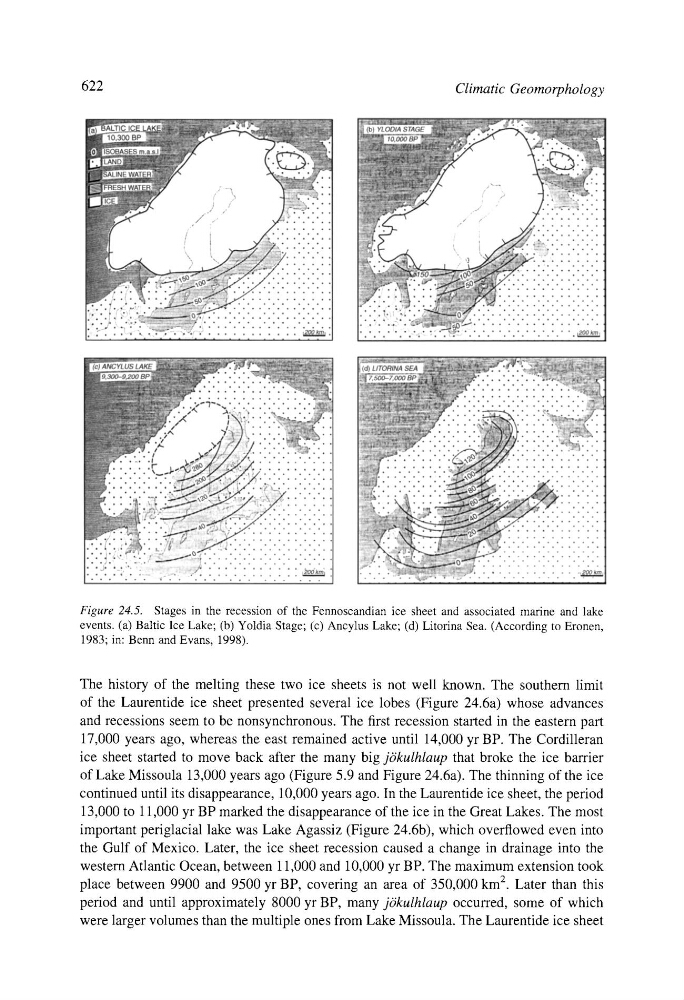
Figure 24.5. Stages in the recession of the Fennoscandian ice sheet and associated marine and lake
events. (a) Baltic Ice Lake; (b) Yoldia Stage; (c) Ancylus Lake; (d) Litorina Sea. (According to Eronen,
1983; in: Benn and Evans, 1998).
The history of the melting these two ice sheets is not well known. The southern limit
of the Laurentide ice sheet presented several ice lobes (Figure 24.6a) whose advances
and recessions seem to be nonsynchronous. The first recession started in the eastern part
17,000 years ago, whereas the east remained active until 14,000 yr BP. The Cordilleran
ice sheet started to move back after the many big j6kulhlaup that broke the ice barrier
of Lake Missoula 13,000 years ago (Figure 5.9 and Figure 24.6a). The thinning of the ice
continued until its disappearance, 10,000 years ago. In the Laurentide ice sheet, the period
13,000 to 11,000 yr BP marked the disappearance of the ice in the Great Lakes. The most
important periglacial lake was Lake Agassiz (Figure 24.6b), which overflowed even into
the Gulf of Mexico. Later, the ice sheet recession caused a change in drainage into the
western Atlantic Ocean, between 11,000 and 10,000 yr BP. The maximum extension took
place between 9900 and 9500 yr BP, covering an area of 350,000 km 2. Later than this
period and until approximately 8000 yr BP, many j6kulhlaup occurred, some of which
were larger volumes than the multiple ones from Lake Missoula. The Laurentide ice sheet