

Climate change in glacial and periglacial regions
619
3.0
3.5
~" 4.0
4.5
5.0
5,5
.............
1
,
0.0
0.5
Composite 8180 Record (0- 2.5 Ma)
8
I
! ......
O
I 0
1.
1.5
2.0
2.5
Age (Ma)
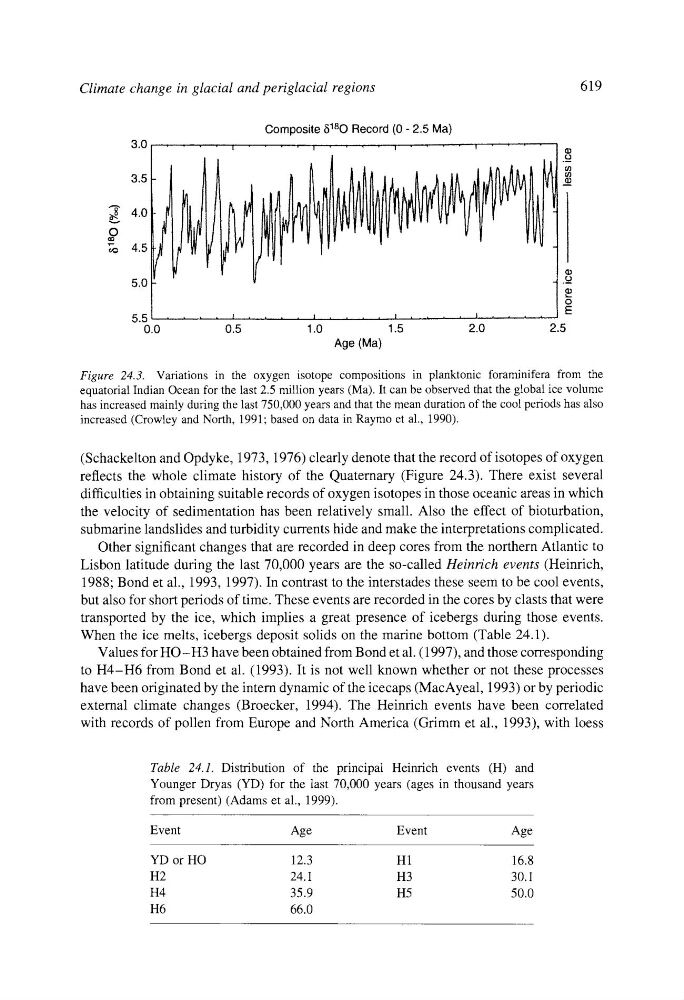
Figure 24.3. Variations in the oxygen isotope compositions in planktonic foraminifera from the
equatorial Indian Ocean for the last 2.5 million years (Ma). It can be observed that the global ice volume
has increased mainly during the last 750,000 years and that the mean duration of the cool periods has also
increased (Crowley and North, 1991; based on data in Raymo et al., 1990).
(Schackelton and Opdyke, 1973, 1976) clearly denote that the record of isotopes of oxygen
reflects the whole climate history of the Quaternary (Figure 24.3). There exist several
difficulties in obtaining suitable records of oxygen isotopes in those oceanic areas in which
the velocity of sedimentation has been relatively small. Also the effect of bioturbation,
submarine landslides and turbidity currents hide and make the interpretations complicated.
Other significant changes that are recorded in deep cores from the northern Atlantic to
Lisbon latitude during the last 70,000 years are the so-called Heinrich events (Heinrich,
1988; Bond et al., 1993, 1997). In contrast to the interstades these seem to be cool events,
but also for short periods of time. These events are recorded in the cores by clasts that were
transported by the ice, which implies a great presence of icebergs during those events.
When the ice melts, icebergs deposit solids on the marine bottom (Table 24.1).
Values for HO-H3 have been obtained from Bond et al. (1997), and those corresponding
to H4-H6 from Bond et al. (1993). It is not well known whether or not these processes
have been originated by the intern dynamic of the icecaps (MacAyeal, 1993) or by periodic
external climate changes (Broecker, 1994). The Heinrich events have been correlated
with records of pollen from Europe and North America (Grimm et al., 1993), with loess
Table 24.1. Distribution of the principal Heinrich events (H) and
Younger Dryas (YD) for the last 70,000 years (ages in thousand years
from present) (Adams et al., 1999).
Event
Age
Event
Age
YD or HO
12.3
H1
16.8
H2
24.1
H3
30.1
H4
35.9
H5
50.0
H6
66.0