

Environmental change
605
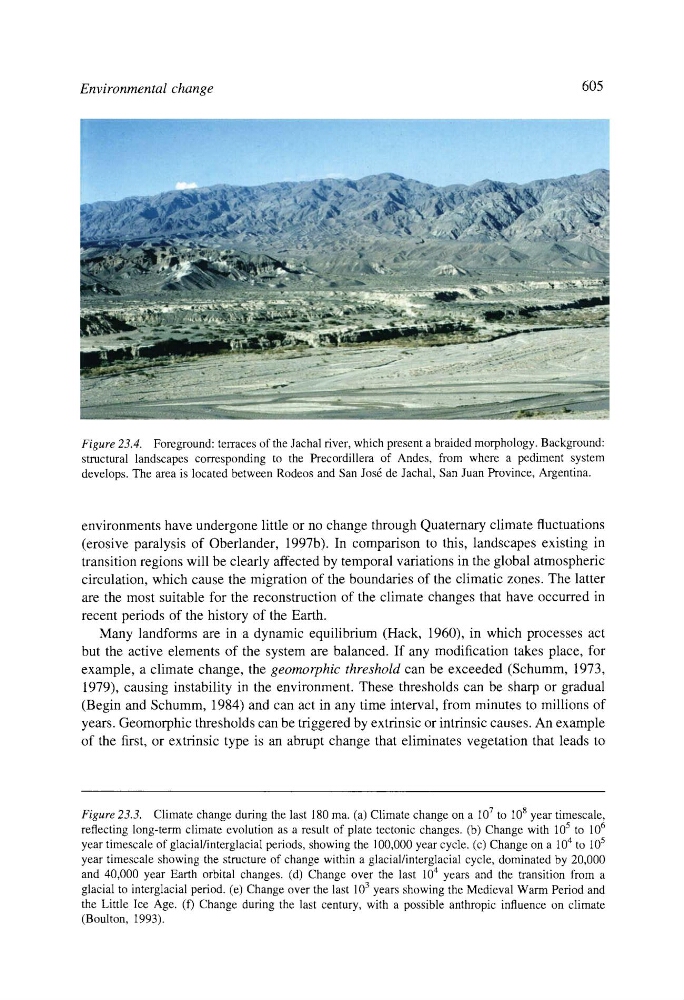
Figure 23.4. Foreground: terraces of the Jachal river, which present a braided morphology. Background:
structural landscapes corresponding to the Precordillera of Andes, from where a pediment system
develops. The area is located between Rodeos and San Jos~ de Jachal, San Juan Province, Argentina.
environments have undergone little or no change through Quaternary climate fluctuations
(erosive paralysis of Oberlander, 1997b). In comparison to this, landscapes existing in
transition regions will be clearly affected by temporal variations in the global atmospheric
circulation, which cause the migration of the boundaries of the climatic zones. The latter
are the most suitable for the reconstruction of the climate changes that have occurred in
recent periods of the history of the Earth.
Many landforms are in a dynamic equilibrium (Hack, 1960), in which processes act
but the active elements of the system are balanced. If any modification takes place, for
example, a climate change, the geomorphic threshold can be exceeded (Schumm, 1973,
1979), causing instability in the environment. These thresholds can be sharp or gradual
(Begin and Schumm, 1984) and can act in any time interval, from minutes to millions of
years. Geomorphic thresholds can be triggered by extrinsic or intrinsic causes. An example
of the first, or extrinsic type is an abrupt change that eliminates vegetation that leads to
Figure 23.3. Climate change during the last 180 ma. (a) Climate change on a 10 v to 108 year timescale,
reflecting long-term climate evolution as a result of plate tectonic changes. (b) Change with 105 to 106
year timescale of glacial/interglacial periods, showing the 100,000 year cycle. (c) Change on a 104 to 105
year timescale showing the structure of change within a glacial/interglacial cycle, dominated by 20,000
and 40,000 year Earth orbital changes. (d) Change over the last 104 years and the transition from a
glacial to interglacial period. (e) Change over the last 103 years showing the Medieval Warm Period and
the Little Ice Age. (f) Change during the last century, with a possible anthropic influence on climate
(Boulton, 1993).