

Glaciers
51
Total
Surface
Movement
o
*
~
9
9 ....
.
./.
.
9
9
Basal
Slip
"
9
9
"
9
9
.
9 9 . . 9
9 9
.
Internal Flow
. " .
.
9 "
9
9
9
.
9
9
.,
,,
9
9
.
9
.
.
9
9
9
.
9
9
9
.
.
9
"
9
,,
*
.
9
9
9
9
.
9
.
m
9
.
.
9
.
9
9
o
"
9
,,
.,
.
9
9
9
,,
"
"
9
"
"
9
9
9
9
9
9
"
9
s
.
9
9
.
9
.
,,
.
.
9
9
.
.
.
"
.
.
"
"
".
.
.
"
.
Ice
9
.
9
9
9
.
.
9
9
9
.
9
.
9
9
*
o
9
9
9
9
9
9
9
"
.
9
~
9
9
9
Basal
Slip
'
'
-
"
.~" .
.
.
9
.
.
9
.
.
.
.
9
.
/ I,, i
~/ I~.?~/i
/~
.
9
.
*
,
9
.
,<,
"
-
"---'","./..',,/\,>,x v
.
.
.
.
9
9
9
.
+'/
9
.
.
*
"=+
~'-"~-'-:;.q-S' "';' """';'"'"<:~''" -
"
"
'- ..,.
., , :-, ,- -,,, ,:,,. -,.
, .'. ,.~ ..
,.';. ,c,.'~,',.-,. -..
t .
.
,~,'
i"-':/r
'
"~
Rock
'-, ~,',,-,./~,,,,\,>;~~~'
'
't
"f,
;,'i
,~.'-,'i'
.~','
' "%#1 "/ ~ " \
x~.t.l~/|--.t
x
,I.~.1. ~,,\..~, \ ,/~,--/.1~..I
+ .,Ix
./.,,tX.,X
~ ,
x ./,~l.l,.I
_~ ,ix .I./l\.,~.X
I~-.,",
I
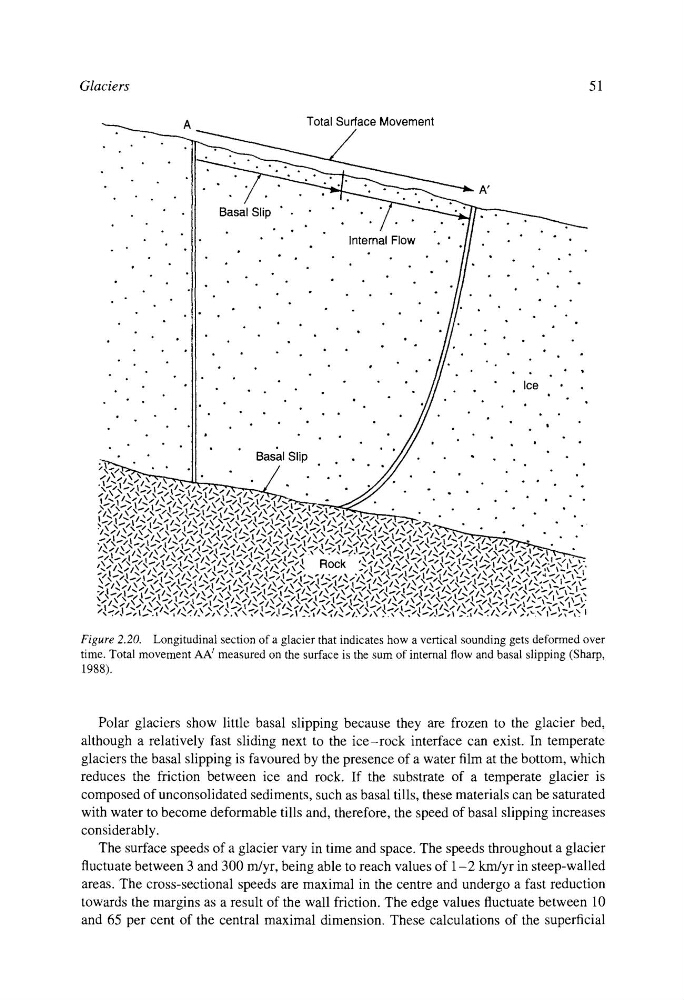
Figure 2.20. Longitudinal section of a glacier that indicates how a vertical sounding gets deformed over
time. Total movement AA t measured on the surface is the sum of internal flow and basal slipping (Sharp,
1988).
Polar glaciers show little basal slipping because they are frozen to the glacier bed,
although a relatively fast sliding next to the ice-rock interface can exist. In temperate
glaciers the basal slipping is favoured by the presence of a water film at the bottom, which
reduces the friction between ice and rock. If the substrate of a temperate glacier is
composed of unconsolidated sediments, such as basal tills, these materials can be saturated
with water to become deformable tills and, therefore, the speed of basal slipping increases
considerably.
The surface speeds of a glacier vary in time and space. The speeds throughout a glacier
fluctuate between 3 and 300 m/yr, being able to reach values of 1-2 km/yr in steep-walled
areas. The cross-sectional speeds are maximal in the centre and undergo a fast reduction
towards the margins as a result of the wall friction. The edge values fluctuate between 10
and 65 per cent of the central maximal dimension. These calculations of the superficial
51
Total
Surface
Movement
o
*
~
9
9 ....
.
./.
.
9
9
Basal
Slip
"
9
9
"
9
9
.
9 9 . . 9
9 9
.
Internal Flow
. " .
.
9 "
9
9
9
.
9
9
.,
,,
9
9
.
9
.
.
9
9
9
.
9
9
9
.
.
9
"
9
,,
*
.
9
9
9
9
.
9
.
m
9
.
.
9
.
9
9
o
"
9
,,
.,
.
9
9
9
,,
"
"
9
"
"
9
9
9
9
9
9
"
9
s
.
9
9
.
9
.
,,
.
.
9
9
.
.
.
"
.
.
"
"
".
.
.
"
.
Ice
9
.
9
9
9
.
.
9
9
9
.
9
.
9
9
*
o
9
9
9
9
9
9
9
"
.
9
~
9
9
9
Basal
Slip
'
'
-
"
.~" .
.
.
9
.
.
9
.
.
.
.
9
.
/ I,, i
~/ I~.?~/i
/~
.
9
.
*
,
9
.
,<,
"
-
"---'","./..',,/\,>,x v
.
.
.
.
9
9
9
.
+'/
9
.
.
*
"=+
~'-"~-'-:;.q-S' "';' """';'"'"<:~''" -
"
"
'- ..,.
., , :-, ,- -,,, ,:,,. -,.
, .'. ,.~ ..
,.';. ,c,.'~,',.-,. -..
t .
.
,~,'
i"-':/r
'
"~
Rock
'-, ~,',,-,./~,,,,\,>;~~~'
'
't
"f,
;,'i
,~.'-,'i'
.~','
' "%#1 "/ ~ " \
x~.t.l~/|--.t
x
,I.~.1. ~,,\..~, \ ,/~,--/.1~..I
+ .,Ix
./.,,tX.,X
~ ,
x ./,~l.l,.I
_~ ,ix .I./l\.,~.X
I~-.,",
I
Figure 2.20. Longitudinal section of a glacier that indicates how a vertical sounding gets deformed over
time. Total movement AA t measured on the surface is the sum of internal flow and basal slipping (Sharp,
1988).
Polar glaciers show little basal slipping because they are frozen to the glacier bed,
although a relatively fast sliding next to the ice-rock interface can exist. In temperate
glaciers the basal slipping is favoured by the presence of a water film at the bottom, which
reduces the friction between ice and rock. If the substrate of a temperate glacier is
composed of unconsolidated sediments, such as basal tills, these materials can be saturated
with water to become deformable tills and, therefore, the speed of basal slipping increases
considerably.
The surface speeds of a glacier vary in time and space. The speeds throughout a glacier
fluctuate between 3 and 300 m/yr, being able to reach values of 1-2 km/yr in steep-walled
areas. The cross-sectional speeds are maximal in the centre and undergo a fast reduction
towards the margins as a result of the wall friction. The edge values fluctuate between 10
and 65 per cent of the central maximal dimension. These calculations of the superficial