

50
Climatic Geomorphology
~:o..
'ii
MALASPINA
GLACIER
~F
___.___.-..--Forest on debris-covered Ice
:SZ--..-.-.'" ...<
;? ....;..:.f
Point Manby
.'~ 9
f~ *o Q"
Bay
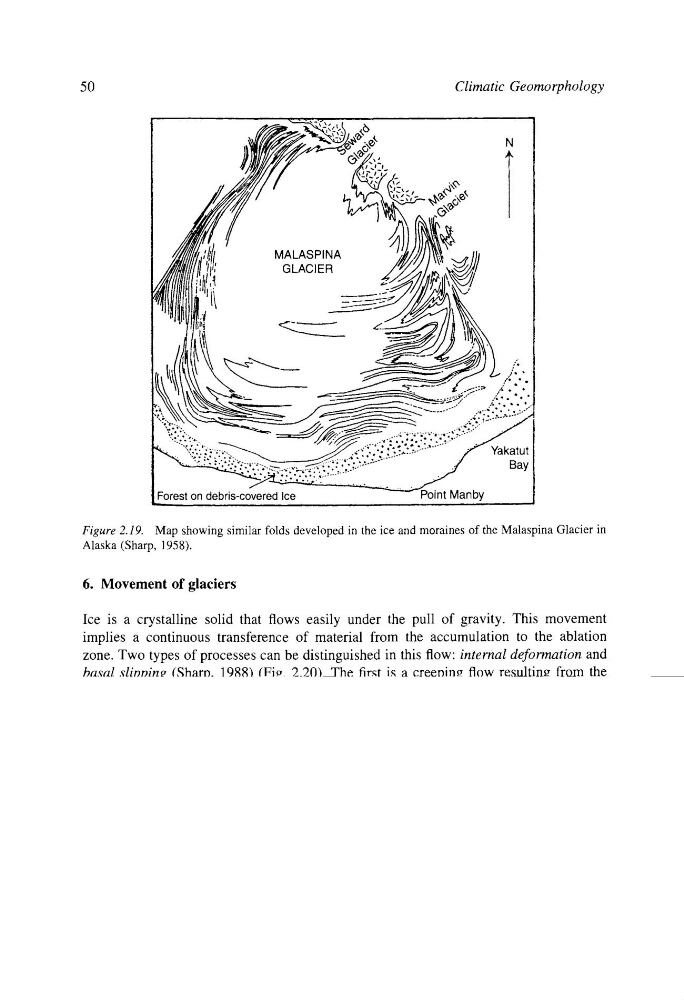
Figure 2.19. Map showing similar folds developed in the ice and moraines of the Malaspina Glacier in
Alaska (Sharp, 1958).
6. Movement of glaciers
Ice is a crystalline solid that flows easily under the pull of gravity. This movement
implies a continuous transference of material from the accumulation to the ablation
zone. Two types of processes can be distinguished in this flow: internal deformation and
basal slipping (Sharp, 1988) (Fig. 2.20). The first is a creeping flow resulting from the
application of force over a long period. Intergranular sliding, re-crystallization and
sliding along crystal network planes in the ice crystals are the mechanisms of this flow
(Weertman, 1983).
The basal slipping indicates the displacement of the ice mass on its bed (Weertman,
1957). This movement on the bottom also implies a process of basal plastic flow in
which the ice flows over and around greater obstacles. These advances can take place
whatever the temperature of the ice is (Fig. 2.21). The other mechanism is denoted
sliding by refreezing. The bottom of the glacier presents a rough surface with small
thresholds and depressions of centimetre to metric scale. Melting by increase of pressure
in the basal ice can take place if the glacier is of the temperate type, near its pressuremelting point, and a refreezing or regelation, when the water pressure is reduced. If the
protuberances are very small, latent heat transference can take place and facilitate new
melting. Refreezing layers of clear ice, laminated and of a few centimetres thickness, can
occur at the base of the glacier (Kamb and LaChapelle, 1964).
Climatic Geomorphology
~:o..
'ii
MALASPINA
GLACIER
~F
___.___.-..--Forest on debris-covered Ice
:SZ--..-.-.'" ...<
;? ....;..:.f
Point Manby
.'~ 9
f~ *o Q"
Bay
Figure 2.19. Map showing similar folds developed in the ice and moraines of the Malaspina Glacier in
Alaska (Sharp, 1958).
6. Movement of glaciers
Ice is a crystalline solid that flows easily under the pull of gravity. This movement
implies a continuous transference of material from the accumulation to the ablation
zone. Two types of processes can be distinguished in this flow: internal deformation and
basal slipping (Sharp, 1988) (Fig. 2.20). The first is a creeping flow resulting from the
application of force over a long period. Intergranular sliding, re-crystallization and
sliding along crystal network planes in the ice crystals are the mechanisms of this flow
(Weertman, 1983).
The basal slipping indicates the displacement of the ice mass on its bed (Weertman,
1957). This movement on the bottom also implies a process of basal plastic flow in
which the ice flows over and around greater obstacles. These advances can take place
whatever the temperature of the ice is (Fig. 2.21). The other mechanism is denoted
sliding by refreezing. The bottom of the glacier presents a rough surface with small
thresholds and depressions of centimetre to metric scale. Melting by increase of pressure
in the basal ice can take place if the glacier is of the temperate type, near its pressuremelting point, and a refreezing or regelation, when the water pressure is reduced. If the
protuberances are very small, latent heat transference can take place and facilitate new
melting. Refreezing layers of clear ice, laminated and of a few centimetres thickness, can
occur at the base of the glacier (Kamb and LaChapelle, 1964).