

Applied geomorphology in tropical regions
589
w,
. ,,
o,.,
",
, .,,*.
,
9
i'" "'.i""
9 o 9
o~ ~176
~176 ". 9
\\\
I
/
/
I
NNN~,
/N/N/N/,, ,
I / / I
\\\',
I
I
I
/
ground surface
"
\\\'
,gossan
/
I
#' /
/
/
,, -, ,, \ \ \ \ \ '
, / / / / / / / /
\\\\\\\\'
"N/ I / / / / / /
,, ,, , ,, \ \ \,
9 / / /
leached zone \
\
\
,
9 "..'...."
/
I
/
I
/
/
I
I
... .... .t, \ \ \ \ \ \ \"
9 .'. . /
/ / /
/
/ / /
.'.........\ \ \ \ \ \ \,
t i
i
,- ,, /
/
/
oxidized ore \
\
\
"
9 "
"
ater-table
supergene sulphide ore
- \~.\~.\ ~ .~ .~ .~
i
/\ groundwater base 4
t. .f / t. / ,,e
\\\\\\~
'
(, /
/
/
/
/
/
I N
primary ore
/
/
,, ,, ,, \ \ ',
I
/ /
/
/
/
/
\_
~'/\/\/\/\/\/"
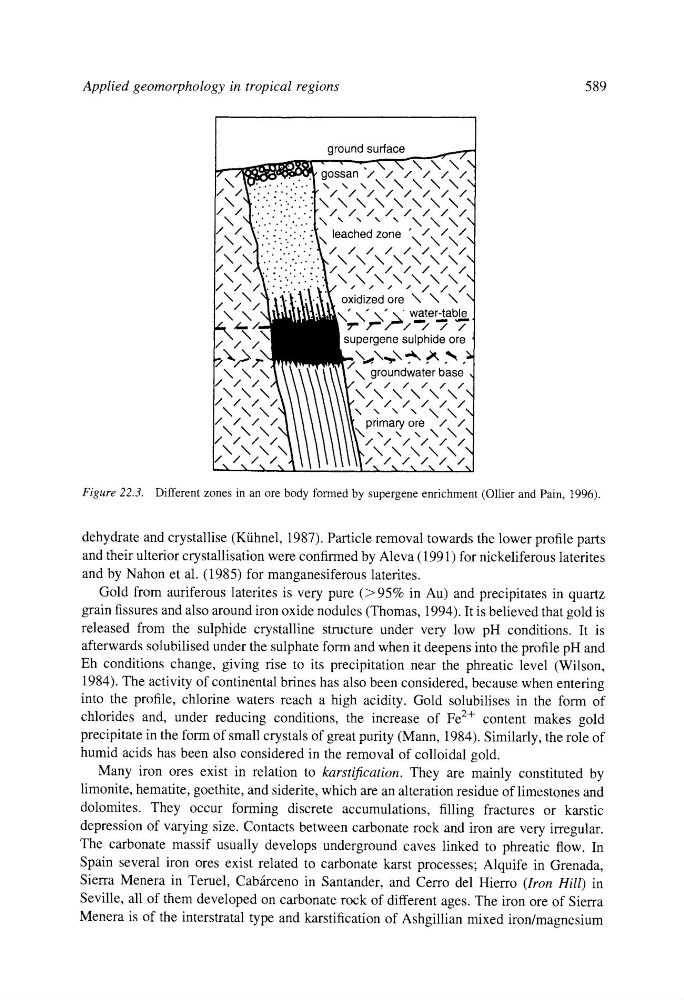
Figure 22.3. Different zones in an ore body formed by supergene enrichment (Ollier and Pain, 1996).
dehydrate and crystallise (Ktihnel, 1987). Particle removal towards the lower profile parts
and their ulterior crystallisation were confirmed by Aleva (1991) for nickeliferous laterites
and by Nahon et al. (1985) for manganesiferous laterites.
Gold from auriferous laterites is very pure (>95% in Au) and precipitates in quartz
grain fissures and also around iron oxide nodules (Thomas, 1994). It is believed that gold is
released from the sulphide crystalline structure under very low pH conditions. It is
afterwards solubilised under the sulphate form and when it deepens into the profile pH and
Eh conditions change, giving rise to its precipitation near the phreatic level (Wilson,
1984). The activity of continental brines has also been considered, because when entering
into the profile, chlorine waters reach a high acidity. Gold solubilises in the form of
chlorides and, under reducing conditions, the increase of Fe z+ content makes gold
precipitate in the form of small crystals of great purity (Mann, 1984). Similarly, the role of
humid acids has been also considered in the removal of colloidal gold.
Many iron ores exist in relation to karstification. They are mainly constituted by
limonite, hematite, goethite, and siderite, which are an alteration residue of limestones and
dolomites. They occur forming discrete accumulations, filling fractures or karstic
depression of varying size. Contacts between carbonate rock and iron are very irregular.
The carbonate massif usually develops underground caves linked to phreatic flow. In
Spain several iron ores exist related to carbonate karst processes; Alquife in Grenada,
Sierra Menera in Teruel, Cabfirceno in Santander, and Cerro del Hierro (Iron Hill) in
Seville, all of them developed on carbonate rock of different ages. The iron ore of Sierra
Menera is of the interstratal type and karstification of Ashgillian mixed iron/magnesium