

588
Climatic Geomorphology
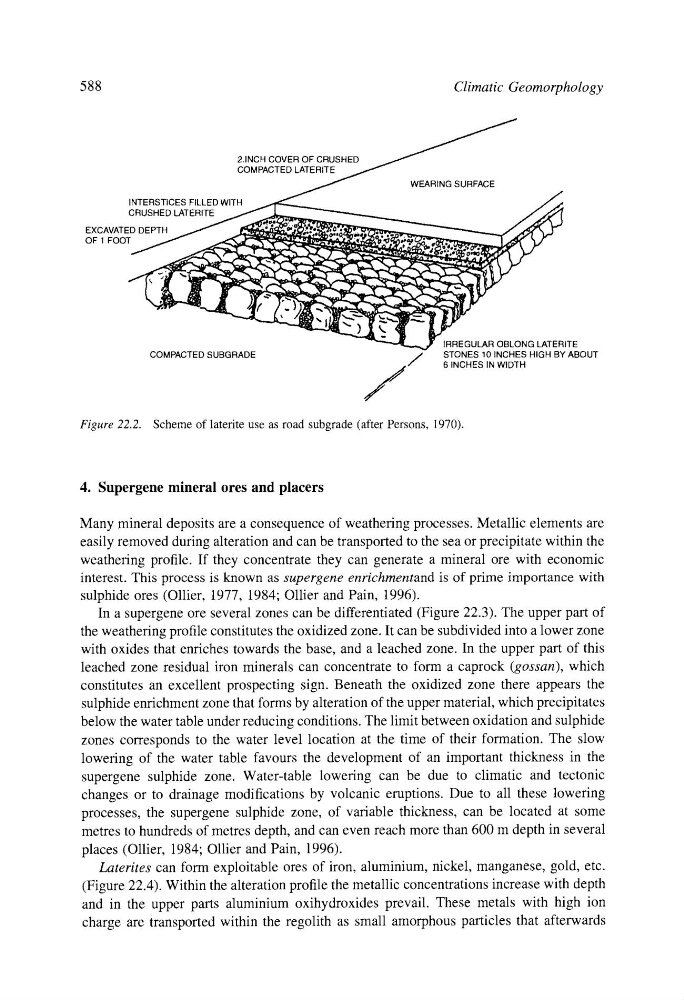
2.INCH COVER OF CRUSHED
COMPACTED LATERITE
INTERSTICES FILLED WITH
CRUSHED LATERITE
EXCAVATED DEPT~
OF 1 FOOT
WEARING SURFACE
COMPACTED SUBGRADE
/
IRREGULAR OBLONG LATERITE
STONES 10 INCHES HIGH BY ABOUT
6 INCHES IN WIDTH
Figure 22.2. Scheme of laterite use as road subgrade (after Persons, 1970).
4. Supergene mineral ores and placers
Many mineral deposits are a consequence of weathering processes. Metallic elements are
easily removed during alteration and can be transported to the sea or precipitate within the
weathering profile. If they concentrate they can generate a mineral ore with economic
interest. This process is known as supergene enrichmentand is of prime importance with
sulphide ores (Ollier, 1977, 1984; Ollier and Pain, 1996).
In a supergene ore several zones can be differentiated (Figure 22.3). The upper part of
the weathering profile constitutes the oxidized zone. It can be subdivided into a lower zone
with oxides that enriches towards the base, and a leached zone. In the upper part of this
leached zone residual iron minerals can concentrate to form a caprock (gossan), which
constitutes an excellent prospecting sign. Beneath the oxidized zone there appears the
sulphide enrichment zone that forms by alteration of the upper material, which precipitates
below the water table under reducing conditions. The limit between oxidation and sulphide
zones corresponds to the water level location at the time of their formation. The slow
lowering of the water table favours the development of an important thickness in the
supergene sulphide zone. Water-table lowering can be due to climatic and tectonic
changes or to drainage modifications by volcanic eruptions. Due to all these lowering
processes, the supergene sulphide zone, of variable thickness, can be located at some
metres to hundreds of metres depth, and can even reach more than 600 m depth in several
places (Ollier, 1984; Ollier and Pain, 1996).
Laterites can form exploitable ores of iron, aluminium, nickel, manganese, gold, etc.
(Figure 22.4). Within the alteration profile the metallic concentrations increase with depth
and in the upper parts aluminium oxihydroxides prevail. These metals with high ion
charge are transported within the regolith as small amorphous particles that afterwards