

564
Climatic Geomorphology
Thomas (1965, 1974, 1994) proposed a classification of plains and etchplains as a
function of denudation rate of the lateritic profiles. In his last version he introduced some
modifications, although this differentiation has not received great acceptance. Thomas
(1989, 1994) and Pavich (1985) compared the basal surface lowering and the differential
erosion of the regolith with the dynamic equilibrium concept of Hack (1960, 1975), by
which there is presumed to exist a balance between regolith erosion and generation. On the
other hand, other authors (e.g., Ollier, 1991) estimated the landform genesis as a group of
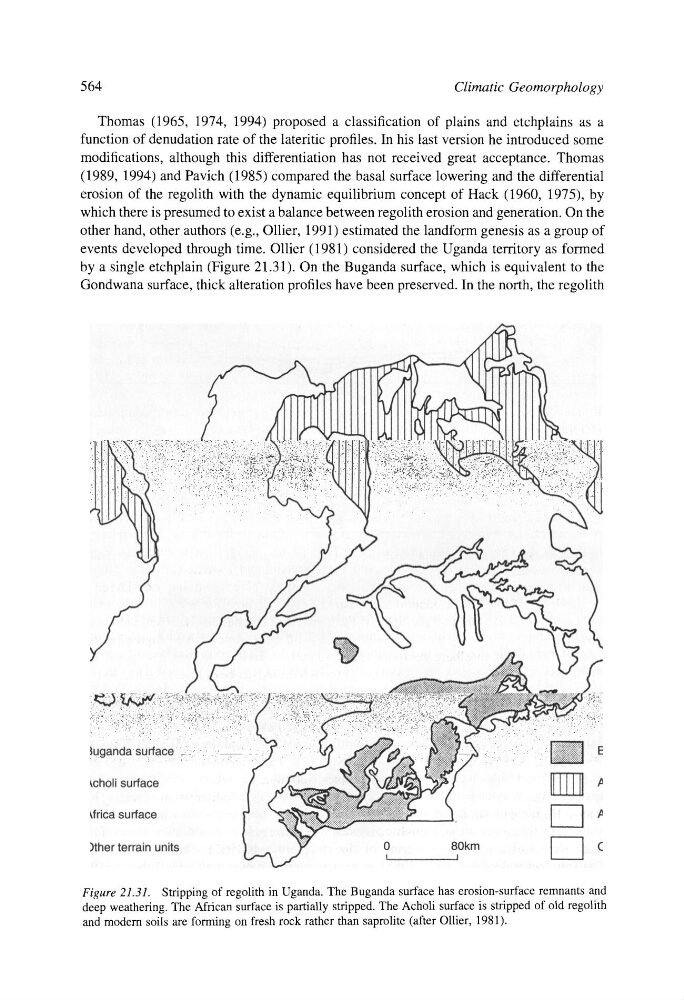
events developed through time. Ollier (1981) considered the Uganda territory as formed
by a single etchplain (Figure 21.31). On the Buganda surface, which is equivalent to the
Gondwana surface, thick alteration profiles have been preserved. In the north, the regolith
Figure 21.31. Stripping of regolith in Uganda. The Buganda surface has erosion-surface remnants and
deep weathering. The African surface is partially stripped. The Acholi surface is stripped of old regolith
and modem soils are forming on fresh rock rather than saprolite (after Ollier, 1981).