

Tropical landforms
563
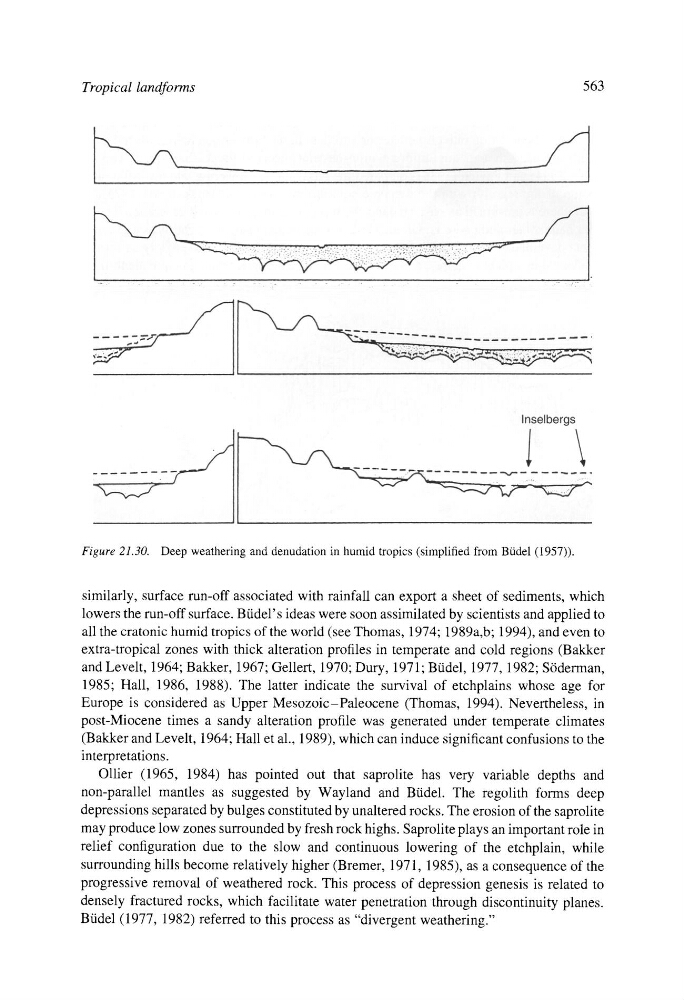
Figure 21.30. Deep weathering and denudation in humid tropics (simplified from Btidel (1957)).
similarly, surface run-off associated with rainfall can export a sheet of sediments, which
lowers the run-off surface. Btidel' s ideas were soon assimilated by scientists and applied to
all the cratonic humid tropics of the world (see Thomas, 1974; 1989a,b; 1994), and even to
extra-tropical zones with thick alteration profiles in temperate and cold regions (Bakker
and Levelt, 1964; Bakker, 1967; Gellert, 1970; Dury, 1971; Biidel, 1977, 1982; S6derman,
1985; Hall, 1986, 1988). The latter indicate the survival of etchplains whose age for
Europe is considered as Upper Mesozoic-Paleocene (Thomas, 1994). Nevertheless, in
post-Miocene times a sandy alteration profile was generated under temperate climates
(Bakker and Levelt, 1964; Hall et al., 1989), which can induce significant confusions to the
interpretations.
Oilier (1965, 1984) has pointed out that saprolite has very variable depths and
non-parallel mantles as suggested by Wayland and Btidel. The regolith forms deep
depressions separated by bulges constituted by unaltered rocks. The erosion of the saprolite
may produce low zones surrounded by fresh rock highs. Saprolite plays an important role in
relief configuration due to the slow and continuous lowering of the etchplain, while
surrounding hills become relatively higher (Bremer, 1971, 1985), as a consequence of the
progressive removal of weathered rock. This process of depression genesis is related to
densely fractured rocks, which facilitate water penetration through discontinuity planes.
Btidel (1977, 1982) referred to this process as "divergent weathering."