

548
Climatic Geomorphology
or remain close to the surface (Boast, 1990). Moreover, a plane relief favours water
penetration and the development of thick saprolites, which following Raunet (1985)
constitute the location of a great part of dambos. In the Taubat6 Basin of southeastern
Brazil, Coltrinari and Nogueira (1989) indicated that slopes limiting dambos are stepped
and present small rounded depressions, with or without hydrophilic vegetation. Possibly
their origin may be related to slides in the Tertiary sediments.
For some authors, the origin of dambos is related to the drainage network dynamics and
evolution, while for others it is associated with differential chemical and biochemical
weathering. The former argue for an incision phase in the valley head, followed by a filling
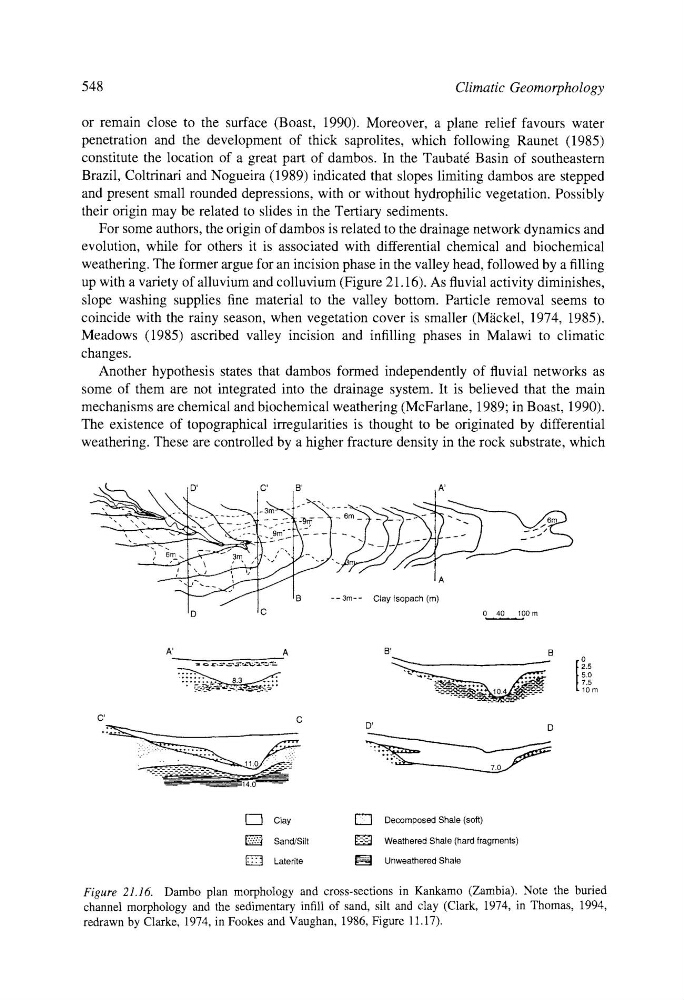
up with a variety of alluvium and colluvium (Figure 21.16). As fluvial activity diminishes,
slope washing supplies fine material to the valley bottom. Particle removal seems to
coincide with the rainy season, when vegetation cover is smaller (M~ickel, 1974, 1985).
Meadows (1985) ascribed valley incision and infilling phases in Malawi to climatic
changes.
Another hypothesis states that dambos formed independently of fluvial networks as
some of them are not integrated into the drainage system. It is believed that the main
mechanisms are chemical and biochemical weathering (McFarlane, 1989; in Boast, 1990).
The existence of topographical irregularities is thought to be originated by differential
weathering. These are controlled by a higher fracture density in the rock substrate, which
D'
C'
B'
A'
.,
"- .....
"
__
_ 6m
,,
,, \
__~----_
_-ajm
U
J
Jc
|B
- 3m
Clay Isopach (m)
040
100m
A'
A
B'
B
:i!!~::... 83 ...:
""~"" 104~"
C'
C
-
14.0
D'
D
0
2.5
5.0
7.5
10m
[-'-"]
Clay
Sand/Silt
Laterite
['77"]
Decomposed Shale (soft)
Weathered Shale (hard fragments)
Unweathered Shale
Figure 21.16. Dambo plan morphology and cross-sections in Kankamo (Zambia). Note the buried
channel morphology and the sedimentary infill of sand, silt and clay (Clark, 1974, in Thomas, 1994,
redrawn by Clarke, 1974, in Fookes and Vaughan, 1986, Figure 11.17).
Climatic Geomorphology
or remain close to the surface (Boast, 1990). Moreover, a plane relief favours water
penetration and the development of thick saprolites, which following Raunet (1985)
constitute the location of a great part of dambos. In the Taubat6 Basin of southeastern
Brazil, Coltrinari and Nogueira (1989) indicated that slopes limiting dambos are stepped
and present small rounded depressions, with or without hydrophilic vegetation. Possibly
their origin may be related to slides in the Tertiary sediments.
For some authors, the origin of dambos is related to the drainage network dynamics and
evolution, while for others it is associated with differential chemical and biochemical
weathering. The former argue for an incision phase in the valley head, followed by a filling
up with a variety of alluvium and colluvium (Figure 21.16). As fluvial activity diminishes,
slope washing supplies fine material to the valley bottom. Particle removal seems to
coincide with the rainy season, when vegetation cover is smaller (M~ickel, 1974, 1985).
Meadows (1985) ascribed valley incision and infilling phases in Malawi to climatic
changes.
Another hypothesis states that dambos formed independently of fluvial networks as
some of them are not integrated into the drainage system. It is believed that the main
mechanisms are chemical and biochemical weathering (McFarlane, 1989; in Boast, 1990).
The existence of topographical irregularities is thought to be originated by differential
weathering. These are controlled by a higher fracture density in the rock substrate, which
D'
C'
B'
A'
.,
"- .....
"
__
_ 6m
,,
,, \
__~----_
_-ajm
U
J
Jc
|B
- 3m
Clay Isopach (m)
040
100m
A'
A
B'
B
:i!!~::... 83 ...:
""~"" 104~"
C'
C
-
14.0
D'
D
0
2.5
5.0
7.5
10m
[-'-"]
Clay
Sand/Silt
Laterite
['77"]
Decomposed Shale (soft)
Weathered Shale (hard fragments)
Unweathered Shale
Figure 21.16. Dambo plan morphology and cross-sections in Kankamo (Zambia). Note the buried
channel morphology and the sedimentary infill of sand, silt and clay (Clark, 1974, in Thomas, 1994,
redrawn by Clarke, 1974, in Fookes and Vaughan, 1986, Figure 11.17).