

Tropical landforms
545
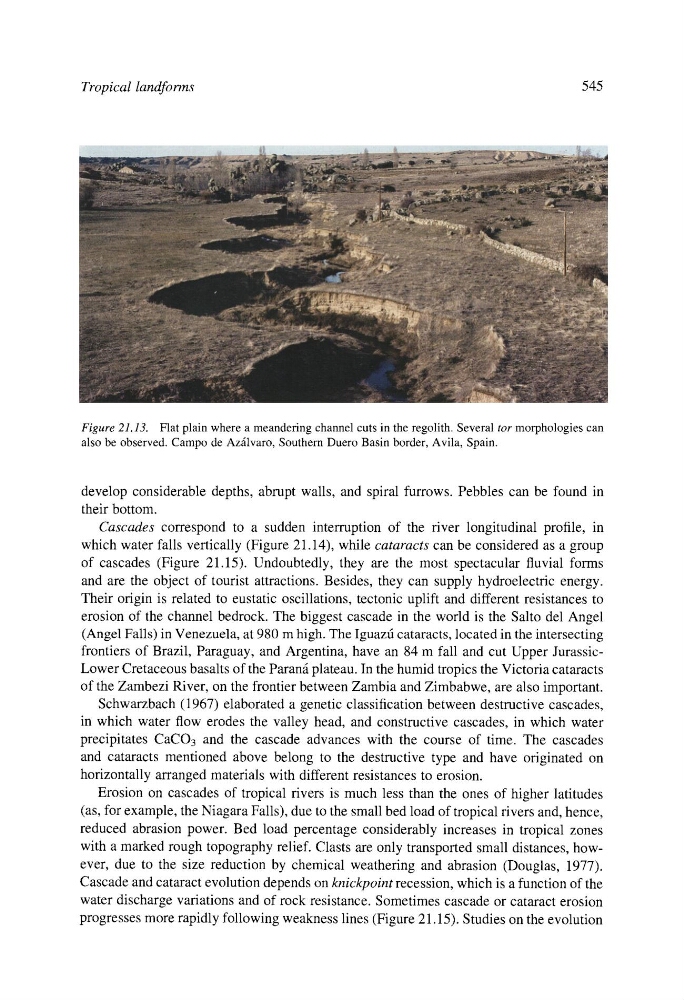
Figure 21.13. Flat plain where a meandering channel cuts in the regolith. Several tor morphologies can
also be observed. Campo de Az~ilvaro, Southern Duero Basin border, Avila, Spain.
develop considerable depths, abrupt walls, and spiral furrows. Pebbles can be found in
their bottom.
Cascades correspond to a sudden interruption of the river longitudinal profile, in
which water falls vertically (Figure 21.14), while cataracts can be considered as a group
of cascades (Figure 21.15). Undoubtedly, they are the most spectacular fluvial forms
and are the object of tourist attractions. Besides, they can supply hydroelectric energy.
Their origin is related to eustatic oscillations, tectonic uplift and different resistances to
erosion of the channel bedrock. The biggest cascade in the world is the Salto del Angel
(Angel Falls) in Venezuela, at 980 m high. The Iguaz6 cataracts, located in the intersecting
frontiers of Brazil, Paraguay, and Argentina, have an 84 m fall and cut Upper JurassicLower Cretaceous basalts of the Paranfi plateau. In the humid tropics the Victoria cataracts
of the Zambezi River, on the frontier between Zambia and Zimbabwe, are also important.
Schwarzbach (1967) elaborated a genetic classification between destructive cascades,
in which water flow erodes the valley head, and constructive cascades, in which water
precipitates CaCO3 and the cascade advances with the course of time. The cascades
and cataracts mentioned above belong to the destructive type and have originated on
horizontally arranged materials with different resistances to erosion.
Erosion on cascades of tropical rivers is much less than the ones of higher latitudes
(as, for example, the Niagara Falls), due to the small bed load of tropical rivers and, hence,
reduced abrasion power. Bed load percentage considerably increases in tropical zones
with a marked rough topography relief. Clasts are only transported small distances, however, due to the size reduction by chemical weathering and abrasion (Douglas, 1977).
Cascade and cataract evolution depends on knickpoint recession, which is a function of the
water discharge variations and of rock resistance. Sometimes cascade or cataract erosion
progresses more rapidly following weakness lines (Figure 21.15). Studies on the evolution
545
Figure 21.13. Flat plain where a meandering channel cuts in the regolith. Several tor morphologies can
also be observed. Campo de Az~ilvaro, Southern Duero Basin border, Avila, Spain.
develop considerable depths, abrupt walls, and spiral furrows. Pebbles can be found in
their bottom.
Cascades correspond to a sudden interruption of the river longitudinal profile, in
which water falls vertically (Figure 21.14), while cataracts can be considered as a group
of cascades (Figure 21.15). Undoubtedly, they are the most spectacular fluvial forms
and are the object of tourist attractions. Besides, they can supply hydroelectric energy.
Their origin is related to eustatic oscillations, tectonic uplift and different resistances to
erosion of the channel bedrock. The biggest cascade in the world is the Salto del Angel
(Angel Falls) in Venezuela, at 980 m high. The Iguaz6 cataracts, located in the intersecting
frontiers of Brazil, Paraguay, and Argentina, have an 84 m fall and cut Upper JurassicLower Cretaceous basalts of the Paranfi plateau. In the humid tropics the Victoria cataracts
of the Zambezi River, on the frontier between Zambia and Zimbabwe, are also important.
Schwarzbach (1967) elaborated a genetic classification between destructive cascades,
in which water flow erodes the valley head, and constructive cascades, in which water
precipitates CaCO3 and the cascade advances with the course of time. The cascades
and cataracts mentioned above belong to the destructive type and have originated on
horizontally arranged materials with different resistances to erosion.
Erosion on cascades of tropical rivers is much less than the ones of higher latitudes
(as, for example, the Niagara Falls), due to the small bed load of tropical rivers and, hence,
reduced abrasion power. Bed load percentage considerably increases in tropical zones
with a marked rough topography relief. Clasts are only transported small distances, however, due to the size reduction by chemical weathering and abrasion (Douglas, 1977).
Cascade and cataract evolution depends on knickpoint recession, which is a function of the
water discharge variations and of rock resistance. Sometimes cascade or cataract erosion
progresses more rapidly following weakness lines (Figure 21.15). Studies on the evolution