

538
Climatic Geomorphology
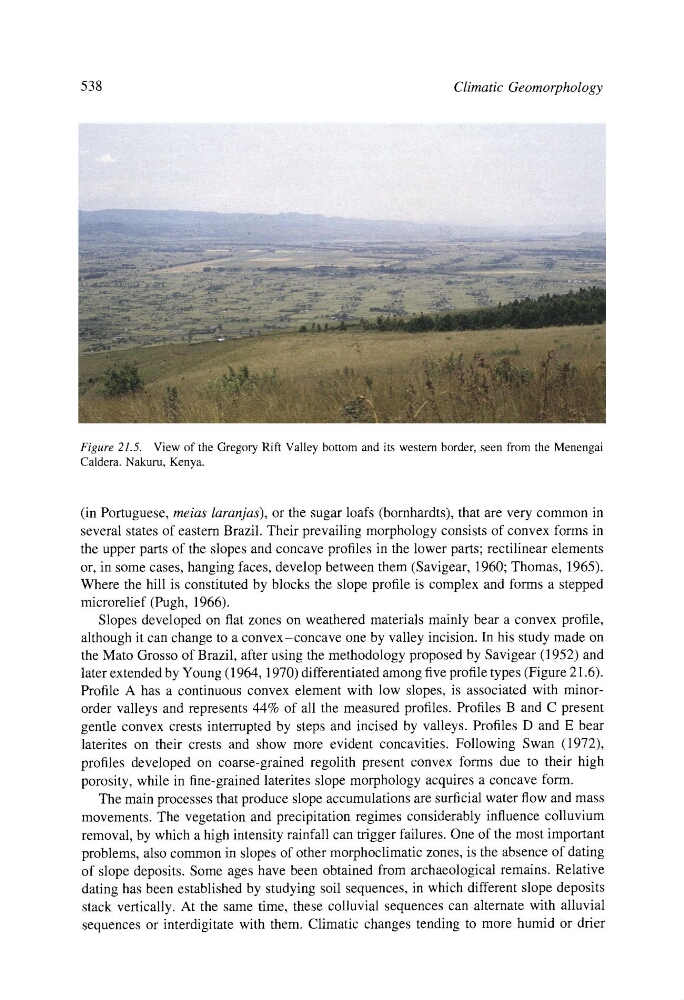
Figure 21.5. View of the Gregory Rift Valley bottom and its western border, seen from the Menengai
Caldera. Nakuru, Kenya.
(in Portuguese, meias laranjas), or the sugar loafs (bornhardts), that are very common in
several states of eastern Brazil. Their prevailing morphology consists of convex forms in
the upper parts of the slopes and concave profiles in the lower parts; rectilinear elements
or, in some cases, hanging faces, develop between them (Savigear, 1960; Thomas, 1965).
Where the hill is constituted by blocks the slope profile is complex and forms a stepped
microrelief (Pugh, 1966).
Slopes developed on flat zones on weathered materials mainly bear a convex profile,
although it can change to a convex-concave one by valley incision. In his study made on
the Mato Grosso of Brazil, after using the methodology proposed by Savigear (1952) and
later extended by Young (1964, 1970) differentiated among five profile types (Figure 21.6).
Profile A has a continuous convex element with low slopes, is associated with minororder valleys and represents 44% of all the measured profiles. Profiles B and C present
gentle convex crests interrupted by steps and incised by valleys. Profiles D and E bear
laterites on their crests and show more evident concavities. Following Swan (1972),
profiles developed on coarse-grained regolith present convex forms due to their high
porosity, while in fine-grained laterites slope morphology acquires a concave form.
The main processes that produce slope accumulations are surficial water flow and mass
movements. The vegetation and precipitation regimes considerably influence colluvium
removal, by which a high intensity rainfall can trigger failures. One of the most important
problems, also common in slopes of other morphoclimatic zones, is the absence of dating
of slope deposits. Some ages have been obtained from archaeological remains. Relative
dating has been established by studying soil sequences, in which different slope deposits
stack vertically. At the same time, these colluvial sequences can alternate with alluvial
sequences or interdigitate with them. Climatic changes tending to more humid or drier
Climatic Geomorphology
Figure 21.5. View of the Gregory Rift Valley bottom and its western border, seen from the Menengai
Caldera. Nakuru, Kenya.
(in Portuguese, meias laranjas), or the sugar loafs (bornhardts), that are very common in
several states of eastern Brazil. Their prevailing morphology consists of convex forms in
the upper parts of the slopes and concave profiles in the lower parts; rectilinear elements
or, in some cases, hanging faces, develop between them (Savigear, 1960; Thomas, 1965).
Where the hill is constituted by blocks the slope profile is complex and forms a stepped
microrelief (Pugh, 1966).
Slopes developed on flat zones on weathered materials mainly bear a convex profile,
although it can change to a convex-concave one by valley incision. In his study made on
the Mato Grosso of Brazil, after using the methodology proposed by Savigear (1952) and
later extended by Young (1964, 1970) differentiated among five profile types (Figure 21.6).
Profile A has a continuous convex element with low slopes, is associated with minororder valleys and represents 44% of all the measured profiles. Profiles B and C present
gentle convex crests interrupted by steps and incised by valleys. Profiles D and E bear
laterites on their crests and show more evident concavities. Following Swan (1972),
profiles developed on coarse-grained regolith present convex forms due to their high
porosity, while in fine-grained laterites slope morphology acquires a concave form.
The main processes that produce slope accumulations are surficial water flow and mass
movements. The vegetation and precipitation regimes considerably influence colluvium
removal, by which a high intensity rainfall can trigger failures. One of the most important
problems, also common in slopes of other morphoclimatic zones, is the absence of dating
of slope deposits. Some ages have been obtained from archaeological remains. Relative
dating has been established by studying soil sequences, in which different slope deposits
stack vertically. At the same time, these colluvial sequences can alternate with alluvial
sequences or interdigitate with them. Climatic changes tending to more humid or drier