

536
Climatic Geomorphology
the soil with a continuous and dense layer of fallen stems and leaves that can reach 25 cm
thick (Ruxton, 1967), preventing the effects of raindrop impact and splash. Therefore,
particles are removed by water flow under the layer of fallen leaves.
Research carried out on fluvial basins reveals that suspended load varies with rain
regime, and from one storm to another. Moreover, suspended load rapidly increases with
water discharge (Douglas, 1977). Data about suspended load obtained from experimental
plots are not easily comparable with values obtained from small basins, due to the
implication of other types of process. In Nigeria, for basins smaller than 20 klTl 2 in
rainforest zones, values obtained of suspended load fluctuate between 0.4 and
29.5 T/kmZ/yr (Ogunkoya and Jeje, 1987). In areas of high relief, such as eastern and
southern Africa, sediment loss considerably increases to values of 100 to 1000 T/kmZ/yr
(Walling, 1984). On the other hand, where basins exceed 10,000 km 2, obtained values on
transported sediments decrease substantially (Pilgrim et al., 1982). In this way, the Congo
River only records 11.3 T/kmZ/yr and the Niger River 33.1 T/km2/yr (Milliman and
Meade, 1983).
Data compiled by Douglas and Spencer (1985b) about suspended load, run-off, basin
area, and vegetation cover percentage on tropical rivers of different locations in the world
can be used for making some considerations. The Amazon River begins in the Peruvian
Andes and at the basin head it has numerous and important affluents excavating the
Andean Cordillera. These tributaries have a great erosive power and denudation velocities
are very high, whereas in the medium and low courses erosion is moderate. Recorded
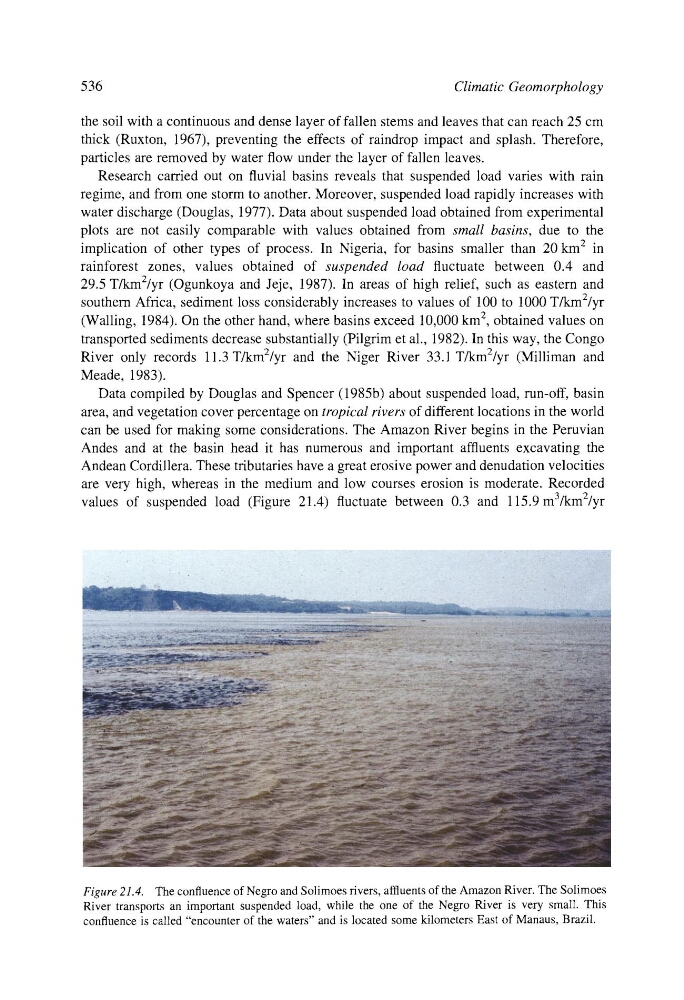
values of suspended load (Figure 21.4) fluctuate between 0.3 and 115.9 m3/kmZ/yr
Figure 21.4. The confluence of Negro and Solimoes rivers, affluents of the Amazon River. The Solimoes
River transports an important suspended load, while the one of the Negro River is very small. This
confluence is called "encounter of the waters" and is located some kilometers East of Manaus, Brazil.
Climatic Geomorphology
the soil with a continuous and dense layer of fallen stems and leaves that can reach 25 cm
thick (Ruxton, 1967), preventing the effects of raindrop impact and splash. Therefore,
particles are removed by water flow under the layer of fallen leaves.
Research carried out on fluvial basins reveals that suspended load varies with rain
regime, and from one storm to another. Moreover, suspended load rapidly increases with
water discharge (Douglas, 1977). Data about suspended load obtained from experimental
plots are not easily comparable with values obtained from small basins, due to the
implication of other types of process. In Nigeria, for basins smaller than 20 klTl 2 in
rainforest zones, values obtained of suspended load fluctuate between 0.4 and
29.5 T/kmZ/yr (Ogunkoya and Jeje, 1987). In areas of high relief, such as eastern and
southern Africa, sediment loss considerably increases to values of 100 to 1000 T/kmZ/yr
(Walling, 1984). On the other hand, where basins exceed 10,000 km 2, obtained values on
transported sediments decrease substantially (Pilgrim et al., 1982). In this way, the Congo
River only records 11.3 T/kmZ/yr and the Niger River 33.1 T/km2/yr (Milliman and
Meade, 1983).
Data compiled by Douglas and Spencer (1985b) about suspended load, run-off, basin
area, and vegetation cover percentage on tropical rivers of different locations in the world
can be used for making some considerations. The Amazon River begins in the Peruvian
Andes and at the basin head it has numerous and important affluents excavating the
Andean Cordillera. These tributaries have a great erosive power and denudation velocities
are very high, whereas in the medium and low courses erosion is moderate. Recorded
values of suspended load (Figure 21.4) fluctuate between 0.3 and 115.9 m3/kmZ/yr
Figure 21.4. The confluence of Negro and Solimoes rivers, affluents of the Amazon River. The Solimoes
River transports an important suspended load, while the one of the Negro River is very small. This
confluence is called "encounter of the waters" and is located some kilometers East of Manaus, Brazil.