

Tropical landforms
535
This behaviour sharply contrasts with the morphodynamics of rivers flowing through
low relief zones, where sediment evacuation by rivers is mainly done by suspension and
dissolution (Thomas, 1994).
In the preceding chapter the main characteristics of precipitation were analysed. In this
chapter hydrological, erosional and depositional aspects of fluvial systems are discussed.
During rain the soil can reach its infiltration capacity and then overland flow occurs.
The run-off coefficient expresses the percentage of precipitation flowing on the surface,
and knowledge of it is very important for understanding the dynamics of geomorphological systems. Calculation of the run-off coefficient is usually made on plots, microbasins, and fluvial catchments. Results vary substantially through time due to the important
role that storm duration and intensity play on the water infiltration.
2.1. Soil-loss quantification
By using our data about soil loss and other data compiled from other authors, results
indicate they strongly differ depending on the studied zones and are controlled by several
factors (Fournier, 1960, Walling, 1984, Douglas and Spencer, 1985b). Nevertheless, in
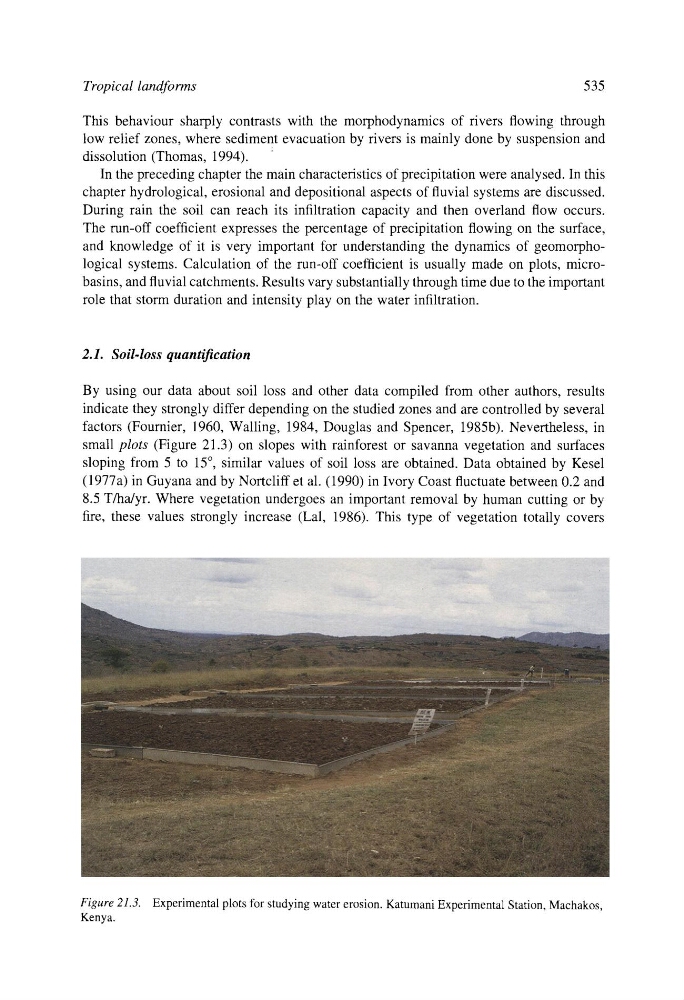
small plots (Figure 21.3) on slopes with rainforest or savanna vegetation and surfaces
sloping from 5 to 15 ~ similar values of soil loss are obtained. Data obtained by Kesel
(1977a) in Guyana and by Nortcliff et al. (1990) in Ivory Coast fluctuate between 0.2 and
8.5 T/ha/yr. Where vegetation undergoes an important removal by human cutting or by
fire, these values strongly increase (Lal, 1986). This type of vegetation totally covers
Figure 21.3. Experimental plots for studying water erosion. Katumani Experimental Station, Machakos,
Kenya.
535
This behaviour sharply contrasts with the morphodynamics of rivers flowing through
low relief zones, where sediment evacuation by rivers is mainly done by suspension and
dissolution (Thomas, 1994).
In the preceding chapter the main characteristics of precipitation were analysed. In this
chapter hydrological, erosional and depositional aspects of fluvial systems are discussed.
During rain the soil can reach its infiltration capacity and then overland flow occurs.
The run-off coefficient expresses the percentage of precipitation flowing on the surface,
and knowledge of it is very important for understanding the dynamics of geomorphological systems. Calculation of the run-off coefficient is usually made on plots, microbasins, and fluvial catchments. Results vary substantially through time due to the important
role that storm duration and intensity play on the water infiltration.
2.1. Soil-loss quantification
By using our data about soil loss and other data compiled from other authors, results
indicate they strongly differ depending on the studied zones and are controlled by several
factors (Fournier, 1960, Walling, 1984, Douglas and Spencer, 1985b). Nevertheless, in
small plots (Figure 21.3) on slopes with rainforest or savanna vegetation and surfaces
sloping from 5 to 15 ~ similar values of soil loss are obtained. Data obtained by Kesel
(1977a) in Guyana and by Nortcliff et al. (1990) in Ivory Coast fluctuate between 0.2 and
8.5 T/ha/yr. Where vegetation undergoes an important removal by human cutting or by
fire, these values strongly increase (Lal, 1986). This type of vegetation totally covers
Figure 21.3. Experimental plots for studying water erosion. Katumani Experimental Station, Machakos,
Kenya.