

492
Climatic Geomorphology
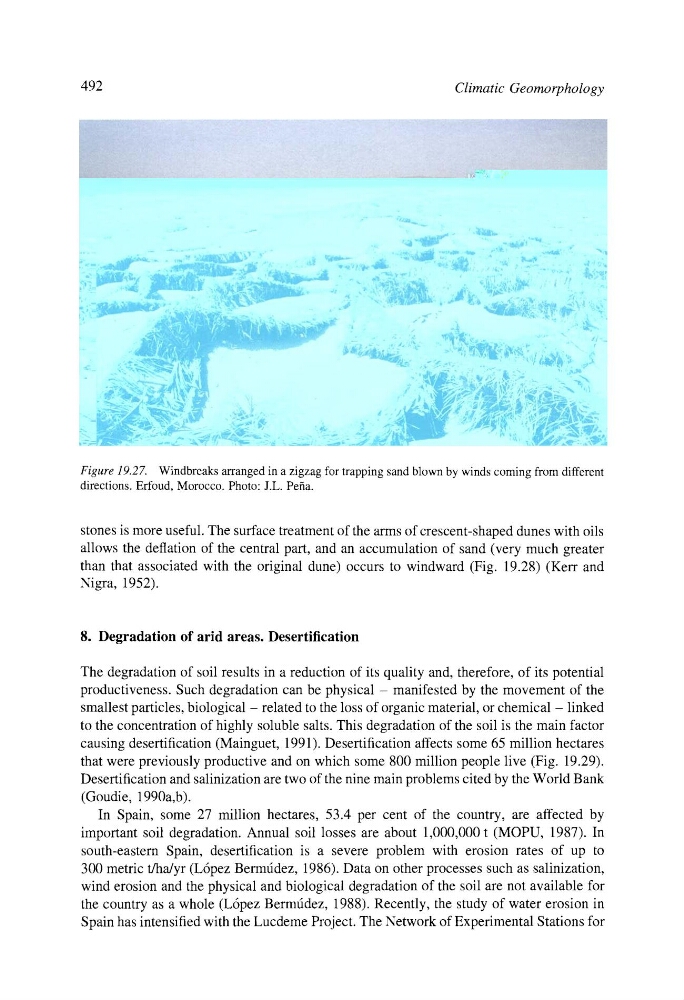
Figure 19.27. Windbreaks arranged in a zigzag for trapping sand blown by winds coming from different
directions. Erfoud, Morocco. Photo: J.L. Pefia.
stones is more useful. The surface treatment of the arms of crescent-shaped dunes with oils
allows the deflation of the central part, and an accumulation of sand (very much greater
than that associated with the original dune) occurs to windward (Fig. 19.28) (Kerr and
Nigra, 1952).
8. Degradation of arid areas. Desertification
The degradation of soil results in a reduction of its quality and, therefore, of its potential
productiveness. Such degradation can be physical - manifested by the movement of the
smallest particles, biological - related to the loss of organic material, or chemical - linked
to the concentration of highly soluble salts. This degradation of the soil is the main factor
causing desertification (Mainguet, 1991). Desertification affects some 65 million hectares
that were previously productive and on which some 800 million people live (Fig. 19.29).
Desertification and salinization are two of the nine main problems cited by the World Bank
(Goudie, 1990a,b).
In Spain, some 27 million hectares, 53.4 per cent of the country, are affected by
important soil degradation. Annual soil losses are about 1,000,000 t (MOPU, 1987). In
south-eastern Spain, desertification is a severe problem with erosion rates of up to
300 metric t/ha/yr (L6pez Bermfidez, 1986). Data on other processes such as salinization,
wind erosion and the physical and biological degradation of the soil are not available for
the country as a whole (L6pez Bermfidez, 1988). Recently, the study of water erosion in
Spain has intensified with the Lucdeme Project. The Network of Experimental Stations for
Climatic Geomorphology
Figure 19.27. Windbreaks arranged in a zigzag for trapping sand blown by winds coming from different
directions. Erfoud, Morocco. Photo: J.L. Pefia.
stones is more useful. The surface treatment of the arms of crescent-shaped dunes with oils
allows the deflation of the central part, and an accumulation of sand (very much greater
than that associated with the original dune) occurs to windward (Fig. 19.28) (Kerr and
Nigra, 1952).
8. Degradation of arid areas. Desertification
The degradation of soil results in a reduction of its quality and, therefore, of its potential
productiveness. Such degradation can be physical - manifested by the movement of the
smallest particles, biological - related to the loss of organic material, or chemical - linked
to the concentration of highly soluble salts. This degradation of the soil is the main factor
causing desertification (Mainguet, 1991). Desertification affects some 65 million hectares
that were previously productive and on which some 800 million people live (Fig. 19.29).
Desertification and salinization are two of the nine main problems cited by the World Bank
(Goudie, 1990a,b).
In Spain, some 27 million hectares, 53.4 per cent of the country, are affected by
important soil degradation. Annual soil losses are about 1,000,000 t (MOPU, 1987). In
south-eastern Spain, desertification is a severe problem with erosion rates of up to
300 metric t/ha/yr (L6pez Bermfidez, 1986). Data on other processes such as salinization,
wind erosion and the physical and biological degradation of the soil are not available for
the country as a whole (L6pez Bermfidez, 1988). Recently, the study of water erosion in
Spain has intensified with the Lucdeme Project. The Network of Experimental Stations for