

470
Climatic Geomorphology
7~
Z
uJ
l.iJ
co
co
z
z -
In
w
I- I.I_
<
w
z
~
on'Z
<
rr
oc:
uJ
~
_
,,,
w
oc
<
>
~s
w
~
cI:
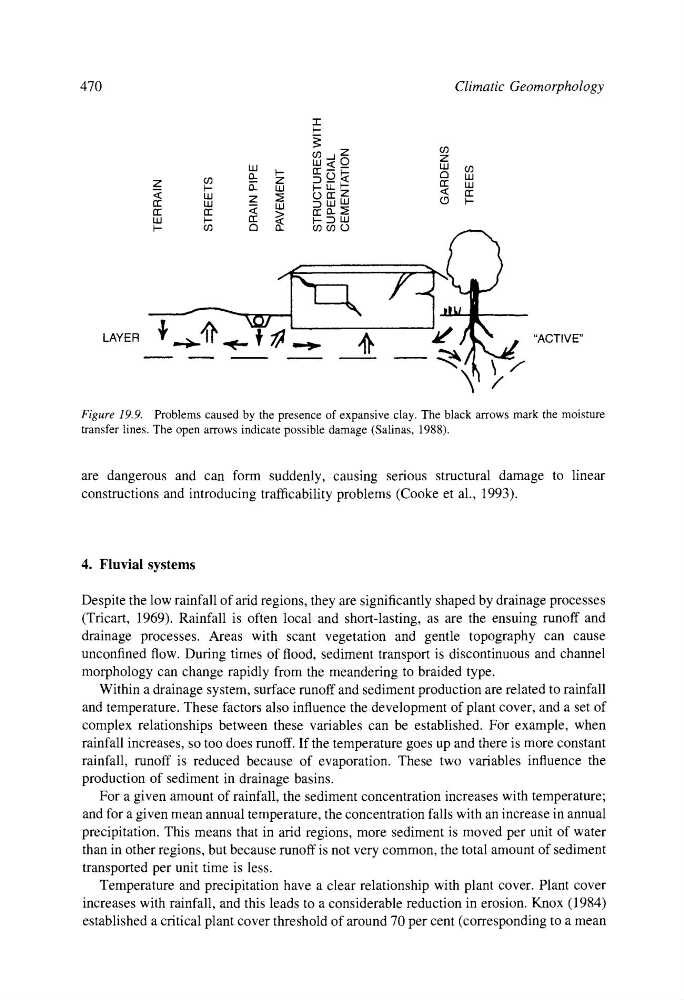
Figure 19.9. Problems caused by the presence of expansive clay. The black arrows mark the moisture
transfer lines. The open arrows indicate possible damage (Salinas, 1988).
are dangerous and can form suddenly, causing serious structural damage to linear
constructions and introducing trafficability problems (Cooke et al., 1993).
4. Fluvial systems
Despite the low rainfall of arid regions, they are significantly shaped by drainage processes
(Tricart, 1969). Rainfall is often local and short-lasting, as are the ensuing runoff and
drainage processes. Areas with scant vegetation and gentle topography can cause
unconfined flow. During times of flood, sediment transport is discontinuous and channel
morphology can change rapidly from the meandering to braided type.
Within a drainage system, surface runoff and sediment production are related to rainfall
and temperature. These factors also influence the development of plant cover, and a set of
complex relationships between these variables can be established. For example, when
rainfall increases, so too does runoff. If the temperature goes up and there is more constant
rainfall, runoff is reduced because of evaporation. These two variables influence the
production of sediment in drainage basins.
For a given amount of rainfall, the sediment concentration increases with temperature;
and for a given mean annual temperature, the concentration falls with an increase in annual
precipitation. This means that in arid regions, more sediment is moved per unit of water
than in other regions, but because runoff is not very common, the total amount of sediment
transported per unit time is less.
Temperature and precipitation have a clear relationship with plant cover. Plant cover
increases with rainfall, and this leads to a considerable reduction in erosion. Knox (1984)
established a critical plant cover threshold of around 70 per cent (corresponding to a mean
Climatic Geomorphology
7~
Z
uJ
l.iJ
co
co
z
z -
In
w
I- I.I_
<
w
z
~
on'Z
<
rr
oc:
uJ
~
_
,,,
w
oc
<
>
~s
w
~
cI:
Figure 19.9. Problems caused by the presence of expansive clay. The black arrows mark the moisture
transfer lines. The open arrows indicate possible damage (Salinas, 1988).
are dangerous and can form suddenly, causing serious structural damage to linear
constructions and introducing trafficability problems (Cooke et al., 1993).
4. Fluvial systems
Despite the low rainfall of arid regions, they are significantly shaped by drainage processes
(Tricart, 1969). Rainfall is often local and short-lasting, as are the ensuing runoff and
drainage processes. Areas with scant vegetation and gentle topography can cause
unconfined flow. During times of flood, sediment transport is discontinuous and channel
morphology can change rapidly from the meandering to braided type.
Within a drainage system, surface runoff and sediment production are related to rainfall
and temperature. These factors also influence the development of plant cover, and a set of
complex relationships between these variables can be established. For example, when
rainfall increases, so too does runoff. If the temperature goes up and there is more constant
rainfall, runoff is reduced because of evaporation. These two variables influence the
production of sediment in drainage basins.
For a given amount of rainfall, the sediment concentration increases with temperature;
and for a given mean annual temperature, the concentration falls with an increase in annual
precipitation. This means that in arid regions, more sediment is moved per unit of water
than in other regions, but because runoff is not very common, the total amount of sediment
transported per unit time is less.
Temperature and precipitation have a clear relationship with plant cover. Plant cover
increases with rainfall, and this leads to a considerable reduction in erosion. Knox (1984)
established a critical plant cover threshold of around 70 per cent (corresponding to a mean