

Applied geomorphology and arid regions
467
//
I'
.
/
/,~/ Relative height of
9
contours in meters
., .- -" Cracks
Motorway border
Factory border
0 15 30 45 FEET
;
J
0 5 10 1,5 METERS
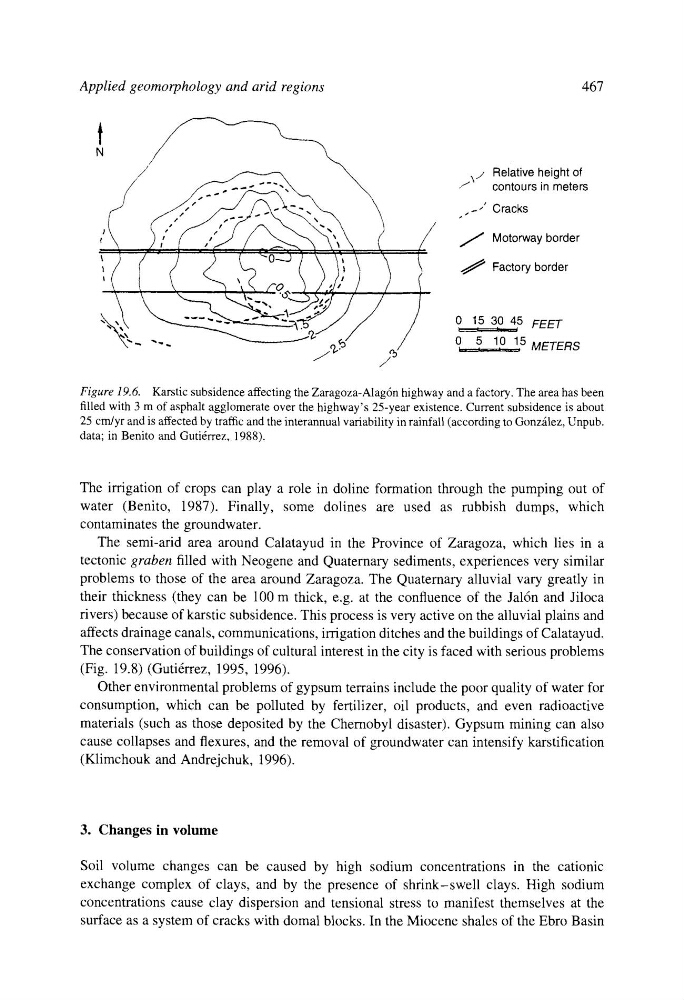
Figure 19.6. Karstic subsidence affecting the Zaragoza-Alag6n highway and a factory. The area has been
filled with 3 m of asphalt agglomerate over the highway' s 25-year existence. Current subsidence is about
25 cm/yr and is affected by traffic and the interannual variability in rainfall (according to Gonzfilez, Unpub.
data; in Benito and Gutirrrez, 1988).
The irrigation of crops can play a role in doline formation through the pumping out of
water (Benito, 1987). Finally, some dolines are used as rubbish dumps, which
contaminates the groundwater.
The semi-arid area around Calatayud in the Province of Zaragoza, which lies in a
tectonic graben filled with Neogene and Quaternary sediments, experiences very similar
problems to those of the area around Zaragoza. The Quaternary alluvial vary greatly in
their thickness (they can be 100 m thick, e.g. at the confluence of the Jalrn and Jiloca
rivers) because of karstic subsidence. This process is very active on the alluvial plains and
affects drainage canals, communications, irrigation ditches and the buildings of Calatayud.
The conservation of buildings of cultural interest in the city is faced with serious problems
(Fig. 19.8)(Gutirrrez, 1995, 1996).
Other environmental problems of gypsum terrains include the poor quality of water for
consumption, which can be polluted by fertilizer, oil products, and even radioactive
materials (such as those deposited by the Chemobyl disaster). Gypsum mining can also
cause collapses and flexures, and the removal of groundwater can intensify karstification
(Klimchouk and Andrejchuk, 1996).
3. Changes in volume
Soil volume changes can be caused by high sodium concentrations in the cationic
exchange complex of clays, and by the presence of shrink-swell clays. High sodium
concentrations cause clay dispersion and tensional stress to manifest themselves at the
surface as a system of cracks with domal blocks. In the Miocene shales of the Ebro Basin
467
//
I'
.
/
/,~/ Relative height of
9
contours in meters
., .- -" Cracks
Motorway border
Factory border
0 15 30 45 FEET
;
J
0 5 10 1,5 METERS
Figure 19.6. Karstic subsidence affecting the Zaragoza-Alag6n highway and a factory. The area has been
filled with 3 m of asphalt agglomerate over the highway' s 25-year existence. Current subsidence is about
25 cm/yr and is affected by traffic and the interannual variability in rainfall (according to Gonzfilez, Unpub.
data; in Benito and Gutirrrez, 1988).
The irrigation of crops can play a role in doline formation through the pumping out of
water (Benito, 1987). Finally, some dolines are used as rubbish dumps, which
contaminates the groundwater.
The semi-arid area around Calatayud in the Province of Zaragoza, which lies in a
tectonic graben filled with Neogene and Quaternary sediments, experiences very similar
problems to those of the area around Zaragoza. The Quaternary alluvial vary greatly in
their thickness (they can be 100 m thick, e.g. at the confluence of the Jalrn and Jiloca
rivers) because of karstic subsidence. This process is very active on the alluvial plains and
affects drainage canals, communications, irrigation ditches and the buildings of Calatayud.
The conservation of buildings of cultural interest in the city is faced with serious problems
(Fig. 19.8)(Gutirrrez, 1995, 1996).
Other environmental problems of gypsum terrains include the poor quality of water for
consumption, which can be polluted by fertilizer, oil products, and even radioactive
materials (such as those deposited by the Chemobyl disaster). Gypsum mining can also
cause collapses and flexures, and the removal of groundwater can intensify karstification
(Klimchouk and Andrejchuk, 1996).
3. Changes in volume
Soil volume changes can be caused by high sodium concentrations in the cationic
exchange complex of clays, and by the presence of shrink-swell clays. High sodium
concentrations cause clay dispersion and tensional stress to manifest themselves at the
surface as a system of cracks with domal blocks. In the Miocene shales of the Ebro Basin