

Aeolian accumulations
455
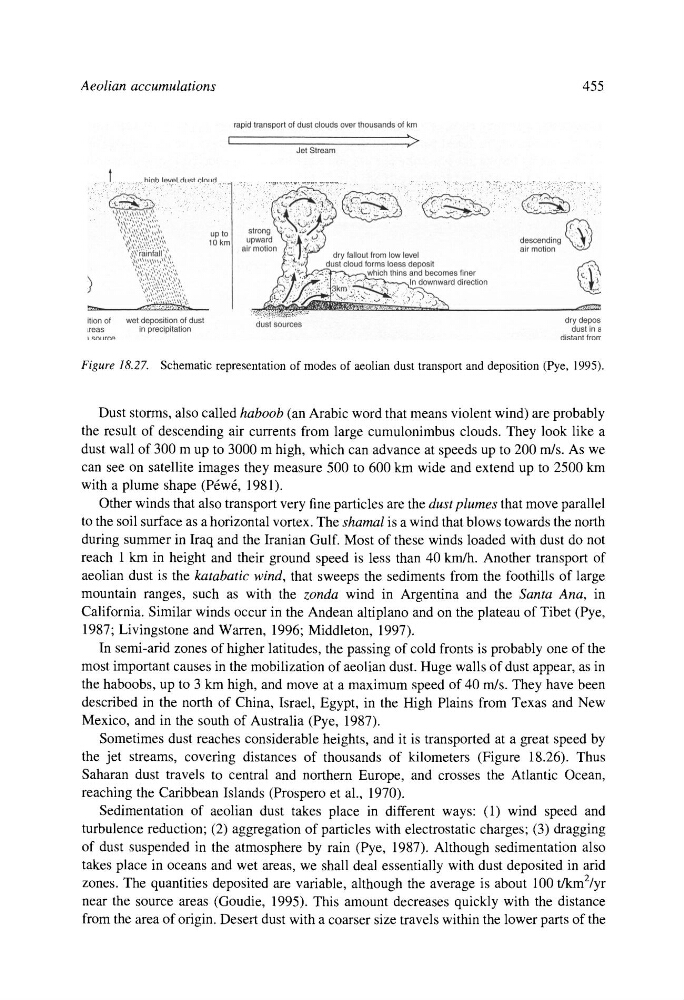
Figure 18.27. Schematic representation of modes of aeolian dust transport and deposition (Pye, 1995).
Dust storms, also called haboob (an Arabic word that means violent wind) are probably
the result of descending air currents from large cumulonimbus clouds. They look like a
dust wall of 300 m up to 3000 m high, which can advance at speeds up to 200 m/s. As we
can see on satellite images they measure 500 to 600 km wide and extend up to 2500 km
with a plume shape (P6w6, 1981).
Other winds that also transport very fine particles are the dust plumes that move parallel
to the soil surface as a horizontal vortex. The shamal is a wind that blows towards the north
during summer in Iraq and the Iranian Gulf. Most of these winds loaded with dust do not
reach 1 km in height and their ground speed is less than 40 km/h. Another transport of
aeolian dust is the katabatic wind, that sweeps the sediments from the foothills of large
mountain ranges, such as with the zonda wind in Argentina and the Santa Ana, in
California. Similar winds occur in the Andean altiplano and on the plateau of Tibet (Pye,
1987; Livingstone and Warren, 1996; Middleton, 1997).
In semi-arid zones of higher latitudes, the passing of cold fronts is probably one of the
most important causes in the mobilization of aeolian dust. Huge walls of dust appear, as in
the haboobs, up to 3 km high, and move at a maximum speed of 40 m/s. They have been
described in the north of China, Israel, Egypt, in the High Plains from Texas and New
Mexico, and in the south of Australia (Pye, 1987).
Sometimes dust reaches considerable heights, and it is transported at a great speed by
the jet streams, coveting distances of thousands of kilometers (Figure 18.26). Thus
Saharan dust travels to central and northern Europe, and crosses the Atlantic Ocean,
reaching the Caribbean Islands (Prospero et al., 1970).
Sedimentation of aeolian dust takes place in different ways: (1) wind speed and
turbulence reduction; (2) aggregation of particles with electrostatic charges; (3) dragging
of dust suspended in the atmosphere by rain (Pye, 1987). Although sedimentation also
takes place in oceans and wet areas, we shall deal essentially with dust deposited in arid
zones. The quantities deposited are variable, although the average is about 100 t/kmZ/yr
near the source areas (Goudie, 1995). This amount decreases quickly with the distance
from the area of origin. Desert dust with a coarser size travels within the lower parts of the
455
Figure 18.27. Schematic representation of modes of aeolian dust transport and deposition (Pye, 1995).
Dust storms, also called haboob (an Arabic word that means violent wind) are probably
the result of descending air currents from large cumulonimbus clouds. They look like a
dust wall of 300 m up to 3000 m high, which can advance at speeds up to 200 m/s. As we
can see on satellite images they measure 500 to 600 km wide and extend up to 2500 km
with a plume shape (P6w6, 1981).
Other winds that also transport very fine particles are the dust plumes that move parallel
to the soil surface as a horizontal vortex. The shamal is a wind that blows towards the north
during summer in Iraq and the Iranian Gulf. Most of these winds loaded with dust do not
reach 1 km in height and their ground speed is less than 40 km/h. Another transport of
aeolian dust is the katabatic wind, that sweeps the sediments from the foothills of large
mountain ranges, such as with the zonda wind in Argentina and the Santa Ana, in
California. Similar winds occur in the Andean altiplano and on the plateau of Tibet (Pye,
1987; Livingstone and Warren, 1996; Middleton, 1997).
In semi-arid zones of higher latitudes, the passing of cold fronts is probably one of the
most important causes in the mobilization of aeolian dust. Huge walls of dust appear, as in
the haboobs, up to 3 km high, and move at a maximum speed of 40 m/s. They have been
described in the north of China, Israel, Egypt, in the High Plains from Texas and New
Mexico, and in the south of Australia (Pye, 1987).
Sometimes dust reaches considerable heights, and it is transported at a great speed by
the jet streams, coveting distances of thousands of kilometers (Figure 18.26). Thus
Saharan dust travels to central and northern Europe, and crosses the Atlantic Ocean,
reaching the Caribbean Islands (Prospero et al., 1970).
Sedimentation of aeolian dust takes place in different ways: (1) wind speed and
turbulence reduction; (2) aggregation of particles with electrostatic charges; (3) dragging
of dust suspended in the atmosphere by rain (Pye, 1987). Although sedimentation also
takes place in oceans and wet areas, we shall deal essentially with dust deposited in arid
zones. The quantities deposited are variable, although the average is about 100 t/kmZ/yr
near the source areas (Goudie, 1995). This amount decreases quickly with the distance
from the area of origin. Desert dust with a coarser size travels within the lower parts of the