

454
Climatic Geomorphology
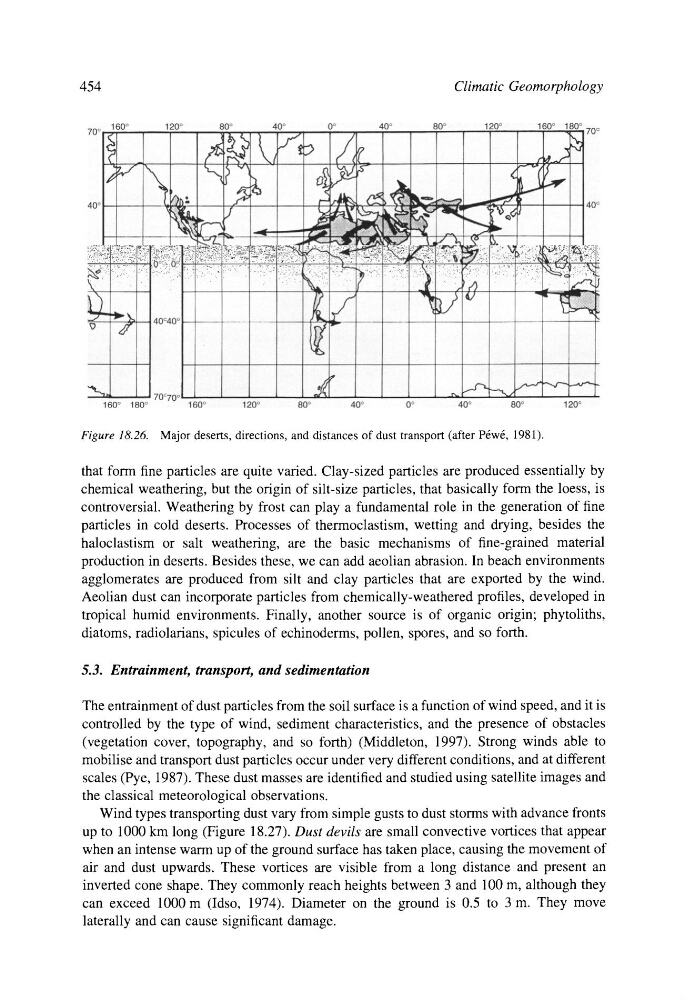
Figure 18.26. Major deserts, directions, and distances of dust transport (after P6w6, 1981).
that form fine particles are quite varied. Clay-sized particles are produced essentially by
chemical weathering, but the origin of silt-size particles, that basically form the loess, is
controversial. Weathering by frost can play a fundamental role in the generation of fine
particles in cold deserts. Processes of thermoclastism, wetting and drying, besides the
haloclastism or salt weathering, are the basic mechanisms of fine-grained material
production in deserts. Besides these, we can add aeolian abrasion. In beach environments
agglomerates are produced from silt and clay particles that are exported by the wind.
Aeolian dust can incorporate particles from chemically-weathered profiles, developed in
tropical humid environments. Finally, another source is of organic origin; phytoliths,
diatoms, radiolarians, spicules of echinoderms, pollen, spores, and so forth.
5.3. Entrainment, transport, and sedimentation
The entrainment of dust particles from the soil surface is a function of wind speed, and it is
controlled by the type of wind, sediment characteristics, and the presence of obstacles
(vegetation cover, topography, and so forth) (Middleton, 1997). Strong winds able to
mobilise and transport dust particles occur under very different conditions, and at different
scales (Pye, 1987). These dust masses are identified and studied using satellite images and
the classical meteorological observations.
Wind types transporting dust vary from simple gusts to dust storms with advance fronts
up to 1000 km long (Figure 18.27). Dust devils are small convective vortices that appear
when an intense warm up of the ground surface has taken place, causing the movement of
air and dust upwards. These vortices are visible from a long distance and present an
inverted cone shape. They commonly reach heights between 3 and 100 m, although they
can exceed 1000 m (Idso, 1974). Diameter on the ground is 0.5 to 3 m. They move
laterally and can cause significant damage.
Climatic Geomorphology
Figure 18.26. Major deserts, directions, and distances of dust transport (after P6w6, 1981).
that form fine particles are quite varied. Clay-sized particles are produced essentially by
chemical weathering, but the origin of silt-size particles, that basically form the loess, is
controversial. Weathering by frost can play a fundamental role in the generation of fine
particles in cold deserts. Processes of thermoclastism, wetting and drying, besides the
haloclastism or salt weathering, are the basic mechanisms of fine-grained material
production in deserts. Besides these, we can add aeolian abrasion. In beach environments
agglomerates are produced from silt and clay particles that are exported by the wind.
Aeolian dust can incorporate particles from chemically-weathered profiles, developed in
tropical humid environments. Finally, another source is of organic origin; phytoliths,
diatoms, radiolarians, spicules of echinoderms, pollen, spores, and so forth.
5.3. Entrainment, transport, and sedimentation
The entrainment of dust particles from the soil surface is a function of wind speed, and it is
controlled by the type of wind, sediment characteristics, and the presence of obstacles
(vegetation cover, topography, and so forth) (Middleton, 1997). Strong winds able to
mobilise and transport dust particles occur under very different conditions, and at different
scales (Pye, 1987). These dust masses are identified and studied using satellite images and
the classical meteorological observations.
Wind types transporting dust vary from simple gusts to dust storms with advance fronts
up to 1000 km long (Figure 18.27). Dust devils are small convective vortices that appear
when an intense warm up of the ground surface has taken place, causing the movement of
air and dust upwards. These vortices are visible from a long distance and present an
inverted cone shape. They commonly reach heights between 3 and 100 m, although they
can exceed 1000 m (Idso, 1974). Diameter on the ground is 0.5 to 3 m. They move
laterally and can cause significant damage.