

Glaciers
37
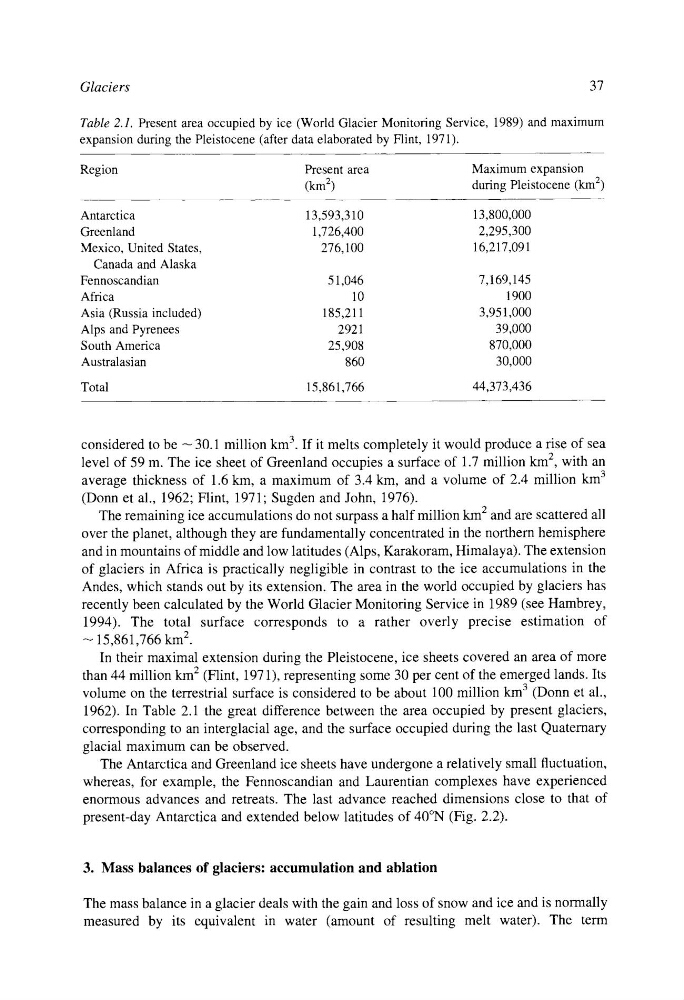
Table 2.1. Present area occupied by ice (World Glacier Monitoring Service, 1989) and maximum
expansion during the Pleistocene (after data elaborated by Flint, 1971).
Region
Present area
Maximum expansion
(km 2)
during Pleistocene (km 2)
Antarctica
13,593,310
13,800,000
Greenland
1,726,400
2,295,300
Mexico, United States,
276,100
16,217,091
Canada and Alaska
Fennoscandian
51,046
7,169,145
Africa
10
1900
Asia (Russia included)
185,211
3,951,000
Alps and Pyrenees
2921
39,000
South America
25,908
870,000
Australasian
860
30,000
Total
15,861,766
44,373,436
considered to be --~ 30.1 million km 3. If it melts completely it would produce a rise of sea
level of 59 m. The ice sheet of Greenland occupies a surface of 1.7 million km 2, with an
average thickness of 1.6 km, a maximum of 3.4 km, and a volume of 2.4 million km 3
(Donn et al., 1962; Flint, 1971; Sugden and John, 1976).
The remaining ice accumulations do not surpass a half million km 2 and are scattered all
over the planet, although they are fundamentally concentrated in the northern hemisphere
and in mountains of middle and low latitudes (Alps, Karakoram, Himalaya). The extension
of glaciers in Africa is practically negligible in contrast to the ice accumulations in the
Andes, which stands out by its extension. The area in the world occupied by glaciers has
recently been calculated by the World Glacier Monitoring Service in 1989 (see Hambrey,
1994). The total surface corresponds to a rather overly precise estimation of
--~ 15,861,766 km 2.
In their maximal extension during the Pleistocene, ice sheets covered an area of more
than 44 million km 2 (Flint, 1971), representing some 30 per cent of the emerged lands. Its
volume on the terrestrial surface is considered to be about 100 million km 3 (Donn et al.,
1962). In Table 2.1 the great difference between the area occupied by present glaciers,
corresponding to an interglacial age, and the surface occupied during the last Quaternary
glacial maximum can be observed.
The Antarctica and Greenland ice sheets have undergone a relatively small fluctuation,
whereas, for example, the Fennoscandian and Laurentian complexes have experienced
enormous advances and retreats. The last advance reached dimensions close to that of
present-day Antarctica and extended below latitudes of 40~ (Fig. 2.2).
3. Mass balances of glaciers: accumulation and ablation
The mass balance in a glacier deals with the gain and loss of snow and ice and is normally
measured by its equivalent in water (amount of resulting melt water). The term
37
Table 2.1. Present area occupied by ice (World Glacier Monitoring Service, 1989) and maximum
expansion during the Pleistocene (after data elaborated by Flint, 1971).
Region
Present area
Maximum expansion
(km 2)
during Pleistocene (km 2)
Antarctica
13,593,310
13,800,000
Greenland
1,726,400
2,295,300
Mexico, United States,
276,100
16,217,091
Canada and Alaska
Fennoscandian
51,046
7,169,145
Africa
10
1900
Asia (Russia included)
185,211
3,951,000
Alps and Pyrenees
2921
39,000
South America
25,908
870,000
Australasian
860
30,000
Total
15,861,766
44,373,436
considered to be --~ 30.1 million km 3. If it melts completely it would produce a rise of sea
level of 59 m. The ice sheet of Greenland occupies a surface of 1.7 million km 2, with an
average thickness of 1.6 km, a maximum of 3.4 km, and a volume of 2.4 million km 3
(Donn et al., 1962; Flint, 1971; Sugden and John, 1976).
The remaining ice accumulations do not surpass a half million km 2 and are scattered all
over the planet, although they are fundamentally concentrated in the northern hemisphere
and in mountains of middle and low latitudes (Alps, Karakoram, Himalaya). The extension
of glaciers in Africa is practically negligible in contrast to the ice accumulations in the
Andes, which stands out by its extension. The area in the world occupied by glaciers has
recently been calculated by the World Glacier Monitoring Service in 1989 (see Hambrey,
1994). The total surface corresponds to a rather overly precise estimation of
--~ 15,861,766 km 2.
In their maximal extension during the Pleistocene, ice sheets covered an area of more
than 44 million km 2 (Flint, 1971), representing some 30 per cent of the emerged lands. Its
volume on the terrestrial surface is considered to be about 100 million km 3 (Donn et al.,
1962). In Table 2.1 the great difference between the area occupied by present glaciers,
corresponding to an interglacial age, and the surface occupied during the last Quaternary
glacial maximum can be observed.
The Antarctica and Greenland ice sheets have undergone a relatively small fluctuation,
whereas, for example, the Fennoscandian and Laurentian complexes have experienced
enormous advances and retreats. The last advance reached dimensions close to that of
present-day Antarctica and extended below latitudes of 40~ (Fig. 2.2).
3. Mass balances of glaciers: accumulation and ablation
The mass balance in a glacier deals with the gain and loss of snow and ice and is normally
measured by its equivalent in water (amount of resulting melt water). The term