

Aeolian accumulations
443
double helix
/
'Y' junction
/
/
.J
/
j
,
linear dune
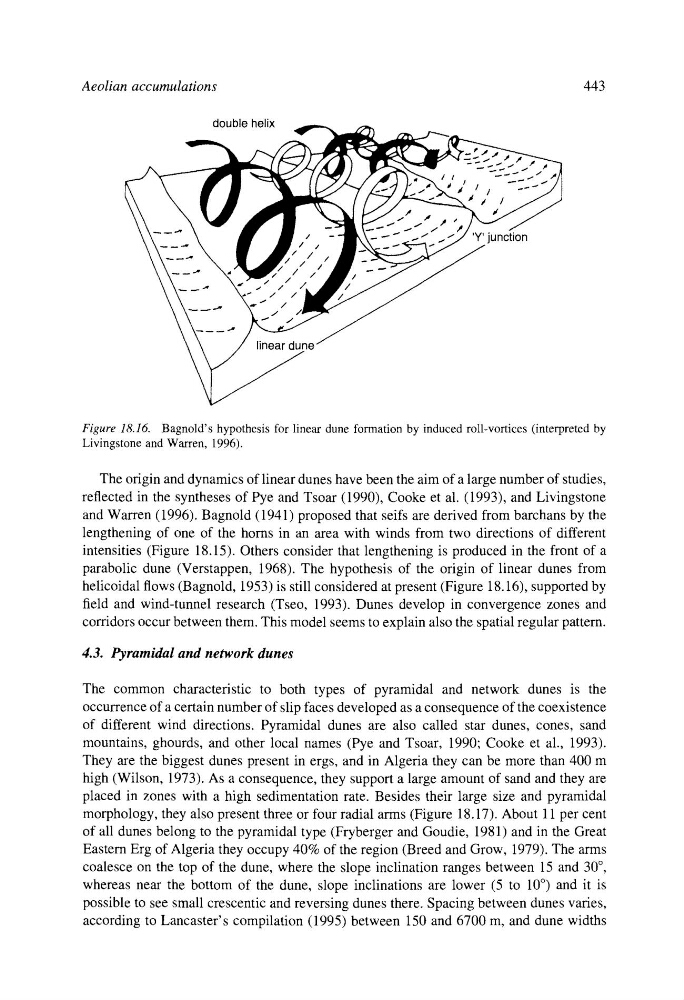
Figure 18.16. Bagnold's hypothesis for linear dune formation by induced roll-vortices (interpreted by
Livingstone and Warren, 1996).
The origin and dynamics of linear dunes have been the aim of a large number of studies,
reflected in the syntheses of Pye and Tsoar (1990), Cooke et al. (1993), and Livingstone
and Warren (1996). Bagnold (1941) proposed that seifs are derived from barchans by the
lengthening of one of the horns in an area with winds from two directions of different
intensities (Figure 18.15). Others consider that lengthening is produced in the front of a
parabolic dune (Verstappen, 1968). The hypothesis of the origin of linear dunes from
helicoidal flows (Bagnold, 1953) is still considered at present (Figure 18.16), supported by
field and wind-tunnel research (Tseo, 1993). Dunes develop in convergence zones and
corridors occur between them. This model seems to explain also the spatial regular pattern.
4.3. Pyramidal and network dunes
The common characteristic to both types of pyramidal and network dunes is the
occurrence of a certain number of slip faces developed as a consequence of the coexistence
of different wind directions. Pyramidal dunes are also called star dunes, cones, sand
mountains, ghourds, and other local names (Pye and Tsoar, 1990; Cooke et al., 1993).
They are the biggest dunes present in ergs, and in Algeria they can be more than 400 m
high (Wilson, 1973). As a consequence, they support a large amount of sand and they are
placed in zones with a high sedimentation rate. Besides their large size and pyramidal
morphology, they also present three or four radial arms (Figure 18.17). About 11 per cent
of all dunes belong to the pyramidal type (Fryberger and Goudie, 1981) and in the Great
Eastern Erg of Algeria they occupy 40% of the region (Breed and Grow, 1979). The arms
coalesce on the top of the dune, where the slope inclination ranges between 15 and 30 ~ ,
whereas near the bottom of the dune, slope inclinations are lower (5 to 10 ~ and it is
possible to see small crescentic and reversing dunes there. Spacing between dunes varies,
according to Lancaster's compilation (1995) between 150 and 6700 m, and dune widths
443
double helix
/
'Y' junction
/
/
.J
/
j
,
linear dune
Figure 18.16. Bagnold's hypothesis for linear dune formation by induced roll-vortices (interpreted by
Livingstone and Warren, 1996).
The origin and dynamics of linear dunes have been the aim of a large number of studies,
reflected in the syntheses of Pye and Tsoar (1990), Cooke et al. (1993), and Livingstone
and Warren (1996). Bagnold (1941) proposed that seifs are derived from barchans by the
lengthening of one of the horns in an area with winds from two directions of different
intensities (Figure 18.15). Others consider that lengthening is produced in the front of a
parabolic dune (Verstappen, 1968). The hypothesis of the origin of linear dunes from
helicoidal flows (Bagnold, 1953) is still considered at present (Figure 18.16), supported by
field and wind-tunnel research (Tseo, 1993). Dunes develop in convergence zones and
corridors occur between them. This model seems to explain also the spatial regular pattern.
4.3. Pyramidal and network dunes
The common characteristic to both types of pyramidal and network dunes is the
occurrence of a certain number of slip faces developed as a consequence of the coexistence
of different wind directions. Pyramidal dunes are also called star dunes, cones, sand
mountains, ghourds, and other local names (Pye and Tsoar, 1990; Cooke et al., 1993).
They are the biggest dunes present in ergs, and in Algeria they can be more than 400 m
high (Wilson, 1973). As a consequence, they support a large amount of sand and they are
placed in zones with a high sedimentation rate. Besides their large size and pyramidal
morphology, they also present three or four radial arms (Figure 18.17). About 11 per cent
of all dunes belong to the pyramidal type (Fryberger and Goudie, 1981) and in the Great
Eastern Erg of Algeria they occupy 40% of the region (Breed and Grow, 1979). The arms
coalesce on the top of the dune, where the slope inclination ranges between 15 and 30 ~ ,
whereas near the bottom of the dune, slope inclinations are lower (5 to 10 ~ and it is
possible to see small crescentic and reversing dunes there. Spacing between dunes varies,
according to Lancaster's compilation (1995) between 150 and 6700 m, and dune widths