

Desert lakes: playa lakes and sebkhas
403
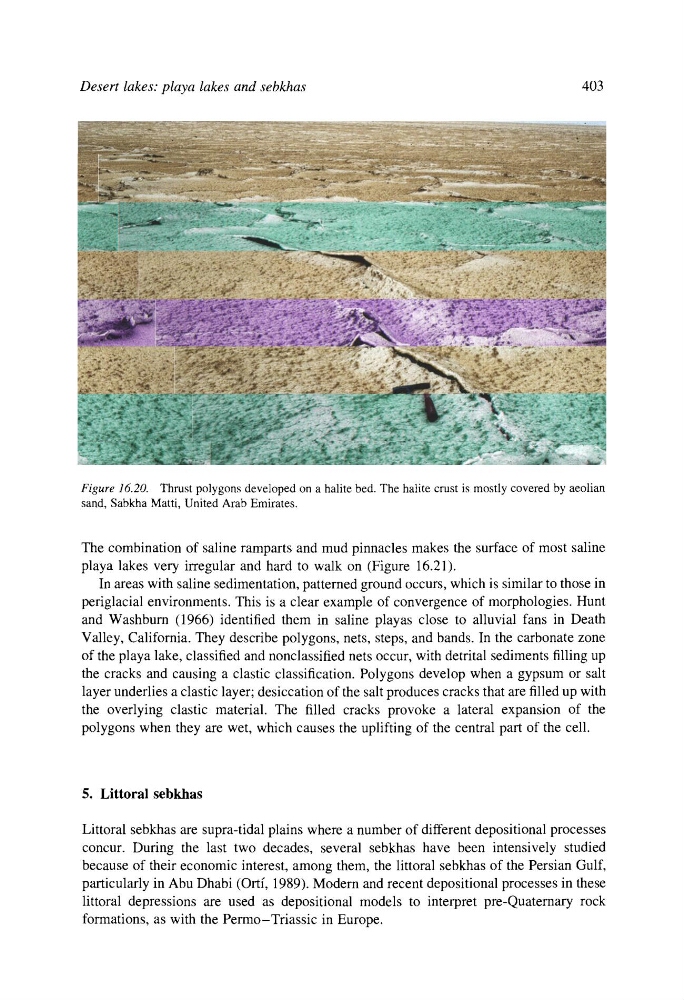
Figure 16.20. Thrust polygons developed on a halite bed. The halite crust is mostly covered by aeolian
sand, Sabkha Matti, United Arab Emirates.
The combination of saline ramparts and mud pinnacles makes the surface of most saline
playa lakes very irregular and hard to walk on (Figure 16.21).
In areas with saline sedimentation, patterned ground occurs, which is similar to those in
periglacial environments. This is a clear example of convergence of morphologies. Hunt
and Washburn (1966) identified them in saline playas close to alluvial fans in Death
Valley, California. They describe polygons, nets, steps, and bands. In the carbonate zone
of the playa lake, classified and nonclassified nets occur, with detrital sediments filling up
the cracks and causing a clastic classification. Polygons develop when a gypsum or salt
layer underlies a clastic layer; desiccation of the salt produces cracks that are filled up with
the overlying clastic material. The filled cracks provoke a lateral expansion of the
polygons when they are wet, which causes the uplifting of the central part of the cell.
5. Littoral sebkhas
Littoral sebkhas are supra-tidal plains where a number of different depositional processes
concur. During the last two decades, several sebkhas have been intensively studied
because of their economic interest, among them, the littoral sebkhas of the Persian Gulf,
particularly in Abu Dhabi (Ortf, 1989). Modem and recent depositional processes in these
littoral depressions are used as depositional models to interpret pre-Quaternary rock
formations, as with the Permo-Triassic in Europe.
403
Figure 16.20. Thrust polygons developed on a halite bed. The halite crust is mostly covered by aeolian
sand, Sabkha Matti, United Arab Emirates.
The combination of saline ramparts and mud pinnacles makes the surface of most saline
playa lakes very irregular and hard to walk on (Figure 16.21).
In areas with saline sedimentation, patterned ground occurs, which is similar to those in
periglacial environments. This is a clear example of convergence of morphologies. Hunt
and Washburn (1966) identified them in saline playas close to alluvial fans in Death
Valley, California. They describe polygons, nets, steps, and bands. In the carbonate zone
of the playa lake, classified and nonclassified nets occur, with detrital sediments filling up
the cracks and causing a clastic classification. Polygons develop when a gypsum or salt
layer underlies a clastic layer; desiccation of the salt produces cracks that are filled up with
the overlying clastic material. The filled cracks provoke a lateral expansion of the
polygons when they are wet, which causes the uplifting of the central part of the cell.
5. Littoral sebkhas
Littoral sebkhas are supra-tidal plains where a number of different depositional processes
concur. During the last two decades, several sebkhas have been intensively studied
because of their economic interest, among them, the littoral sebkhas of the Persian Gulf,
particularly in Abu Dhabi (Ortf, 1989). Modem and recent depositional processes in these
littoral depressions are used as depositional models to interpret pre-Quaternary rock
formations, as with the Permo-Triassic in Europe.