

390
Climatic Geomorphology
""
i
9 ,,>- )
]
.
#
n~
4,..'," I t~ >
, .s:"
x
\
o.,
.... .~_,,
I N
.~
.,.
",
;.h ............ "N
.
.................. ?,': .... ,"" "
", ........ ,.Q''-,l~
_/..-, ....... /
'"""7''" .................. "" ............. ~i
.... ,.,
.,'+' ......
~.+,i; .....
.~,,,,....,,
.r"
f,.,.i
...... - ....
o,+
'~
.~, ........... k
! .... j,
)
,i~ t
......................... ~ (~
(i
:
. ,,,
f
,..
9 ~
~.
,","
: ,.,, ,,
Ni~II 1
4
2
~-----~ 5
~7
)
oo ~
o.o ~
/
.1
'
'
"
'
"
"
"
"
I"%
I
o
|
~.~...
~-,
,
....
-
0
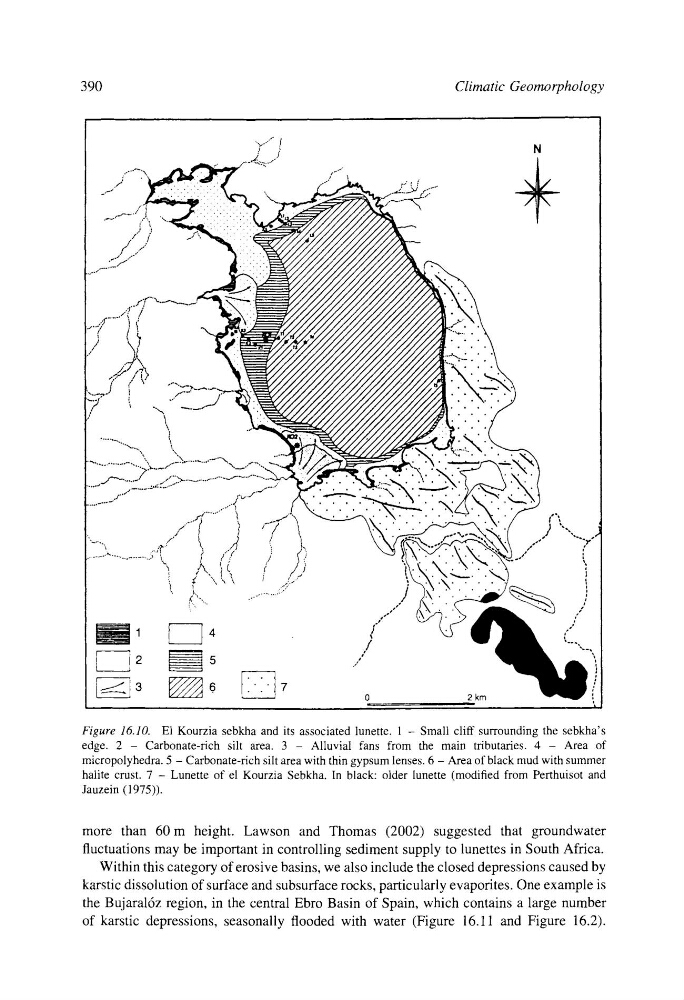
Figure 16.10. E1 Kourzia sebkha and its associated lunette. 1 - Small cliff surrounding the sebkha's
edge. 2 - Carbonate-rich silt area. 3 - Alluvial fans from the main tributaries. 4 - Area of
micropolyhedra. 5 - Carbonate-rich silt area with thin gypsum lenses. 6 - Area of black mud with summer
halite crust. 7 - Lunette of el Kourzia Sebkha. In black: older lunette (modified from Perthuisot and
Jauzein (1975)).
more than 60m height. Lawson and Thomas (2002) suggested that groundwater
fluctuations may be important in controlling sediment supply to lunettes in South Africa.
Within this category of erosive basins, we also include the closed depressions caused by
karstic dissolution of surface and subsurface rocks, particularly evaporites. One example is
the Bujaral6z region, in the central Ebro Basin of Spain, which contains a large number
of karstic depressions, seasonally flooded with water (Figure 16.11 and Figure 16.2).
Climatic Geomorphology
""
i
9 ,,>- )
]
.
#
n~
4,..'," I t~ >
, .s:"
x
\
o.,
.... .~_,,
I N
.~
.,.
",
;.h ............ "N
.
.................. ?,': .... ,"" "
", ........ ,.Q''-,l~
_/..-, ....... /
'"""7''" .................. "" ............. ~i
.... ,.,
.,'+' ......
~.+,i; .....
.~,,,,....,,
.r"
f,.,.i
...... - ....
o,+
'~
.~, ........... k
! .... j,
)
,i~ t
......................... ~ (~
(i
:
. ,,,
f
,..
9 ~
~.
,","
: ,.,, ,,
Ni~II 1
4
2
~-----~ 5
~7
)
oo ~
o.o ~
/
.1
'
'
"
'
"
"
"
"
I"%
I
o
|
~.~...
~-,
,
....
-
0
Figure 16.10. E1 Kourzia sebkha and its associated lunette. 1 - Small cliff surrounding the sebkha's
edge. 2 - Carbonate-rich silt area. 3 - Alluvial fans from the main tributaries. 4 - Area of
micropolyhedra. 5 - Carbonate-rich silt area with thin gypsum lenses. 6 - Area of black mud with summer
halite crust. 7 - Lunette of el Kourzia Sebkha. In black: older lunette (modified from Perthuisot and
Jauzein (1975)).
more than 60m height. Lawson and Thomas (2002) suggested that groundwater
fluctuations may be important in controlling sediment supply to lunettes in South Africa.
Within this category of erosive basins, we also include the closed depressions caused by
karstic dissolution of surface and subsurface rocks, particularly evaporites. One example is
the Bujaral6z region, in the central Ebro Basin of Spain, which contains a large number
of karstic depressions, seasonally flooded with water (Figure 16.11 and Figure 16.2).