

388
Climatic Geomorphology
From an ecological point of view, lacustrine habitats are limited to water bodies deeper
than 2 m; water bodies less than 2 m deep are considered as palustrine or paludal (swamp)
habitats (Cowardin et al., 1979, in Currey (1994)). Lacustrine environments contain
numerous plant- (blue green algae and reds) and animal-salinity-tolerant species (Eugster
and Hardie, 1978). Lakes with high salinity are mined for chlorides, nitrates, sodium
carbonates, borax, and other minerals of lithium and potassium. Those lakes with large flat
areas can be used as airports, or for sport and military activities. Archaeological sites have
been found in the littoral areas of some saline lakes where ancient people settled during
pluvial periods (Demangeot, 1981).
2. Origin of closed depressions in arid environments
Desert lakes have a variety of origins. Hutchinson (1957) distinguished two main types
(structural and geomorphic) and enumerated 13 processes that led to 75 different types of
closed depressions. Mabbutt (1977) identified four main lake basins: tectonic, erosive,
depositional, and crater lakes (volcanic and meteoritic). Each one of these main types is
subdivided into more categories. Shaw and Thomas (1997) followed this classification and
added some new cases.
Tectonic basins originate as a result of fault-bounded depressions or large sag basins.
Examples in the East African Rift Valley system are the Dead Sea in Israel and Jordan,
Lake Turkana or Rudolph in Kenya, and Lake Natron in Tanzania. Lake Victoria and Lake
Chad in Africa, and Lake Eyre in Australia are related to large, tectonic intracontinental
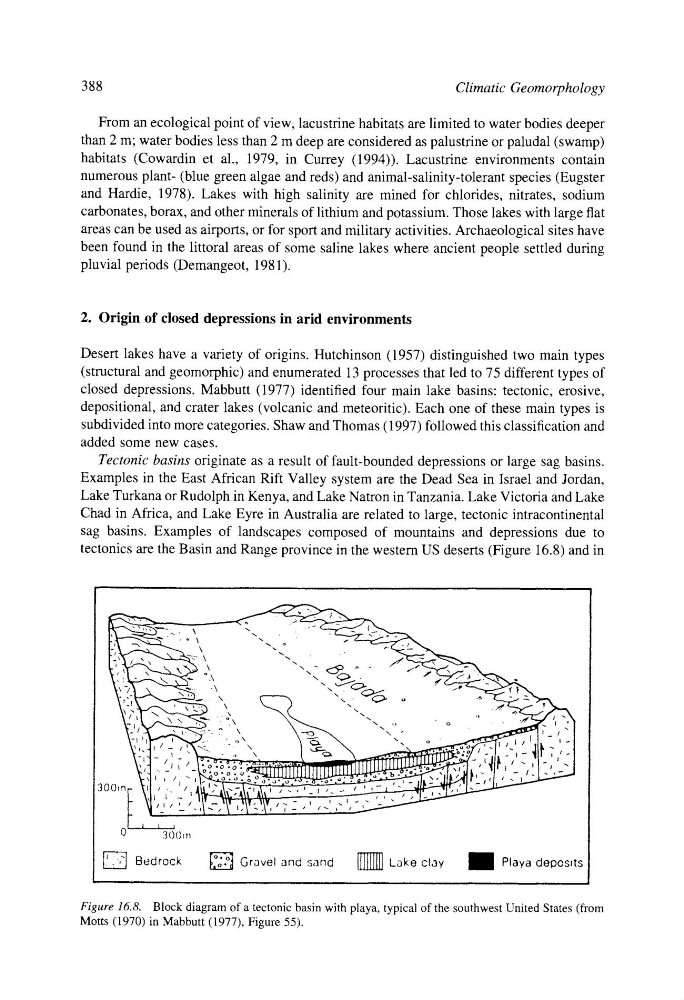
sag basins. Examples of landscapes composed of mountains and depressions due to
tectonics are the Basin and Range province in the western US deserts (Figure 16.8) and in
3
8 0ri i Gr voon0s n L kec y "Paya0eoosts
Figure 16.8. Block diagram of a tectonic basin with playa, typical of the southwest United States (from
Motts (1970) in Mabbutt (1977), Figure 55).
Climatic Geomorphology
From an ecological point of view, lacustrine habitats are limited to water bodies deeper
than 2 m; water bodies less than 2 m deep are considered as palustrine or paludal (swamp)
habitats (Cowardin et al., 1979, in Currey (1994)). Lacustrine environments contain
numerous plant- (blue green algae and reds) and animal-salinity-tolerant species (Eugster
and Hardie, 1978). Lakes with high salinity are mined for chlorides, nitrates, sodium
carbonates, borax, and other minerals of lithium and potassium. Those lakes with large flat
areas can be used as airports, or for sport and military activities. Archaeological sites have
been found in the littoral areas of some saline lakes where ancient people settled during
pluvial periods (Demangeot, 1981).
2. Origin of closed depressions in arid environments
Desert lakes have a variety of origins. Hutchinson (1957) distinguished two main types
(structural and geomorphic) and enumerated 13 processes that led to 75 different types of
closed depressions. Mabbutt (1977) identified four main lake basins: tectonic, erosive,
depositional, and crater lakes (volcanic and meteoritic). Each one of these main types is
subdivided into more categories. Shaw and Thomas (1997) followed this classification and
added some new cases.
Tectonic basins originate as a result of fault-bounded depressions or large sag basins.
Examples in the East African Rift Valley system are the Dead Sea in Israel and Jordan,
Lake Turkana or Rudolph in Kenya, and Lake Natron in Tanzania. Lake Victoria and Lake
Chad in Africa, and Lake Eyre in Australia are related to large, tectonic intracontinental
sag basins. Examples of landscapes composed of mountains and depressions due to
tectonics are the Basin and Range province in the western US deserts (Figure 16.8) and in
3
8 0ri i Gr voon0s n L kec y "Paya0eoosts
Figure 16.8. Block diagram of a tectonic basin with playa, typical of the southwest United States (from
Motts (1970) in Mabbutt (1977), Figure 55).