

374
Climatic Geomorphology
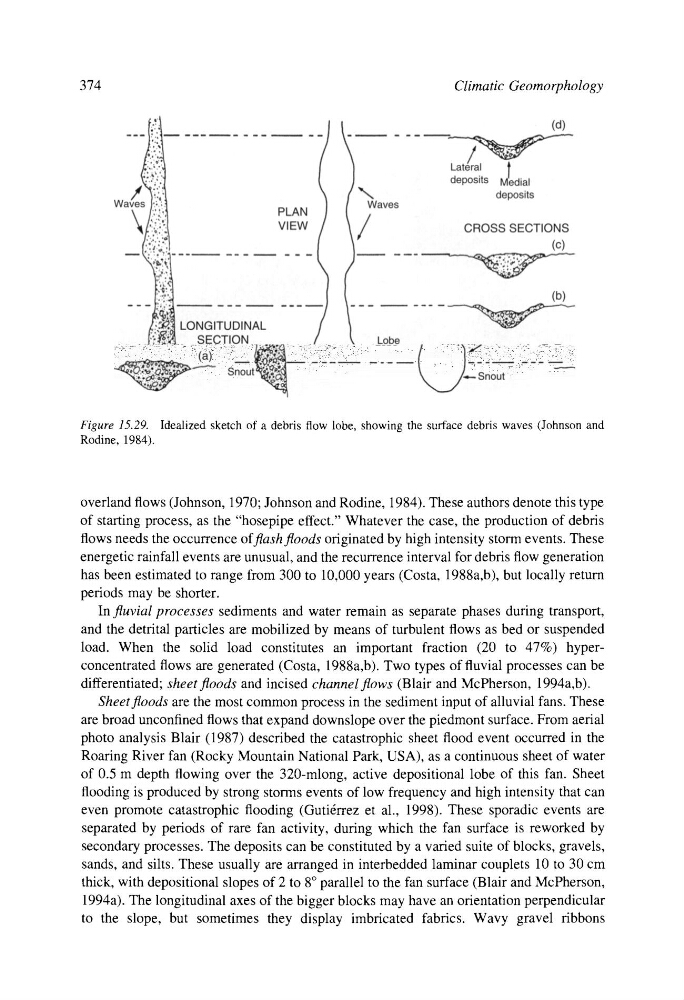
Figure 15.29. Idealized sketch of a debris flow lobe, showing the surface debris waves (Johnson and
Rodine, 1984).
overland flows (Johnson, 1970; Johnson and Rodine, 1984). These authors denote this type
of starting process, as the "hosepipe effect." Whatever the case, the production of debris
flows needs the occurrence offlash floods originated by high intensity storm events. These
energetic rainfall events are unusual, and the recurrence interval for debris flow generation
has been estimated to range from 300 to 10,000 years (Costa, 1988a,b), but locally return
periods may be shorter.
In fluvial processes sediments and water remain as separate phases during transport,
and the detrital particles are mobilized by means of turbulent flows as bed or suspended
load. When the solid load constitutes an important fraction (20 to 47%) hyperconcentrated flows are generated (Costa, 1988a,b). Two types of fluvial processes can be
differentiated; sheet floods and incised channel flows (Blair and McPherson, 1994a,b).
Sheet floods are the most common process in the sediment input of alluvial fans. These
are broad unconfined flows that expand downslope over the piedmont surface. From aerial
photo analysis Blair (1987) described the catastrophic sheet flood event occurred in the
Roaring River fan (Rocky Mountain National Park, USA), as a continuous sheet of water
of 0.5 m depth flowing over the 320-mlong, active depositional lobe of this fan. Sheet
flooding is produced by strong storms events of low frequency and high intensity that can
even promote catastrophic flooding (Guti6rrez et al., 1998). These sporadic events are
separated by periods of rare fan activity, during which the fan surface is reworked by
secondary processes. The deposits can be constituted by a varied suite of blocks, gravels,
sands, and silts. These usually are arranged in interbedded laminar couplets 10 to 30 cm
thick, with depositional slopes of 2 to 8 ~ parallel to the fan surface (Blair and McPherson,
1994a). The longitudinal axes of the bigger blocks may have an orientation perpendicular
to the slope, but sometimes they display imbricated fabrics. Wavy gravel ribbons
Climatic Geomorphology
Figure 15.29. Idealized sketch of a debris flow lobe, showing the surface debris waves (Johnson and
Rodine, 1984).
overland flows (Johnson, 1970; Johnson and Rodine, 1984). These authors denote this type
of starting process, as the "hosepipe effect." Whatever the case, the production of debris
flows needs the occurrence offlash floods originated by high intensity storm events. These
energetic rainfall events are unusual, and the recurrence interval for debris flow generation
has been estimated to range from 300 to 10,000 years (Costa, 1988a,b), but locally return
periods may be shorter.
In fluvial processes sediments and water remain as separate phases during transport,
and the detrital particles are mobilized by means of turbulent flows as bed or suspended
load. When the solid load constitutes an important fraction (20 to 47%) hyperconcentrated flows are generated (Costa, 1988a,b). Two types of fluvial processes can be
differentiated; sheet floods and incised channel flows (Blair and McPherson, 1994a,b).
Sheet floods are the most common process in the sediment input of alluvial fans. These
are broad unconfined flows that expand downslope over the piedmont surface. From aerial
photo analysis Blair (1987) described the catastrophic sheet flood event occurred in the
Roaring River fan (Rocky Mountain National Park, USA), as a continuous sheet of water
of 0.5 m depth flowing over the 320-mlong, active depositional lobe of this fan. Sheet
flooding is produced by strong storms events of low frequency and high intensity that can
even promote catastrophic flooding (Guti6rrez et al., 1998). These sporadic events are
separated by periods of rare fan activity, during which the fan surface is reworked by
secondary processes. The deposits can be constituted by a varied suite of blocks, gravels,
sands, and silts. These usually are arranged in interbedded laminar couplets 10 to 30 cm
thick, with depositional slopes of 2 to 8 ~ parallel to the fan surface (Blair and McPherson,
1994a). The longitudinal axes of the bigger blocks may have an orientation perpendicular
to the slope, but sometimes they display imbricated fabrics. Wavy gravel ribbons