

The arid region piedmonts: glacis and alluvial fans
373
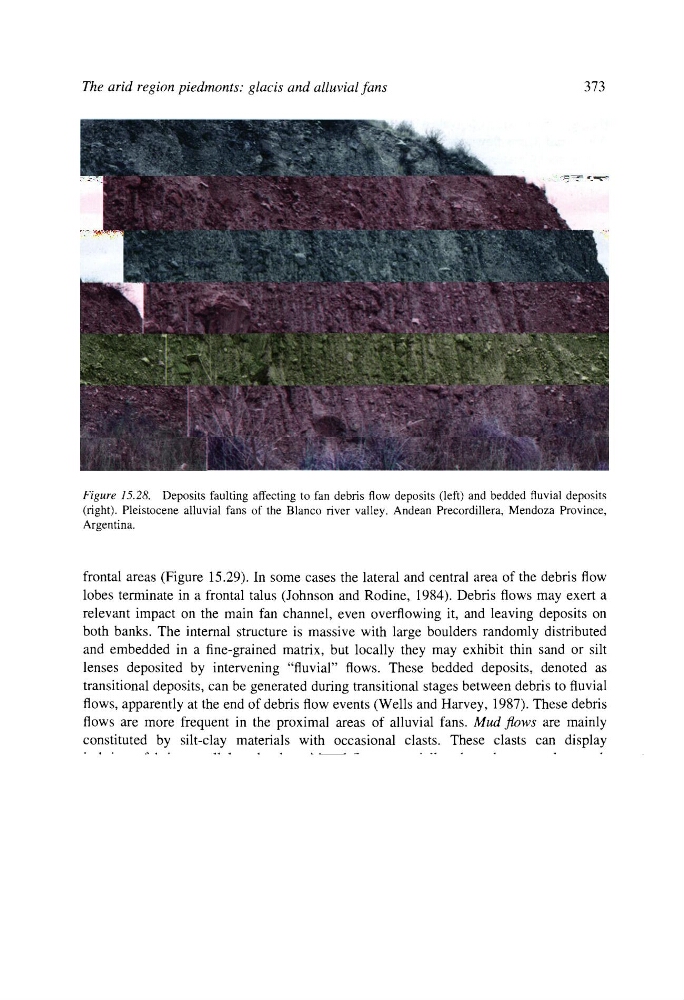
Figure 15.28. Deposits faulting affecting to fan debris flow deposits (left) and bedded fluvial deposits
(right). Pleistocene alluvial fans of the Blanco fiver valley. Andean Precordillera, Mendoza Province,
Argentina.
frontal areas (Figure 15.29). In some cases the lateral and central area of the debris flow
lobes terminate in a frontal talus (Johnson and Rodine, 1984). Debris flows may exert a
relevant impact on the main fan channel, even overflowing it, and leaving deposits on
both banks. The internal structure is massive with large boulders randomly distributed
and embedded in a fine-grained matrix, but locally they may exhibit thin sand or silt
lenses deposited by intervening "fluvial" flows. These bedded deposits, denoted as
transitional deposits, can be generated during transitional stages between debris to fluvial
flows, apparently at the end of debris flow events (Wells and Harvey, 1987). These debris
flows are more frequent in the proximal areas of alluvial fans. Mud flows are mainly
constituted by silt-clay materials with occasional clasts. These clasts can display
imbricate fabrics parallel to the depositional flow, especially when clasts are elongated.
Mud flows, however, are rare deposits in the alluvial fans developed in arid and semiarid regions.
Two mechanisms have been traditionally considered for the origin of debris flows. The
more accepted idea considers the generation of debris flows from the downslope failure of
steep colluvial slopes (27 to 56 ~ triggered by the progressive wetting and saturation of the
ground during rainfall or snow-melt events. The water saturation of loose detrital materials
promotes the reduction of their shear stress assists their downslope movement as debris
flows (Campbell, 1975; Costa, 1988a,b). Other proposals suggest that debris flows are
generated by the mobilization of the loose materials mantling the hillslopes by single
373
Figure 15.28. Deposits faulting affecting to fan debris flow deposits (left) and bedded fluvial deposits
(right). Pleistocene alluvial fans of the Blanco fiver valley. Andean Precordillera, Mendoza Province,
Argentina.
frontal areas (Figure 15.29). In some cases the lateral and central area of the debris flow
lobes terminate in a frontal talus (Johnson and Rodine, 1984). Debris flows may exert a
relevant impact on the main fan channel, even overflowing it, and leaving deposits on
both banks. The internal structure is massive with large boulders randomly distributed
and embedded in a fine-grained matrix, but locally they may exhibit thin sand or silt
lenses deposited by intervening "fluvial" flows. These bedded deposits, denoted as
transitional deposits, can be generated during transitional stages between debris to fluvial
flows, apparently at the end of debris flow events (Wells and Harvey, 1987). These debris
flows are more frequent in the proximal areas of alluvial fans. Mud flows are mainly
constituted by silt-clay materials with occasional clasts. These clasts can display
imbricate fabrics parallel to the depositional flow, especially when clasts are elongated.
Mud flows, however, are rare deposits in the alluvial fans developed in arid and semiarid regions.
Two mechanisms have been traditionally considered for the origin of debris flows. The
more accepted idea considers the generation of debris flows from the downslope failure of
steep colluvial slopes (27 to 56 ~ triggered by the progressive wetting and saturation of the
ground during rainfall or snow-melt events. The water saturation of loose detrital materials
promotes the reduction of their shear stress assists their downslope movement as debris
flows (Campbell, 1975; Costa, 1988a,b). Other proposals suggest that debris flows are
generated by the mobilization of the loose materials mantling the hillslopes by single