

The arid region piedmonts: glacis and alluvial fans
367
The temperature can also affect fan development because it may increase the rates of
chemical weathering. On the other hand, it is necessary to consider the common occurrence
of altitudinal coolness gradients, which may give place to congelifraction in the headwater
zones. Also, the amount of precipitation increases with altitude. These orographic gradients
may affect the vegetal cover, which in turn has a relevant impact on soil erosion and
slope stability. This is mainly driven by the development and penetration of the roots in
the ground, which is different for different types of plants. Consequently, when climatic
changes, or human activity (overgrazing, deforestation, fires, etc.), impact the expansion
and type of the vegetal cover, the affected hillslopes may became unstable.
Fans can develop in areas of tectonic quiescence, but also in active tectonic zones. The
latter are characterized by the occurrence of basin and range deserts such as those
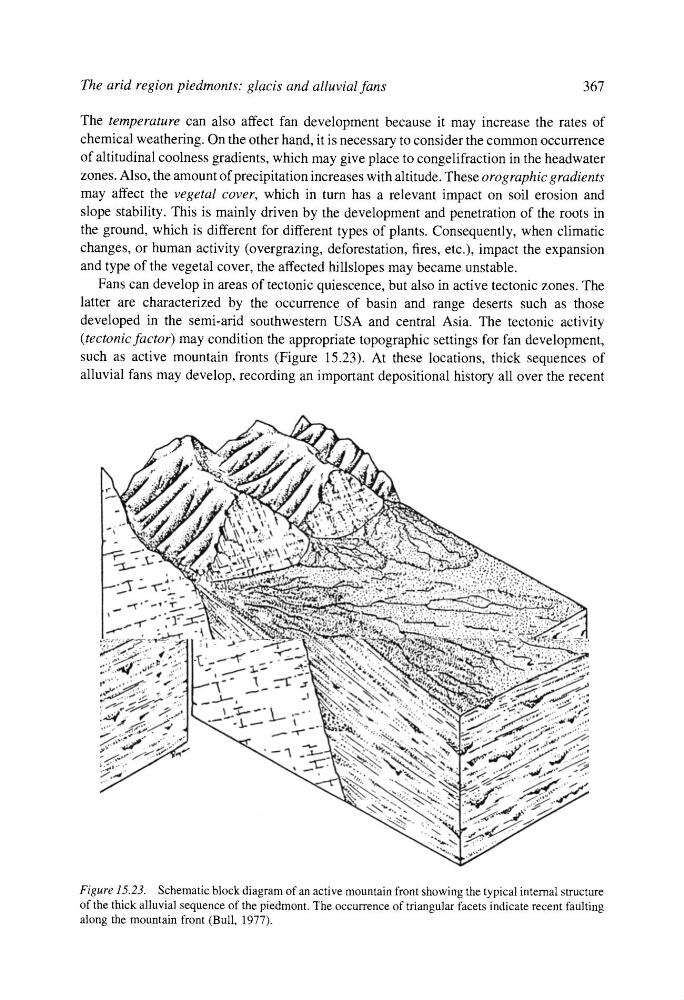
developed in the semi-arid southwestern USA and central Asia. The tectonic activity
(tectonic factor) may condition the appropriate topographic settings for fan development,
such as active mountain fronts (Figure 15.23). At these locations, thick sequences of
alluvial fans may develop, recording an important depositional history all over the recent
Figure 15.23. Schematic block diagram of an active mountain front showing the typical internal structure
of the thick alluvial sequence of the piedmont. The occurrence of triangular facets indicate recent faulting
along the mountain front (Bull, 1977).
367
The temperature can also affect fan development because it may increase the rates of
chemical weathering. On the other hand, it is necessary to consider the common occurrence
of altitudinal coolness gradients, which may give place to congelifraction in the headwater
zones. Also, the amount of precipitation increases with altitude. These orographic gradients
may affect the vegetal cover, which in turn has a relevant impact on soil erosion and
slope stability. This is mainly driven by the development and penetration of the roots in
the ground, which is different for different types of plants. Consequently, when climatic
changes, or human activity (overgrazing, deforestation, fires, etc.), impact the expansion
and type of the vegetal cover, the affected hillslopes may became unstable.
Fans can develop in areas of tectonic quiescence, but also in active tectonic zones. The
latter are characterized by the occurrence of basin and range deserts such as those
developed in the semi-arid southwestern USA and central Asia. The tectonic activity
(tectonic factor) may condition the appropriate topographic settings for fan development,
such as active mountain fronts (Figure 15.23). At these locations, thick sequences of
alluvial fans may develop, recording an important depositional history all over the recent
Figure 15.23. Schematic block diagram of an active mountain front showing the typical internal structure
of the thick alluvial sequence of the piedmont. The occurrence of triangular facets indicate recent faulting
along the mountain front (Bull, 1977).