

366
Climatic Geomorphology
0.5
-A Debris flow fans
o Intermediate and fluvial fans
0,2
-r
(1)
0.1 -
03
x_
O')
r
03
a_ 0.05 -
0.02 -
oA
O
9
9 9
9
9
9
O
O
A
o =
o
%0 ~
o
o
o o
o
o
0.01
I
I
I
I
I
I
I
1
0.1
0.2
0.5
1
2
5
10
20
50
Drainage area (km 2)
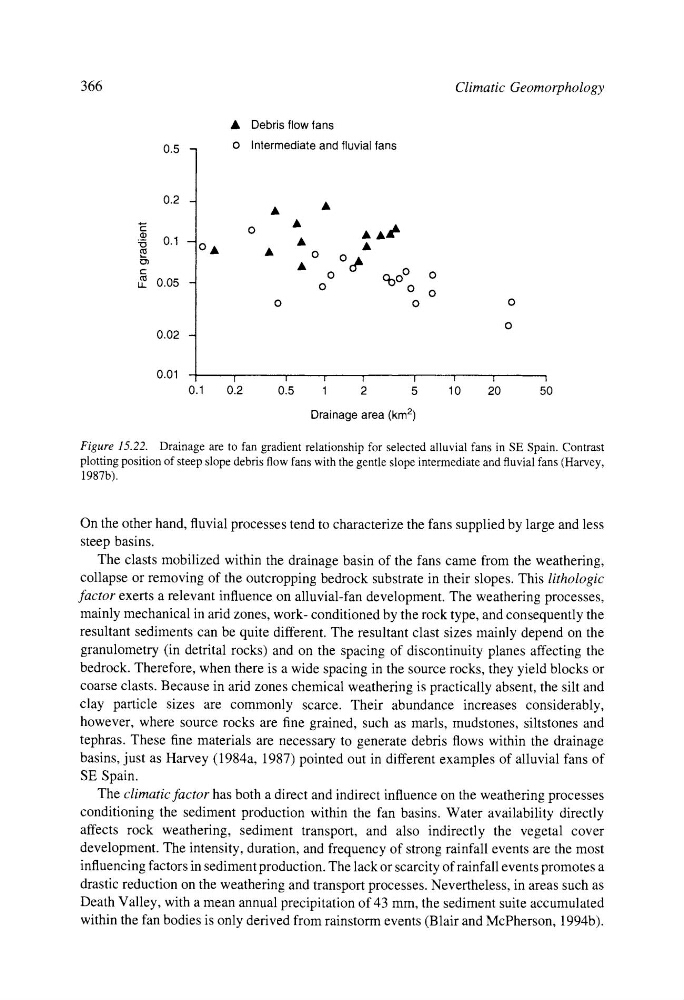
Figure 15.22. Drainage are to fan gradient relationship for selected alluvial fans in SE Spain. Contrast
plotting position of steep slope debris flow fans with the gentle slope intermediate and fluvial fans (Harvey,
1987b).
On the other hand, fluvial processes tend to characterize the fans supplied by large and less
steep basins.
The clasts mobilized within the drainage basin of the fans came from the weathering,
collapse or removing of the outcropping bedrock substrate in their slopes. This lithologic
factor exerts a relevant influence on alluvial-fan development. The weathering processes,
mainly mechanical in arid zones, work- conditioned by the rock type, and consequently the
resultant sediments can be quite different. The resultant clast sizes mainly depend on the
granulometry (in detrital rocks) and on the spacing of discontinuity planes affecting the
bedrock. Therefore, when there is a wide spacing in the source rocks, they yield blocks or
coarse clasts. Because in arid zones chemical weathering is practically absent, the silt and
clay particle sizes are commonly scarce. Their abundance increases considerably,
however, where source rocks are fine grained, such as marls, mudstones, siltstones and
tephras. These fine materials are necessary to generate debris flows within the drainage
basins, just as Harvey (1984a, 1987) pointed out in different examples of alluvial fans of
SE Spain.
The climatic factor has both a direct and indirect influence on the weathering processes
conditioning the sediment production within the fan basins. Water availability directly
affects rock weathering, sediment transport, and also indirectly the vegetal cover
development. The intensity, duration, and frequency of strong rainfall events are the most
influencing factors in sediment production. The lack or scarcity of rainfall events promotes a
drastic reduction on the weathering and transport processes. Nevertheless, in areas such as
Death Valley, with a mean annual precipitation of 43 mm, the sediment suite accumulated
within the fan bodies is only derived from rainstorm events (Blair and McPherson, 1994b).
Climatic Geomorphology
0.5
-A Debris flow fans
o Intermediate and fluvial fans
0,2
-r
(1)
0.1 -
03
x_
O')
r
03
a_ 0.05 -
0.02 -
oA
O
9
9 9
9
9
9
O
O
A
o =
o
%0 ~
o
o
o o
o
o
0.01
I
I
I
I
I
I
I
1
0.1
0.2
0.5
1
2
5
10
20
50
Drainage area (km 2)
Figure 15.22. Drainage are to fan gradient relationship for selected alluvial fans in SE Spain. Contrast
plotting position of steep slope debris flow fans with the gentle slope intermediate and fluvial fans (Harvey,
1987b).
On the other hand, fluvial processes tend to characterize the fans supplied by large and less
steep basins.
The clasts mobilized within the drainage basin of the fans came from the weathering,
collapse or removing of the outcropping bedrock substrate in their slopes. This lithologic
factor exerts a relevant influence on alluvial-fan development. The weathering processes,
mainly mechanical in arid zones, work- conditioned by the rock type, and consequently the
resultant sediments can be quite different. The resultant clast sizes mainly depend on the
granulometry (in detrital rocks) and on the spacing of discontinuity planes affecting the
bedrock. Therefore, when there is a wide spacing in the source rocks, they yield blocks or
coarse clasts. Because in arid zones chemical weathering is practically absent, the silt and
clay particle sizes are commonly scarce. Their abundance increases considerably,
however, where source rocks are fine grained, such as marls, mudstones, siltstones and
tephras. These fine materials are necessary to generate debris flows within the drainage
basins, just as Harvey (1984a, 1987) pointed out in different examples of alluvial fans of
SE Spain.
The climatic factor has both a direct and indirect influence on the weathering processes
conditioning the sediment production within the fan basins. Water availability directly
affects rock weathering, sediment transport, and also indirectly the vegetal cover
development. The intensity, duration, and frequency of strong rainfall events are the most
influencing factors in sediment production. The lack or scarcity of rainfall events promotes a
drastic reduction on the weathering and transport processes. Nevertheless, in areas such as
Death Valley, with a mean annual precipitation of 43 mm, the sediment suite accumulated
within the fan bodies is only derived from rainstorm events (Blair and McPherson, 1994b).