

The arid region piedmonts: glacis and alluvial fans
361
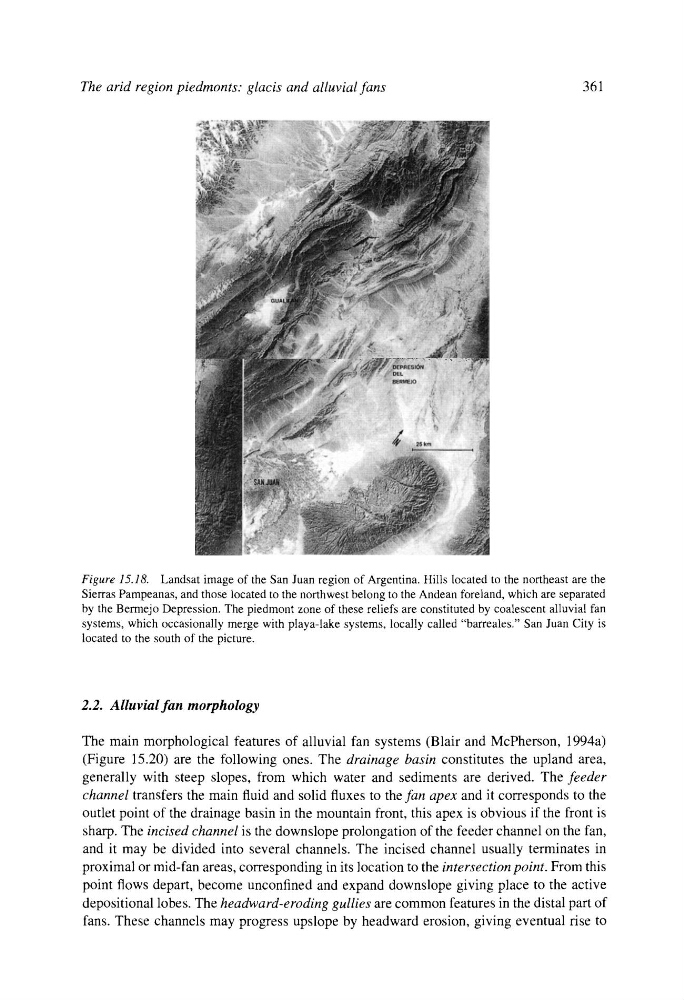
Figure 15.18. Landsat image of the San Juan region of Argentina. Hills located to the northeast are the
Sierras Pampeanas, and those located to the northwest belong to the Andean foreland, which are separated
by the Bermejo Depression. The piedmont zone of these reliefs are constituted by coalescent alluvial fan
systems, which occasionally merge with playa-lake systems, locally called "barreales." San Juan City is
located to the south of the picture.
2.2. Alluvial fan morphology
The main morphological features of alluvial fan systems (Blair and McPherson, 1994a)
(Figure 15.20) are the following ones. The drainage basin constitutes the upland area,
generally with steep slopes, from which water and sediments are derived. The feeder
channel transfers the main fluid and solid fluxes to the fan apex and it corresponds to the
outlet point of the drainage basin in the mountain front, this apex is obvious if the front is
sharp. The incised channel is the downslope prolongation of the feeder channel on the fan,
and it may be divided into several channels. The incised channel usually terminates in
proximal or mid-fan areas, corresponding in its location to the intersection point. From this
point flows depart, become unconfined and expand downslope giving place to the active
depositional lobes. The headward-eroding gullies are common features in the distal part of
fans. These channels may progress upslope by headward erosion, giving eventual rise to
361
Figure 15.18. Landsat image of the San Juan region of Argentina. Hills located to the northeast are the
Sierras Pampeanas, and those located to the northwest belong to the Andean foreland, which are separated
by the Bermejo Depression. The piedmont zone of these reliefs are constituted by coalescent alluvial fan
systems, which occasionally merge with playa-lake systems, locally called "barreales." San Juan City is
located to the south of the picture.
2.2. Alluvial fan morphology
The main morphological features of alluvial fan systems (Blair and McPherson, 1994a)
(Figure 15.20) are the following ones. The drainage basin constitutes the upland area,
generally with steep slopes, from which water and sediments are derived. The feeder
channel transfers the main fluid and solid fluxes to the fan apex and it corresponds to the
outlet point of the drainage basin in the mountain front, this apex is obvious if the front is
sharp. The incised channel is the downslope prolongation of the feeder channel on the fan,
and it may be divided into several channels. The incised channel usually terminates in
proximal or mid-fan areas, corresponding in its location to the intersection point. From this
point flows depart, become unconfined and expand downslope giving place to the active
depositional lobes. The headward-eroding gullies are common features in the distal part of
fans. These channels may progress upslope by headward erosion, giving eventual rise to