

Slopes in arid zones
339
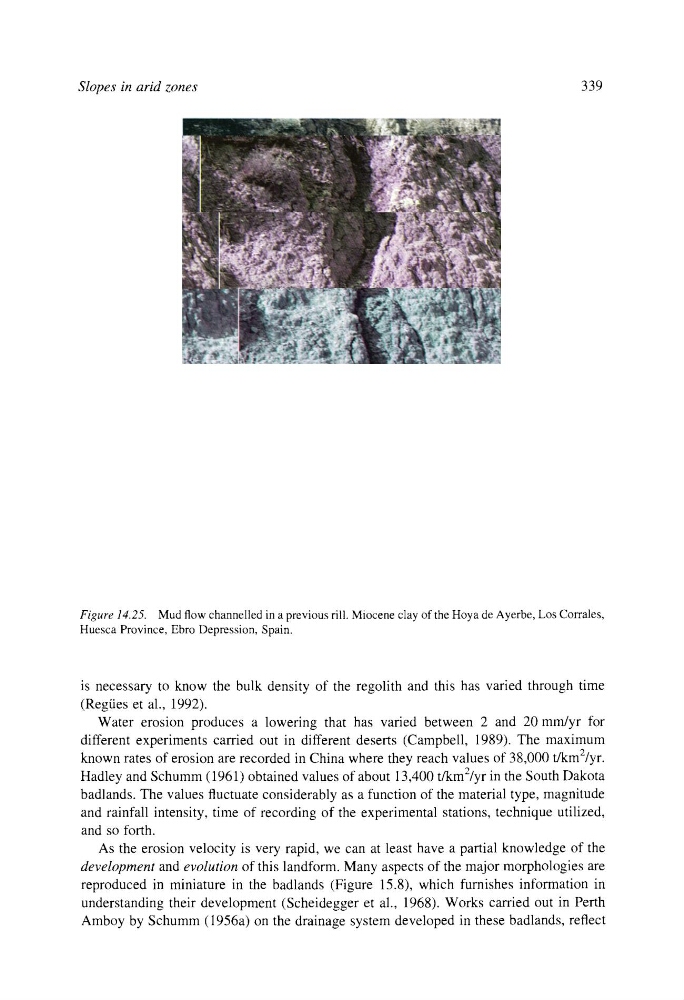
Figure 14.25. Mud flow channelled in a previous rill. Miocene clay of the Hoya de Ayerbe, Los Corrales,
Huesca Province, Ebro Depression, Spain.
is necessary to know the bulk density of the regolith and this has varied through time
(Regfies et al., 1992).
Water erosion produces a lowering that has varied between 2 and 20 mm/yr for
different experiments carried out in different deserts (Campbell, 1989). The maximum
known rates of erosion are recorded in China where they reach values of 38,000 t/kmZ/yr.
Hadley and Schumm (1961) obtained values of about 13,400 t/km2/yr in the South Dakota
badlands. The values fluctuate considerably as a function of the material type, magnitude
and rainfall intensity, time of recording of the experimental stations, technique utilized,
and so forth.
As the erosion velocity is very rapid, we can at least have a partial knowledge of the
development and evolution of this landform. Many aspects of the major morphologies are
reproduced in miniature in the badlands (Figure 15.8), which furnishes information in
understanding their development (Scheidegger et al., 1968). Works carried out in Perth
Amboy by Schumm (1956a) on the drainage system developed in these badlands, reflect
339
Figure 14.25. Mud flow channelled in a previous rill. Miocene clay of the Hoya de Ayerbe, Los Corrales,
Huesca Province, Ebro Depression, Spain.
is necessary to know the bulk density of the regolith and this has varied through time
(Regfies et al., 1992).
Water erosion produces a lowering that has varied between 2 and 20 mm/yr for
different experiments carried out in different deserts (Campbell, 1989). The maximum
known rates of erosion are recorded in China where they reach values of 38,000 t/kmZ/yr.
Hadley and Schumm (1961) obtained values of about 13,400 t/km2/yr in the South Dakota
badlands. The values fluctuate considerably as a function of the material type, magnitude
and rainfall intensity, time of recording of the experimental stations, technique utilized,
and so forth.
As the erosion velocity is very rapid, we can at least have a partial knowledge of the
development and evolution of this landform. Many aspects of the major morphologies are
reproduced in miniature in the badlands (Figure 15.8), which furnishes information in
understanding their development (Scheidegger et al., 1968). Works carried out in Perth
Amboy by Schumm (1956a) on the drainage system developed in these badlands, reflect