

328
Climatic Geomorphology
that for generating a talus flatiron the alternation of stages is necessary in which
accumulation is dominant, followed by another where erosion is dominant. The succession
of several alternant stages gives rise to talus flatiron sequences, in which the oldest
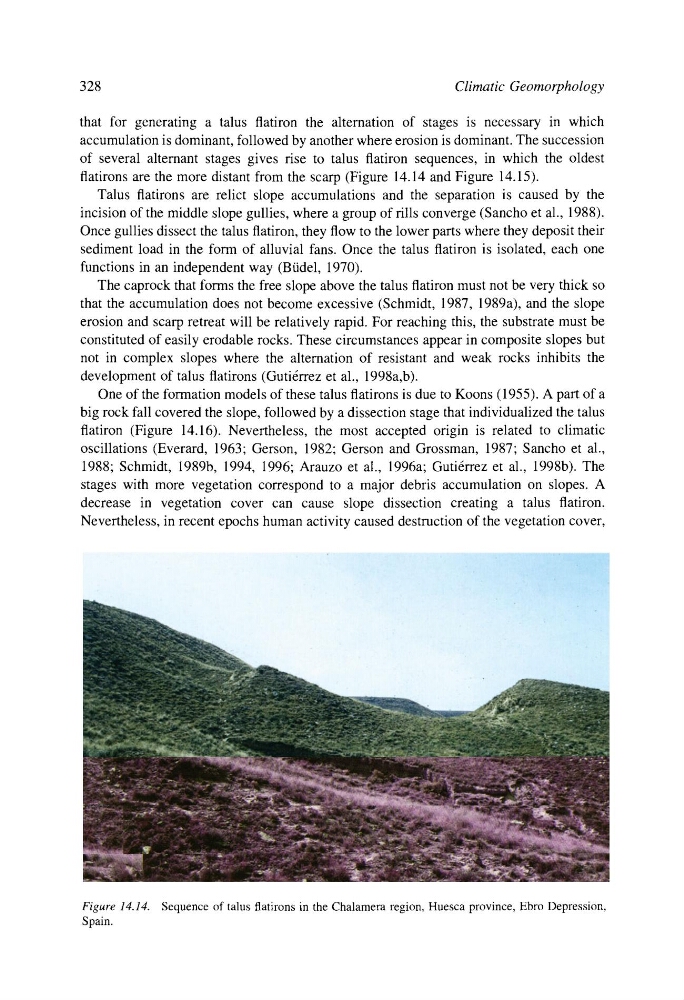
flatirons are the more distant from the scarp (Figure 14.14 and Figure 14.15).
Talus flatirons are relict slope accumulations and the separation is caused by the
incision of the middle slope gullies, where a group of fills converge (Sancho et al., 1988).
Once gullies dissect the talus flatiron, they flow to the lower parts where they deposit their
sediment load in the form of alluvial fans. Once the talus flatiron is isolated, each one
functions in an independent way (Btidel, 1970).
The caprock that forms the free slope above the talus flatiron must not be very thick so
that the accumulation does not become excessive (Schmidt, 1987, 1989a), and the slope
erosion and scarp retreat will be relatively rapid. For reaching this, the substrate must be
constituted of easily erodable rocks. These circumstances appear in composite slopes but
not in complex slopes where the alternation of resistant and weak rocks inhibits the
development of talus flatirons (Gutifrrez et al., 1998a,b).
One of the formation models of these talus flatirons is due to Koons (1955). A part of a
big rock fall covered the slope, followed by a dissection stage that individualized the talus
flatiron (Figure 14.16). Nevertheless, the most accepted origin is related to climatic
oscillations (Everard, 1963; Gerson, 1982; Gerson and Grossman, 1987; Sancho et al.,
1988; Schmidt, 1989b, 1994, 1996; Arauzo et al., 1996a; Gutifrrez et al., 1998b). The
stages with more vegetation correspond to a major debris accumulation on slopes. A
decrease in vegetation cover can cause slope dissection creating a talus flatiron.
Nevertheless, in recent epochs human activity caused destruction of the vegetation cover,
Figure 14.14. Sequence of talus flatirons in the Chalamera region, Huesca province, Ebro Depression,
Spain.
Climatic Geomorphology
that for generating a talus flatiron the alternation of stages is necessary in which
accumulation is dominant, followed by another where erosion is dominant. The succession
of several alternant stages gives rise to talus flatiron sequences, in which the oldest
flatirons are the more distant from the scarp (Figure 14.14 and Figure 14.15).
Talus flatirons are relict slope accumulations and the separation is caused by the
incision of the middle slope gullies, where a group of fills converge (Sancho et al., 1988).
Once gullies dissect the talus flatiron, they flow to the lower parts where they deposit their
sediment load in the form of alluvial fans. Once the talus flatiron is isolated, each one
functions in an independent way (Btidel, 1970).
The caprock that forms the free slope above the talus flatiron must not be very thick so
that the accumulation does not become excessive (Schmidt, 1987, 1989a), and the slope
erosion and scarp retreat will be relatively rapid. For reaching this, the substrate must be
constituted of easily erodable rocks. These circumstances appear in composite slopes but
not in complex slopes where the alternation of resistant and weak rocks inhibits the
development of talus flatirons (Gutifrrez et al., 1998a,b).
One of the formation models of these talus flatirons is due to Koons (1955). A part of a
big rock fall covered the slope, followed by a dissection stage that individualized the talus
flatiron (Figure 14.16). Nevertheless, the most accepted origin is related to climatic
oscillations (Everard, 1963; Gerson, 1982; Gerson and Grossman, 1987; Sancho et al.,
1988; Schmidt, 1989b, 1994, 1996; Arauzo et al., 1996a; Gutifrrez et al., 1998b). The
stages with more vegetation correspond to a major debris accumulation on slopes. A
decrease in vegetation cover can cause slope dissection creating a talus flatiron.
Nevertheless, in recent epochs human activity caused destruction of the vegetation cover,
Figure 14.14. Sequence of talus flatirons in the Chalamera region, Huesca province, Ebro Depression,
Spain.