

Slopes in arid zones
327
!
9 ~
.,
~,
----_-_
\,~,,
Q1 ~o~
0
500
1000 Ft.
9
,
A
,
~11
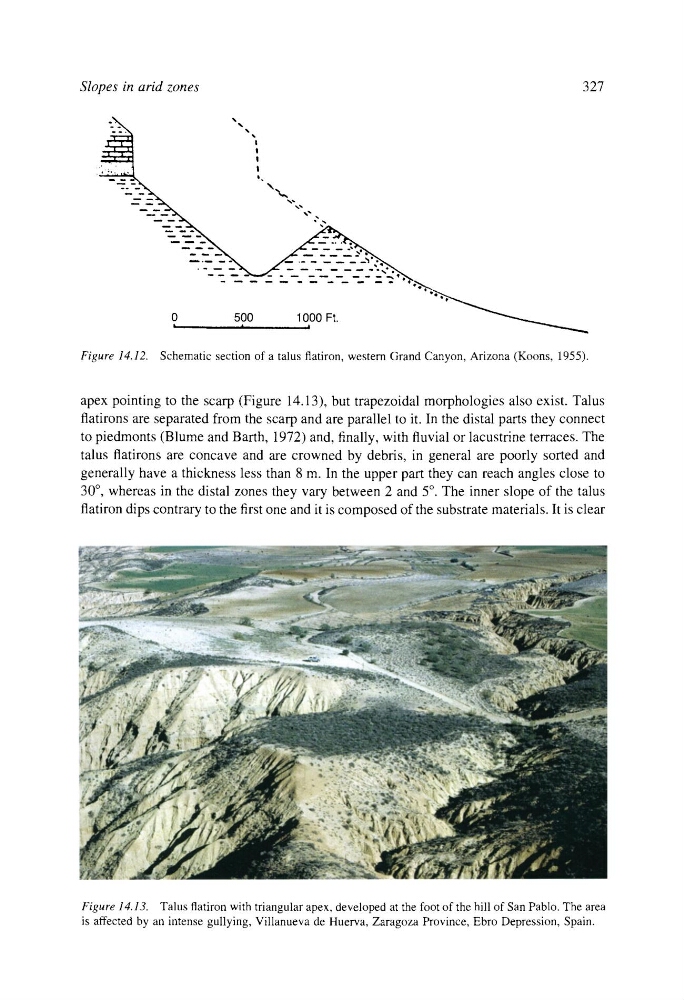
Figure 14.12. Schematic section of a talus flatiron, western Grand Canyon, Arizona (Koons, 1955).
apex pointing to the scarp (Figure 14.13), but trapezoidal morphologies also exist. Talus
flatirons are separated from the scarp and are parallel to it. In the distal parts they connect
to piedmonts (Blume and Barth, 1972) and, finally, with fluvial or lacustrine terraces. The
talus flatirons are concave and are crowned by debris, in general are poorly sorted and
generally have a thickness less than 8 m. In the upper part they can reach angles close to
30 ~ whereas in the distal zones they vary between 2 and 5 ~ The inner slope of the talus
flatiron dips contrary to the first one and it is composed of the substrate materials. It is clear
Figure 14.13. Talus flatiron with triangular apex, developed at the foot of the hill of San Pablo. The area
is affected by an intense gullying, Villanueva de Huerva, Zaragoza Province, Ebro Depression, Spain.
327
!
9 ~
.,
~,
----_-_
\,~,,
Q1 ~o~
0
500
1000 Ft.
9
,
A
,
~11
Figure 14.12. Schematic section of a talus flatiron, western Grand Canyon, Arizona (Koons, 1955).
apex pointing to the scarp (Figure 14.13), but trapezoidal morphologies also exist. Talus
flatirons are separated from the scarp and are parallel to it. In the distal parts they connect
to piedmonts (Blume and Barth, 1972) and, finally, with fluvial or lacustrine terraces. The
talus flatirons are concave and are crowned by debris, in general are poorly sorted and
generally have a thickness less than 8 m. In the upper part they can reach angles close to
30 ~ whereas in the distal zones they vary between 2 and 5 ~ The inner slope of the talus
flatiron dips contrary to the first one and it is composed of the substrate materials. It is clear
Figure 14.13. Talus flatiron with triangular apex, developed at the foot of the hill of San Pablo. The area
is affected by an intense gullying, Villanueva de Huerva, Zaragoza Province, Ebro Depression, Spain.