

Slopes in arid zones
319
FEET
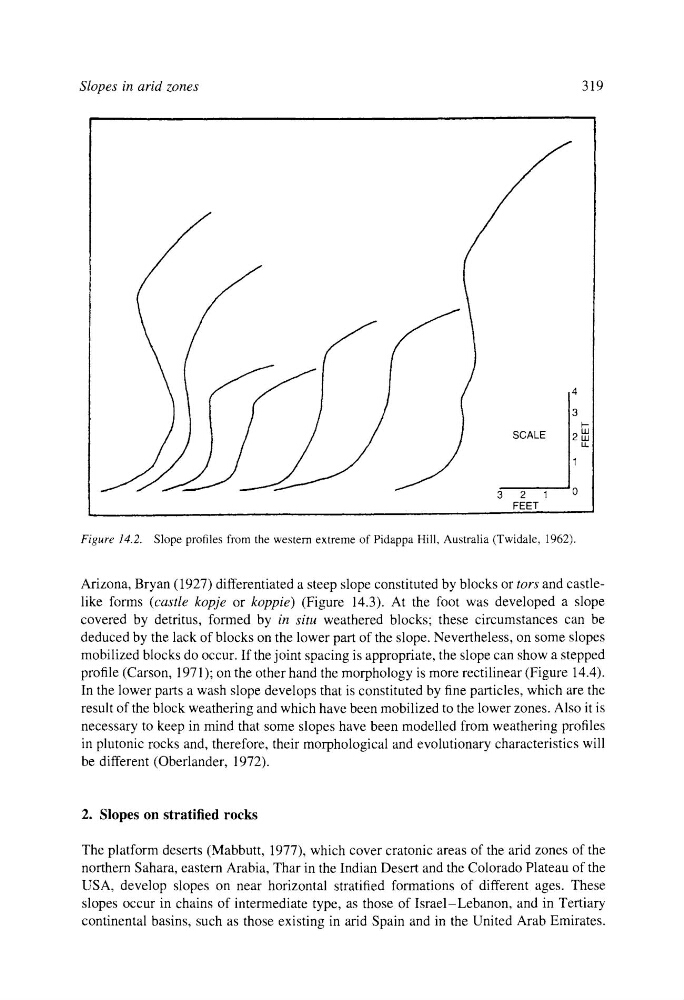
Figure 14.2. Slope profiles from the western extreme of Pidappa Hill, Australia (Twidale, 1962).
Arizona, Bryan (1927) differentiated a steep slope constituted by blocks or tors and castlelike forms (castle kopje or koppie) (Figure 14.3). At the foot was developed a slope
covered by detritus, formed by in situ weathered blocks; these circumstances can be
deduced by the lack of blocks on the lower part of the slope. Nevertheless, on some slopes
mobilized blocks do occur. If the joint spacing is appropriate, the slope can show a stepped
profile (Carson, 1971); on the other hand the morphology is more rectilinear (Figure 14.4).
In the lower parts a wash slope develops that is constituted by fine particles, which are the
result of the block weathering and which have been mobilized to the lower zones. Also it is
necessary to keep in mind that some slopes have been modelled from weathering profiles
in plutonic rocks and, therefore, their morphological and evolutionary characteristics will
be different (Oberlander, 1972).
2. Slopes on stratified rocks
The platform deserts (Mabbutt, 1977), which cover cratonic areas of the arid zones of the
northern Sahara, eastern Arabia, Thar in the Indian Desert and the Colorado Plateau of the
USA, develop slopes on near horizontal stratified formations of different ages. These
slopes occur in chains of intermediate type, as those of Israel-Lebanon, and in Tertiary
continental basins, such as those existing in arid Spain and in the United Arab Emirates.
319
FEET
Figure 14.2. Slope profiles from the western extreme of Pidappa Hill, Australia (Twidale, 1962).
Arizona, Bryan (1927) differentiated a steep slope constituted by blocks or tors and castlelike forms (castle kopje or koppie) (Figure 14.3). At the foot was developed a slope
covered by detritus, formed by in situ weathered blocks; these circumstances can be
deduced by the lack of blocks on the lower part of the slope. Nevertheless, on some slopes
mobilized blocks do occur. If the joint spacing is appropriate, the slope can show a stepped
profile (Carson, 1971); on the other hand the morphology is more rectilinear (Figure 14.4).
In the lower parts a wash slope develops that is constituted by fine particles, which are the
result of the block weathering and which have been mobilized to the lower zones. Also it is
necessary to keep in mind that some slopes have been modelled from weathering profiles
in plutonic rocks and, therefore, their morphological and evolutionary characteristics will
be different (Oberlander, 1972).
2. Slopes on stratified rocks
The platform deserts (Mabbutt, 1977), which cover cratonic areas of the arid zones of the
northern Sahara, eastern Arabia, Thar in the Indian Desert and the Colorado Plateau of the
USA, develop slopes on near horizontal stratified formations of different ages. These
slopes occur in chains of intermediate type, as those of Israel-Lebanon, and in Tertiary
continental basins, such as those existing in arid Spain and in the United Arab Emirates.