

318
Climatic Geomorphology
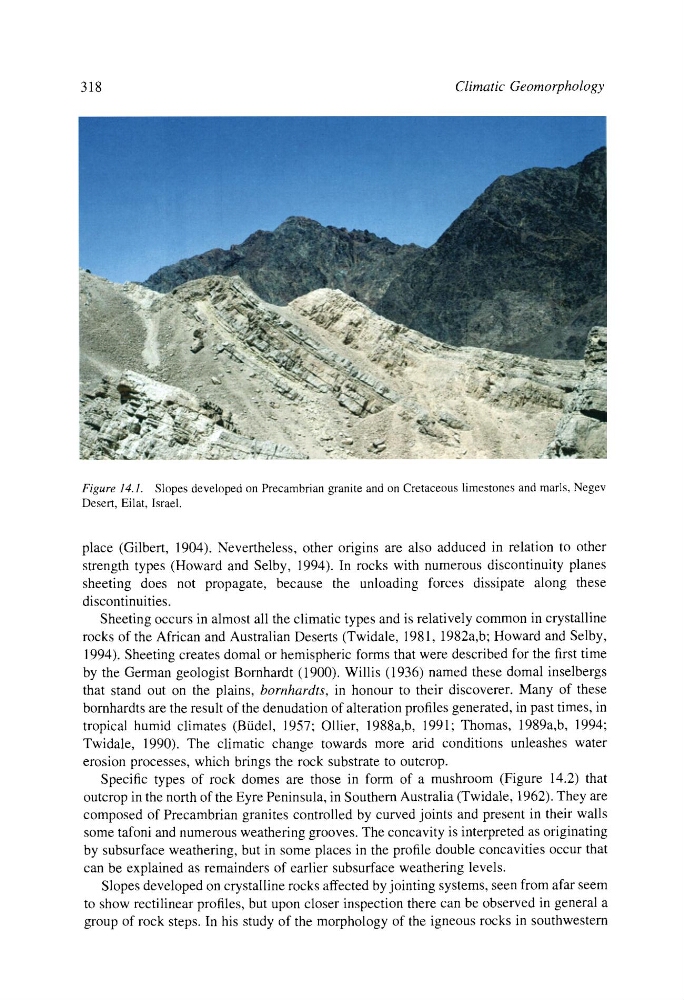
Figure 14.1. Slopes developed on Precambrian granite and on Cretaceous limestones and marls, Negev
Desert, Eilat, Israel.
place (Gilbert, 1904). Nevertheless, other origins are also adduced in relation to other
strength types (Howard and Selby, 1994). In rocks with numerous discontinuity planes
sheeting does not propagate, because the unloading forces dissipate along these
discontinuities.
Sheeting occurs in almost all the climatic types and is relatively common in crystalline
rocks of the African and Australian Deserts (Twidale, 1981, 1982a,b; Howard and Selby,
1994). Sheeting creates domal or hemispheric forms that were described for the first time
by the German geologist Bornhardt (1900). Willis (1936) named these domal inselbergs
that stand out on the plains, bornhardts, in honour to their discoverer. Many of these
bornhardts are the result of the denudation of alteration profiles generated, in past times, in
tropical humid climates (B~idel, 1957; Ollier, 1988a,b, 1991; Thomas, 1989a,b, 1994;
Twidale, 1990). The climatic change towards more arid conditions unleashes water
erosion processes, which brings the rock substrate to outcrop.
Specific types of rock domes are those in form of a mushroom (Figure 14.2) that
outcrop in the north of the Eyre Peninsula, in Southern Australia (Twidale, 1962). They are
composed of Precambrian granites controlled by curved joints and present in their walls
some tafoni and numerous weathering grooves. The concavity is interpreted as originating
by subsurface weathering, but in some places in the profile double concavities occur that
can be explained as remainders of earlier subsurface weathering levels.
Slopes developed on crystalline rocks affected by jointing systems, seen from afar seem
to show rectilinear profiles, but upon closer inspection there can be observed in general a
group of rock steps. In his study of the morphology of the igneous rocks in southwestern
Climatic Geomorphology
Figure 14.1. Slopes developed on Precambrian granite and on Cretaceous limestones and marls, Negev
Desert, Eilat, Israel.
place (Gilbert, 1904). Nevertheless, other origins are also adduced in relation to other
strength types (Howard and Selby, 1994). In rocks with numerous discontinuity planes
sheeting does not propagate, because the unloading forces dissipate along these
discontinuities.
Sheeting occurs in almost all the climatic types and is relatively common in crystalline
rocks of the African and Australian Deserts (Twidale, 1981, 1982a,b; Howard and Selby,
1994). Sheeting creates domal or hemispheric forms that were described for the first time
by the German geologist Bornhardt (1900). Willis (1936) named these domal inselbergs
that stand out on the plains, bornhardts, in honour to their discoverer. Many of these
bornhardts are the result of the denudation of alteration profiles generated, in past times, in
tropical humid climates (B~idel, 1957; Ollier, 1988a,b, 1991; Thomas, 1989a,b, 1994;
Twidale, 1990). The climatic change towards more arid conditions unleashes water
erosion processes, which brings the rock substrate to outcrop.
Specific types of rock domes are those in form of a mushroom (Figure 14.2) that
outcrop in the north of the Eyre Peninsula, in Southern Australia (Twidale, 1962). They are
composed of Precambrian granites controlled by curved joints and present in their walls
some tafoni and numerous weathering grooves. The concavity is interpreted as originating
by subsurface weathering, but in some places in the profile double concavities occur that
can be explained as remainders of earlier subsurface weathering levels.
Slopes developed on crystalline rocks affected by jointing systems, seen from afar seem
to show rectilinear profiles, but upon closer inspection there can be observed in general a
group of rock steps. In his study of the morphology of the igneous rocks in southwestern