

The action of water in arid regions
305
In this manner, the cracks enlarge and form pipes. These can occur in flat areas incised
by the fluvial network and on slopes. Where there is a large contrast in relief, large
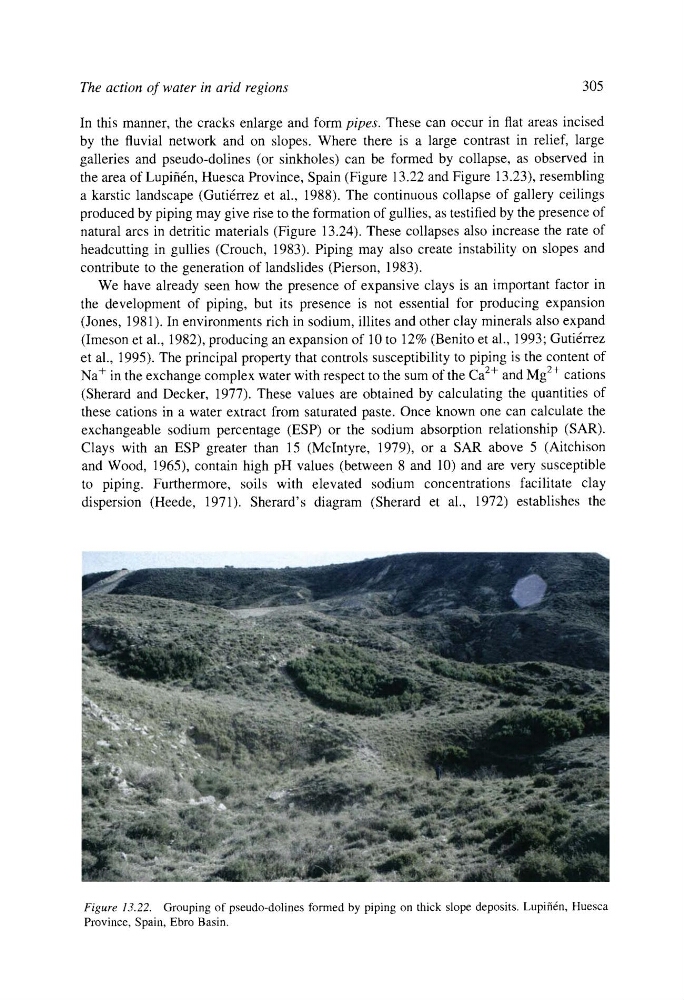
galleries and pseudo-dolines (or sinkholes) can be formed by collapse, as observed in
the area of Lupifi6n, Huesca Province, Spain (Figure 13.22 and Figure 13.23), resembling
a karstic landscape (Guti6rrez et al., 1988). The continuous collapse of gallery ceilings
produced by piping may give rise to the formation of gullies, as testified by the presence of
natural arcs in detritic materials (Figure 13.24). These collapses also increase the rate of
headcutting in gullies (Crouch, 1983). Piping may also create instability on slopes and
contribute to the generation of landslides (Pierson, 1983).
We have already seen how the presence of expansive clays is an important factor in
the development of piping, but its presence is not essential for producing expansion
(Jones, 1981). In environments rich in sodium, illites and other clay minerals also expand
(Imeson et al., 1982), producing an expansion of 10 to 12% (Benito et al., 1993; Guti6rrez
et al., 1995). The principal property that controls susceptibility to piping is the content of
Na + in the exchange complex water with respect to the sum of the Ca 2+ and Mg 2+ cations
(Sherard and Decker, 1977). These values are obtained by calculating the quantities of
these cations in a water extract from saturated paste. Once known one can calculate the
exchangeable sodium percentage (ESP) or the sodium absorption relationship (SAR).
Clays with an ESP greater than 15 (Mclntyre, 1979), or a SAR above 5 (Aitchison
and Wood, 1965), contain high pH values (between 8 and 10) and are very susceptible
to piping. Furthermore, soils with elevated sodium concentrations facilitate clay
dispersion (Heede, 1971). Sherard's diagram (Sherard et al., 1972) establishes the
Figure 13.22. Grouping of pseudo-dolines formed by piping on thick slope deposits. Lupifi6n, Huesca
Province, Spain, Ebro Basin.
305
In this manner, the cracks enlarge and form pipes. These can occur in flat areas incised
by the fluvial network and on slopes. Where there is a large contrast in relief, large
galleries and pseudo-dolines (or sinkholes) can be formed by collapse, as observed in
the area of Lupifi6n, Huesca Province, Spain (Figure 13.22 and Figure 13.23), resembling
a karstic landscape (Guti6rrez et al., 1988). The continuous collapse of gallery ceilings
produced by piping may give rise to the formation of gullies, as testified by the presence of
natural arcs in detritic materials (Figure 13.24). These collapses also increase the rate of
headcutting in gullies (Crouch, 1983). Piping may also create instability on slopes and
contribute to the generation of landslides (Pierson, 1983).
We have already seen how the presence of expansive clays is an important factor in
the development of piping, but its presence is not essential for producing expansion
(Jones, 1981). In environments rich in sodium, illites and other clay minerals also expand
(Imeson et al., 1982), producing an expansion of 10 to 12% (Benito et al., 1993; Guti6rrez
et al., 1995). The principal property that controls susceptibility to piping is the content of
Na + in the exchange complex water with respect to the sum of the Ca 2+ and Mg 2+ cations
(Sherard and Decker, 1977). These values are obtained by calculating the quantities of
these cations in a water extract from saturated paste. Once known one can calculate the
exchangeable sodium percentage (ESP) or the sodium absorption relationship (SAR).
Clays with an ESP greater than 15 (Mclntyre, 1979), or a SAR above 5 (Aitchison
and Wood, 1965), contain high pH values (between 8 and 10) and are very susceptible
to piping. Furthermore, soils with elevated sodium concentrations facilitate clay
dispersion (Heede, 1971). Sherard's diagram (Sherard et al., 1972) establishes the
Figure 13.22. Grouping of pseudo-dolines formed by piping on thick slope deposits. Lupifi6n, Huesca
Province, Spain, Ebro Basin.