

The action of water in arid regions
303
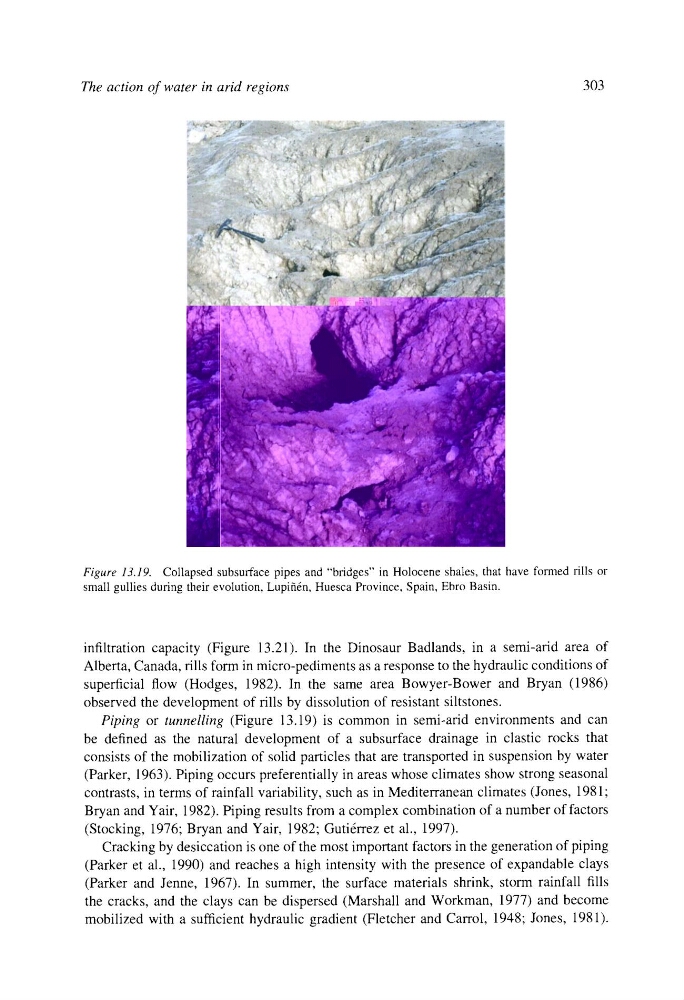
Figure 13.19. Collapsed subsurface pipes and "bridges" in Holocene shales, that have formed rills or
small gullies during their evolution, Lupifi6n, Huesca Province, Spain, Ebro Basin.
infiltration capacity (Figure 13.21). In the Dinosaur Badlands, in a semi-arid area of
Alberta, Canada, fills form in micro-pediments as a response to the hydraulic conditions of
superficial flow (Hodges, 1982). In the same area Bowyer-Bower and Bryan (1986)
observed the development of fills by dissolution of resistant siltstones.
Piping or tunnelling (Figure 13.19) is common in semi-arid environments and can
be defined as the natural development of a subsurface drainage in clastic rocks that
consists of the mobilization of solid particles that are transported in suspension by water
(Parker, 1963). Piping occurs preferentially in areas whose climates show strong seasonal
contrasts, in terms of rainfall variability, such as in Mediterranean climates (Jones, 1981;
Bryan and Yair, 1982). Piping results from a complex combination of a number of factors
(Stocking, 1976; Bryan and Yair, 1982; Guti6rrez et al., 1997).
Cracking by desiccation is one of the most important factors in the generation of piping
(Parker et al., 1990) and reaches a high intensity with the presence of expandable clays
(Parker and Jenne, 1967). In summer, the surface materials shrink, storm rainfall fills
the cracks, and the clays can be dispersed (Marshall and Workman, 1977) and become
mobilized with a sufficient hydraulic gradient (Fletcher and Carrol, 1948; Jones, 1981).
303
Figure 13.19. Collapsed subsurface pipes and "bridges" in Holocene shales, that have formed rills or
small gullies during their evolution, Lupifi6n, Huesca Province, Spain, Ebro Basin.
infiltration capacity (Figure 13.21). In the Dinosaur Badlands, in a semi-arid area of
Alberta, Canada, fills form in micro-pediments as a response to the hydraulic conditions of
superficial flow (Hodges, 1982). In the same area Bowyer-Bower and Bryan (1986)
observed the development of fills by dissolution of resistant siltstones.
Piping or tunnelling (Figure 13.19) is common in semi-arid environments and can
be defined as the natural development of a subsurface drainage in clastic rocks that
consists of the mobilization of solid particles that are transported in suspension by water
(Parker, 1963). Piping occurs preferentially in areas whose climates show strong seasonal
contrasts, in terms of rainfall variability, such as in Mediterranean climates (Jones, 1981;
Bryan and Yair, 1982). Piping results from a complex combination of a number of factors
(Stocking, 1976; Bryan and Yair, 1982; Guti6rrez et al., 1997).
Cracking by desiccation is one of the most important factors in the generation of piping
(Parker et al., 1990) and reaches a high intensity with the presence of expandable clays
(Parker and Jenne, 1967). In summer, the surface materials shrink, storm rainfall fills
the cracks, and the clays can be dispersed (Marshall and Workman, 1977) and become
mobilized with a sufficient hydraulic gradient (Fletcher and Carrol, 1948; Jones, 1981).