

302
Climatic Geomorphology
Dunne and Aubry (1986) believed that the dynamics of rill systems can be explained
by the balance between the intensity of filling and inter-rill processes or the processes of
sheetflow and rainsplash. When the latter do not occur, sheetflow becomes unstable, but
if it does and sets in motion the impacted particles of the inter-rill areas, the particles tend
to fill and eliminate the fills. This indicates various spatial and temporal variations that
reflect the changing effectiveness of these processes. At the experimental station of
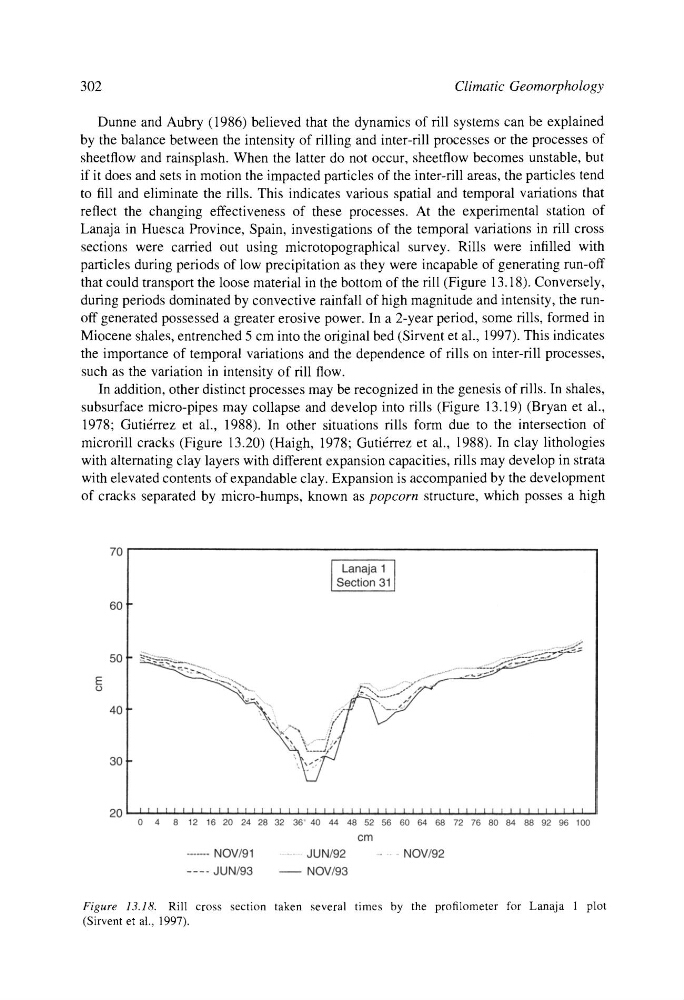
Lanaja in Huesca Province, Spain, investigations of the temporal variations in rill cross
sections were carried out using microtopographical survey. Rills were infilled with
particles during periods of low precipitation as they were incapable of generating run-off
that could transport the loose material in the bottom of the fill (Figure 13.18). Conversely,
during periods dominated by convective rainfall of high magnitude and intensity, the runoff generated possessed a greater erosive power. In a 2-year period, some fills, formed in
Miocene shales, entrenched 5 cm into the original bed (Sirvent et al., 1997). This indicates
the importance of temporal variations and the dependence of fills on inter-fill processes,
such as the variation in intensity of rill flow.
In addition, other distinct processes may be recognized in the genesis of rills. In shales,
subsurface micro-pipes may collapse and develop into fills (Figure 13.19) (Bryan et al.,
1978; Guti~rrez et al., 1988). In other situations rills form due to the intersection of
microrill cracks (Figure 13.20) (Haigh, 1978; Guti6rrez et al., 1988). In clay lithologies
with alternating clay layers with different expansion capacities, rills may develop in strata
with elevated contents of expandable clay. Expansion is accompanied by the development
of cracks separated by micro-humps, known as popcorn structure, which posses a high
Figure 13.18. Rill cross section taken several times by the profilometer for Lanaja 1 plot
(Sirvent et al., 1997).
Climatic Geomorphology
Dunne and Aubry (1986) believed that the dynamics of rill systems can be explained
by the balance between the intensity of filling and inter-rill processes or the processes of
sheetflow and rainsplash. When the latter do not occur, sheetflow becomes unstable, but
if it does and sets in motion the impacted particles of the inter-rill areas, the particles tend
to fill and eliminate the fills. This indicates various spatial and temporal variations that
reflect the changing effectiveness of these processes. At the experimental station of
Lanaja in Huesca Province, Spain, investigations of the temporal variations in rill cross
sections were carried out using microtopographical survey. Rills were infilled with
particles during periods of low precipitation as they were incapable of generating run-off
that could transport the loose material in the bottom of the fill (Figure 13.18). Conversely,
during periods dominated by convective rainfall of high magnitude and intensity, the runoff generated possessed a greater erosive power. In a 2-year period, some fills, formed in
Miocene shales, entrenched 5 cm into the original bed (Sirvent et al., 1997). This indicates
the importance of temporal variations and the dependence of fills on inter-fill processes,
such as the variation in intensity of rill flow.
In addition, other distinct processes may be recognized in the genesis of rills. In shales,
subsurface micro-pipes may collapse and develop into fills (Figure 13.19) (Bryan et al.,
1978; Guti~rrez et al., 1988). In other situations rills form due to the intersection of
microrill cracks (Figure 13.20) (Haigh, 1978; Guti6rrez et al., 1988). In clay lithologies
with alternating clay layers with different expansion capacities, rills may develop in strata
with elevated contents of expandable clay. Expansion is accompanied by the development
of cracks separated by micro-humps, known as popcorn structure, which posses a high
Figure 13.18. Rill cross section taken several times by the profilometer for Lanaja 1 plot
(Sirvent et al., 1997).