

The action of water in arid regions
297
o
o~
L
tl:i
co
O~
CI
1500 -
1000 -
!
i
I
F
I
I
!
500 -
0
4pro
I
September 9, 1964
Flume 6 (upstream)
vol = 74.8 acre-feet
___ Flume 1 (downstream)
vol = 32.5 acre-feet
k
I\
I
I t
I I
I
\ I
"\
~ "F-v------a__
"~ ....
4----~
8pm
12pm
Time (hours)
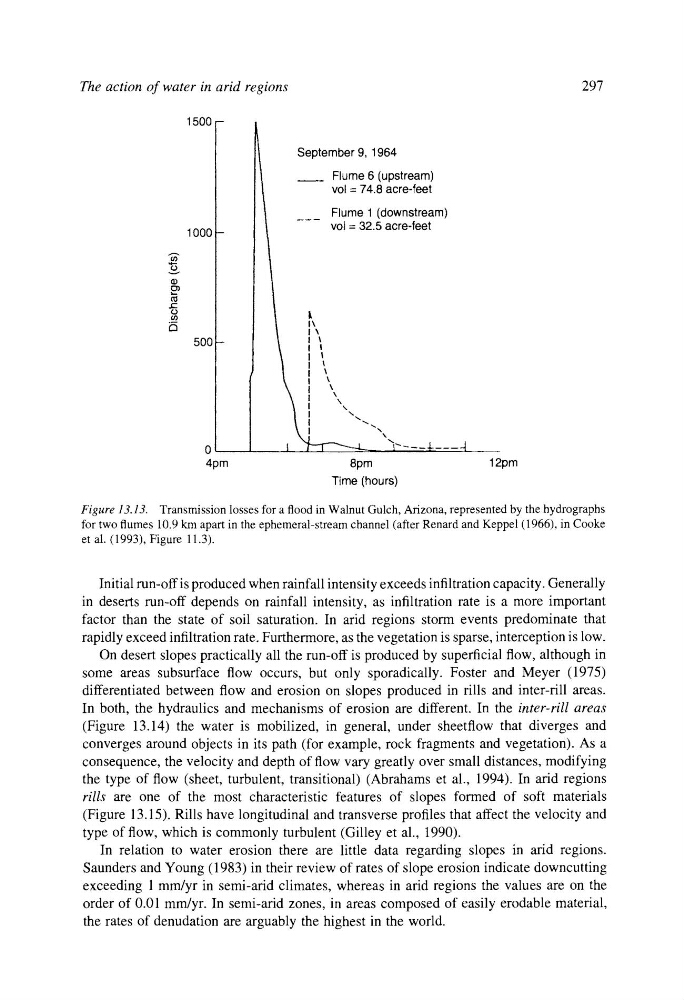
Figure 13.13. Transmission losses for a flood in Walnut Gulch, Arizona, represented by the hydrographs
for two flumes 10.9 km apart in the ephemeral-stream channel (after Renard and Keppel (1966), in Cooke
et al. (1993), Figure 11.3).
Initial run-off is produced when rainfall intensity exceeds infiltration capacity. Generally
in deserts run-off depends on rainfall intensity, as infiltration rate is a more important
factor than the state of soil saturation. In arid regions storm events predominate that
rapidly exceed infiltration rate. Furthermore, as the vegetation is sparse, interception is low.
On desert slopes practically all the run-off is produced by superficial flow, although in
some areas subsurface flow occurs, but only sporadically. Foster and Meyer (1975)
differentiated between flow and erosion on slopes produced in fills and inter-fill areas.
In both, the hydraulics and mechanisms of erosion are different. In the inter-rill areas
(Figure 13.14) the water is mobilized, in general, under sheetflow that diverges and
converges around objects in its path (for example, rock fragments and vegetation). As a
consequence, the velocity and depth of flow vary greatly over small distances, modifying
the type of flow (sheet, turbulent, transitional) (Abrahams et al., 1994). In arid regions
rills are one of the most characteristic features of slopes formed of soft materials
(Figure 13.15). Rills have longitudinal and transverse profiles that affect the velocity and
type of flow, which is commonly turbulent (Gilley et al., 1990).
In relation to water erosion there are little data regarding slopes in arid regions.
Saunders and Young (1983) in their review of rates of slope erosion indicate downcutting
exceeding 1 mm/yr in semi-arid climates, whereas in arid regions the values are on the
order of 0.01 mm/yr. In semi-arid zones, in areas composed of easily erodable material,
the rates of denudation are arguably the highest in the world.
297
o
o~
L
tl:i
co
O~
CI
1500 -
1000 -
!
i
I
F
I
I
!
500 -
0
4pro
I
September 9, 1964
Flume 6 (upstream)
vol = 74.8 acre-feet
___ Flume 1 (downstream)
vol = 32.5 acre-feet
k
I\
I
I t
I I
I
\ I
"\
~ "F-v------a__
"~ ....
4----~
8pm
12pm
Time (hours)
Figure 13.13. Transmission losses for a flood in Walnut Gulch, Arizona, represented by the hydrographs
for two flumes 10.9 km apart in the ephemeral-stream channel (after Renard and Keppel (1966), in Cooke
et al. (1993), Figure 11.3).
Initial run-off is produced when rainfall intensity exceeds infiltration capacity. Generally
in deserts run-off depends on rainfall intensity, as infiltration rate is a more important
factor than the state of soil saturation. In arid regions storm events predominate that
rapidly exceed infiltration rate. Furthermore, as the vegetation is sparse, interception is low.
On desert slopes practically all the run-off is produced by superficial flow, although in
some areas subsurface flow occurs, but only sporadically. Foster and Meyer (1975)
differentiated between flow and erosion on slopes produced in fills and inter-fill areas.
In both, the hydraulics and mechanisms of erosion are different. In the inter-rill areas
(Figure 13.14) the water is mobilized, in general, under sheetflow that diverges and
converges around objects in its path (for example, rock fragments and vegetation). As a
consequence, the velocity and depth of flow vary greatly over small distances, modifying
the type of flow (sheet, turbulent, transitional) (Abrahams et al., 1994). In arid regions
rills are one of the most characteristic features of slopes formed of soft materials
(Figure 13.15). Rills have longitudinal and transverse profiles that affect the velocity and
type of flow, which is commonly turbulent (Gilley et al., 1990).
In relation to water erosion there are little data regarding slopes in arid regions.
Saunders and Young (1983) in their review of rates of slope erosion indicate downcutting
exceeding 1 mm/yr in semi-arid climates, whereas in arid regions the values are on the
order of 0.01 mm/yr. In semi-arid zones, in areas composed of easily erodable material,
the rates of denudation are arguably the highest in the world.