

294
Climatic Geomorphology
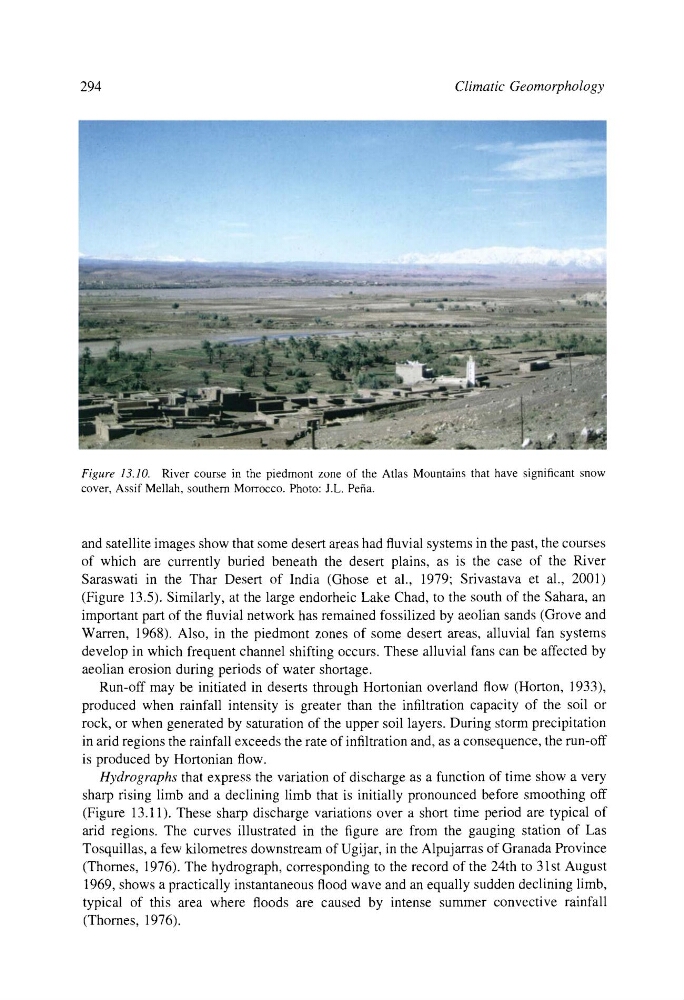
Figure 13.10. River course in the piedmont zone of the Atlas Mountains that have significant snow
cover, Assif Mellah, southern Morrocco. Photo: J.L. Pefia.
and satellite images show that some desert areas had fluvial systems in the past, the courses
of which are currently buried beneath the desert plains, as is the case of the River
Saraswati in the Thar Desert of India (Ghose et al., 1979; Srivastava et al., 2001)
(Figure 13.5). Similarly, at the large endorheic Lake Chad, to the south of the Sahara, an
important part of the fluvial network has remained fossilized by aeolian sands (Grove and
Warren, 1968). Also, in the piedmont zones of some desert areas, alluvial fan systems
develop in which frequent channel shifting occurs. These alluvial fans can be affected by
aeolian erosion during periods of water shortage.
Run-off may be initiated in deserts through Hortonian overland flow (Horton, 1933),
produced when rainfall intensity is greater than the infiltration capacity of the soil or
rock, or when generated by saturation of the upper soil layers. During storm precipitation
in arid regions the rainfall exceeds the rate of infiltration and, as a consequence, the run-off
is produced by Hortonian flow.
Hydrographs that express the variation of discharge as a function of time show a very
sharp rising limb and a declining limb that is initially pronounced before smoothing off
(Figure 13.11). These sharp discharge variations over a short time period are typical of
arid regions. The curves illustrated in the figure are from the gauging station of Las
Tosquillas, a few kilometres downstream of Ugijar, in the Alpujarras of Granada Province
(Thornes, 1976). The hydrograph, corresponding to the record of the 24th to 31st August
1969, shows a practically instantaneous flood wave and an equally sudden declining limb,
typical of this area where floods are caused by intense summer convective rainfall
(Thornes, 1976).
Climatic Geomorphology
Figure 13.10. River course in the piedmont zone of the Atlas Mountains that have significant snow
cover, Assif Mellah, southern Morrocco. Photo: J.L. Pefia.
and satellite images show that some desert areas had fluvial systems in the past, the courses
of which are currently buried beneath the desert plains, as is the case of the River
Saraswati in the Thar Desert of India (Ghose et al., 1979; Srivastava et al., 2001)
(Figure 13.5). Similarly, at the large endorheic Lake Chad, to the south of the Sahara, an
important part of the fluvial network has remained fossilized by aeolian sands (Grove and
Warren, 1968). Also, in the piedmont zones of some desert areas, alluvial fan systems
develop in which frequent channel shifting occurs. These alluvial fans can be affected by
aeolian erosion during periods of water shortage.
Run-off may be initiated in deserts through Hortonian overland flow (Horton, 1933),
produced when rainfall intensity is greater than the infiltration capacity of the soil or
rock, or when generated by saturation of the upper soil layers. During storm precipitation
in arid regions the rainfall exceeds the rate of infiltration and, as a consequence, the run-off
is produced by Hortonian flow.
Hydrographs that express the variation of discharge as a function of time show a very
sharp rising limb and a declining limb that is initially pronounced before smoothing off
(Figure 13.11). These sharp discharge variations over a short time period are typical of
arid regions. The curves illustrated in the figure are from the gauging station of Las
Tosquillas, a few kilometres downstream of Ugijar, in the Alpujarras of Granada Province
(Thornes, 1976). The hydrograph, corresponding to the record of the 24th to 31st August
1969, shows a practically instantaneous flood wave and an equally sudden declining limb,
typical of this area where floods are caused by intense summer convective rainfall
(Thornes, 1976).