

Desert surfaces: pavements, patterned ground, varnishes and crusts
281
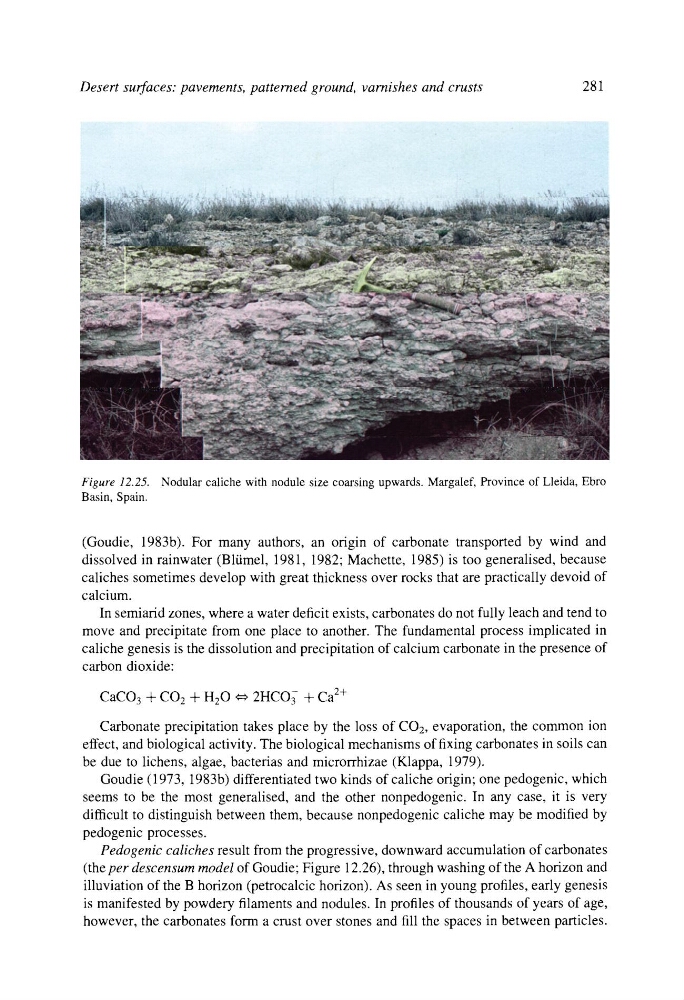
Figure 12.25. Nodular caliche with nodule size coarsing upwards. Margalef, Province of Lleida, Ebro
Basin, Spain.
(Goudie, 1983b). For many authors, an origin of carbonate transported by wind and
dissolved in rainwater (Bltimel, 1981, 1982; Machette, 1985) is too generalised, because
caliches sometimes develop with great thickness over rocks that are practically devoid of
calcium.
In semiarid zones, where a water deficit exists, carbonates do not fully leach and tend to
move and precipitate from one place to another. The fundamental process implicated in
caliche genesis is the dissolution and precipitation of calcium carbonate in the presence of
carbon dioxide:
CaCO3 + CO 2 + H20 r 2HCO3 + Ca 2+
Carbonate precipitation takes place by the loss of CO2, evaporation, the common ion
effect, and biological activity. The biological mechanisms of fixing carbonates in soils can
be due to lichens, algae, bacterias and microrrhizae (Klappa, 1979).
Goudie (1973, 1983b) differentiated two kinds of caliche origin; one pedogenic, which
seems to be the most generalised, and the other nonpedogenic. In any case, it is very
difficult to distinguish between them, because nonpedogenic caliche may be modified by
pedogenic processes.
Pedogenic caliches result from the progressive, downward accumulation of carbonates
(the per descensum model of Goudie; Figure 12.26), through washing of the A horizon and
illuviation of the B horizon (petrocalcic horizon). As seen in young profiles, early genesis
is manifested by powdery filaments and nodules. In profiles of thousands of years of age,
however, the carbonates form a crust over stones and fill the spaces in between particles.
281
Figure 12.25. Nodular caliche with nodule size coarsing upwards. Margalef, Province of Lleida, Ebro
Basin, Spain.
(Goudie, 1983b). For many authors, an origin of carbonate transported by wind and
dissolved in rainwater (Bltimel, 1981, 1982; Machette, 1985) is too generalised, because
caliches sometimes develop with great thickness over rocks that are practically devoid of
calcium.
In semiarid zones, where a water deficit exists, carbonates do not fully leach and tend to
move and precipitate from one place to another. The fundamental process implicated in
caliche genesis is the dissolution and precipitation of calcium carbonate in the presence of
carbon dioxide:
CaCO3 + CO 2 + H20 r 2HCO3 + Ca 2+
Carbonate precipitation takes place by the loss of CO2, evaporation, the common ion
effect, and biological activity. The biological mechanisms of fixing carbonates in soils can
be due to lichens, algae, bacterias and microrrhizae (Klappa, 1979).
Goudie (1973, 1983b) differentiated two kinds of caliche origin; one pedogenic, which
seems to be the most generalised, and the other nonpedogenic. In any case, it is very
difficult to distinguish between them, because nonpedogenic caliche may be modified by
pedogenic processes.
Pedogenic caliches result from the progressive, downward accumulation of carbonates
(the per descensum model of Goudie; Figure 12.26), through washing of the A horizon and
illuviation of the B horizon (petrocalcic horizon). As seen in young profiles, early genesis
is manifested by powdery filaments and nodules. In profiles of thousands of years of age,
however, the carbonates form a crust over stones and fill the spaces in between particles.