

Desert surfaces: pavements, patterned ground, varnishes and crusts
277
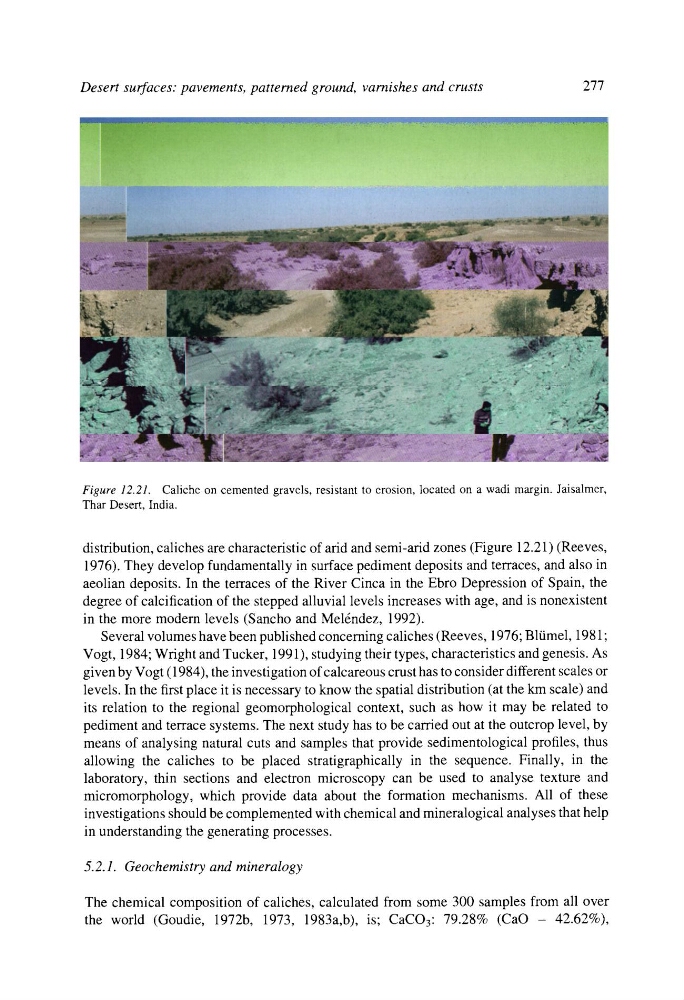
Figure 12.21. Caliche on cemented gravels, resistant to erosion, located on a wadi margin. Jaisalmer,
Thar Desert, India.
distribution, caliches are characteristic of arid and semi-arid zones (Figure 12.21) (Reeves,
1976). They develop fundamentally in surface pediment deposits and terraces, and also in
aeolian deposits. In the terraces of the River Cinca in the Ebro Depression of Spain, the
degree of calcification of the stepped alluvial levels increases with age, and is nonexistent
in the more modern levels (Sancho and Melrndez, 1992).
Several volumes have been published concerning caliches (Reeves, 1976; Bltimel, 1981;
Vogt, 1984; Wright and Tucker, 1991), studying their types, characteristics and genesis. As
given by Vogt (1984), the investigation of calcareous crust has to consider different scales or
levels. In the first place it is necessary to know the spatial distribution (at the km scale) and
its relation to the regional geomorphological context, such as how it may be related to
pediment and terrace systems. The next study has to be carried out at the outcrop level, by
means of analysing natural cuts and samples that provide sedimentological profiles, thus
allowing the caliches to be placed stratigraphically in the sequence. Finally, in the
laboratory, thin sections and electron microscopy can be used to analyse texture and
micromorphology, which provide data about the formation mechanisms. All of these
investigations should be complemented with chemical and mineralogical analyses that help
in understanding the generating processes.
5.2.1. Geochemistry and mineralogy
The chemical composition of caliches, calculated from some 300 samples from all over
the world (Goudie, 1972b, 1973, 1983a,b), is; CaCO3: 79.28% (CaO - 42.62%),
277
Figure 12.21. Caliche on cemented gravels, resistant to erosion, located on a wadi margin. Jaisalmer,
Thar Desert, India.
distribution, caliches are characteristic of arid and semi-arid zones (Figure 12.21) (Reeves,
1976). They develop fundamentally in surface pediment deposits and terraces, and also in
aeolian deposits. In the terraces of the River Cinca in the Ebro Depression of Spain, the
degree of calcification of the stepped alluvial levels increases with age, and is nonexistent
in the more modern levels (Sancho and Melrndez, 1992).
Several volumes have been published concerning caliches (Reeves, 1976; Bltimel, 1981;
Vogt, 1984; Wright and Tucker, 1991), studying their types, characteristics and genesis. As
given by Vogt (1984), the investigation of calcareous crust has to consider different scales or
levels. In the first place it is necessary to know the spatial distribution (at the km scale) and
its relation to the regional geomorphological context, such as how it may be related to
pediment and terrace systems. The next study has to be carried out at the outcrop level, by
means of analysing natural cuts and samples that provide sedimentological profiles, thus
allowing the caliches to be placed stratigraphically in the sequence. Finally, in the
laboratory, thin sections and electron microscopy can be used to analyse texture and
micromorphology, which provide data about the formation mechanisms. All of these
investigations should be complemented with chemical and mineralogical analyses that help
in understanding the generating processes.
5.2.1. Geochemistry and mineralogy
The chemical composition of caliches, calculated from some 300 samples from all over
the world (Goudie, 1972b, 1973, 1983a,b), is; CaCO3: 79.28% (CaO - 42.62%),