

276
Climatic Geomorphology
2
it
1.080 + 60 ka
A
1
ill
0.5I i I 11111
I I I111
II1 i1|111
I11
i 11 i 1| 1| i i 11 illlll |il
i11 iii
111 Iii
1| i i11 i II illllllll I11 ll[I.
llt lid
!111
-Ill
Ill
Ill[lllllllll|lll| I11 | I III
I Ill
0
20 40
60 80 100 120 140 160 180 200 220 240 260
Depth (micrometers)
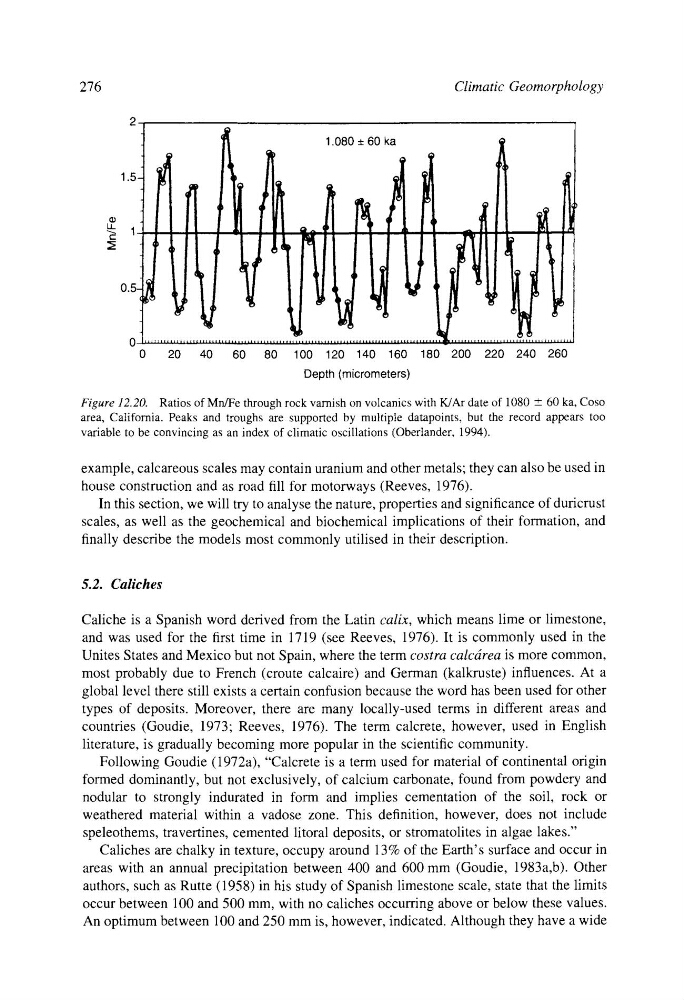
Figure 12.20. Ratios of Mn/Fe through rock varnish on volcanics with K/Ar date of 1080 ___ 60 ka, Coso
area, California. Peaks and troughs are supported by multiple datapoints, but the record appears too
variable to be convincing as an index of climatic oscillations (Oberlander, 1994).
example, calcareous scales may contain uranium and other metals; they can also be used in
house construction and as road fill for motorways (Reeves, 1976).
In this section, we will try to analyse the nature, properties and significance of duricrust
scales, as well as the geochemical and biochemical implications of their formation, and
finally describe the models most commonly utilised in their description.
5.2. Cafiches
Caliche is a Spanish word derived from the Latin calix, which means lime or limestone,
and was used for the first time in 1719 (see Reeves, 1976). It is commonly used in the
Unites States and Mexico but not Spain, where the term costra calcdrea is more common,
most probably due to French (croute calcaire) and German (kalkruste) influences. At a
global level there still exists a certain confusion because the word has been used for other
types of deposits. Moreover, there are many locally-used terms in different areas and
countries (Goudie, 1973; Reeves, 1976). The term calcrete, however, used in English
literature, is gradually becoming more popular in the scientific community.
Following Goudie (1972a), "Calcrete is a term used for material of continental origin
formed dominantly, but not exclusively, of calcium carbonate, found from powdery and
nodular to strongly indurated in form and implies cementation of the soil, rock or
weathered material within a vadose zone. This definition, however, does not include
speleothems, travertines, cemented litoral deposits, or stromatolites in algae lakes."
Caliches are chalky in texture, occupy around 13% of the Earth's surface and occur in
areas with an annual precipitation between 400 and 600 mm (Goudie, 1983a,b). Other
authors, such as Rutte (1958) in his study of Spanish limestone scale, state that the limits
occur between 100 and 500 mm, with no caliches occurring above or below these values.
An optimum between 100 and 250 mm is, however, indicated. Although they have a wide
Climatic Geomorphology
2
it
1.080 + 60 ka
A
1
ill
0.5I i I 11111
I I I111
II1 i1|111
I11
i 11 i 1| 1| i i 11 illlll |il
i11 iii
111 Iii
1| i i11 i II illllllll I11 ll[I.
llt lid
!111
-Ill
Ill
Ill[lllllllll|lll| I11 | I III
I Ill
0
20 40
60 80 100 120 140 160 180 200 220 240 260
Depth (micrometers)
Figure 12.20. Ratios of Mn/Fe through rock varnish on volcanics with K/Ar date of 1080 ___ 60 ka, Coso
area, California. Peaks and troughs are supported by multiple datapoints, but the record appears too
variable to be convincing as an index of climatic oscillations (Oberlander, 1994).
example, calcareous scales may contain uranium and other metals; they can also be used in
house construction and as road fill for motorways (Reeves, 1976).
In this section, we will try to analyse the nature, properties and significance of duricrust
scales, as well as the geochemical and biochemical implications of their formation, and
finally describe the models most commonly utilised in their description.
5.2. Cafiches
Caliche is a Spanish word derived from the Latin calix, which means lime or limestone,
and was used for the first time in 1719 (see Reeves, 1976). It is commonly used in the
Unites States and Mexico but not Spain, where the term costra calcdrea is more common,
most probably due to French (croute calcaire) and German (kalkruste) influences. At a
global level there still exists a certain confusion because the word has been used for other
types of deposits. Moreover, there are many locally-used terms in different areas and
countries (Goudie, 1973; Reeves, 1976). The term calcrete, however, used in English
literature, is gradually becoming more popular in the scientific community.
Following Goudie (1972a), "Calcrete is a term used for material of continental origin
formed dominantly, but not exclusively, of calcium carbonate, found from powdery and
nodular to strongly indurated in form and implies cementation of the soil, rock or
weathered material within a vadose zone. This definition, however, does not include
speleothems, travertines, cemented litoral deposits, or stromatolites in algae lakes."
Caliches are chalky in texture, occupy around 13% of the Earth's surface and occur in
areas with an annual precipitation between 400 and 600 mm (Goudie, 1983a,b). Other
authors, such as Rutte (1958) in his study of Spanish limestone scale, state that the limits
occur between 100 and 500 mm, with no caliches occurring above or below these values.
An optimum between 100 and 250 mm is, however, indicated. Although they have a wide