

268
Climatic Geomorphology
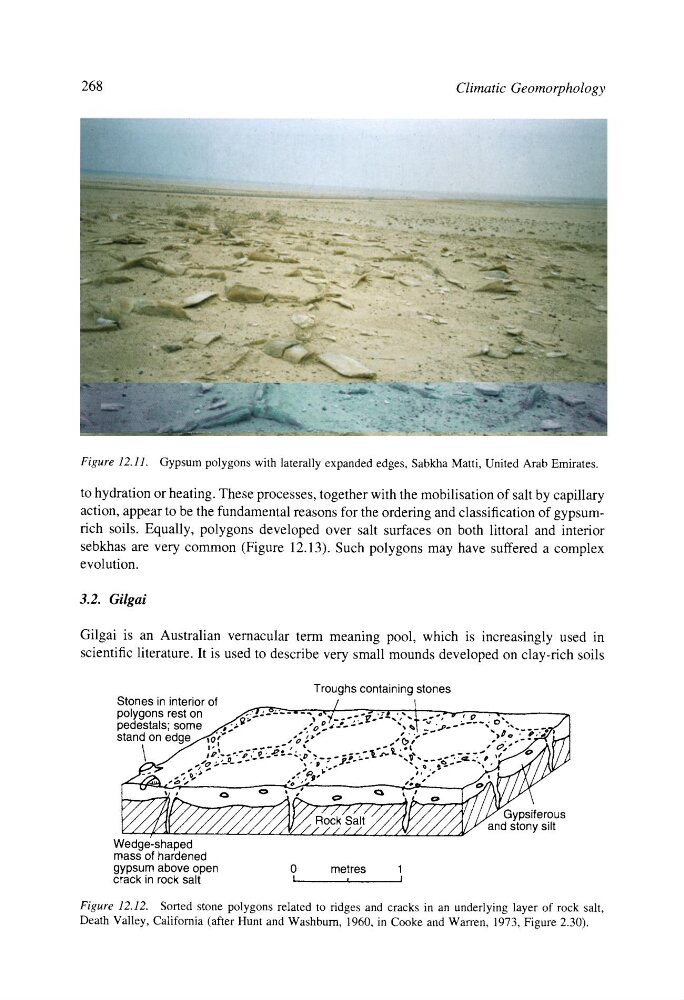
Figure 12.11. Gypsum polygons with laterally expanded edges, Sabkha Matti, United Arab Emirates.
to hydration or heating. These processes, together with the mobilisation of salt by capillary
action, appear to be the fundamental reasons for the ordering and classification of gypsumrich soils. Equally, polygons developed over salt surfaces on both littoral and interior
sebkhas are very common (Figure 12.13). Such polygons may have suffered a complex
evolution.
3.2. Gilgai
Gilgai is an Australian vernacular term meaning pool, which is increasingly used in
scientific literature. It is used to describe very small mounds developed on clay-rich soils
Troughs containing stones
Stones in interior of
polygons rest on
pedestals; some
9
s s
~
~
j~/Roc~ ~~~~a n dGsYtPs!erol t
u
Gypsiferous
Rock Salt
Wedge-shaped
mass of hardened
gypsum above open
0
metres
1
crack in rock salt
9
.
t
Figure 12.12. Sorted stone polygons related to ridges and cracks in an underlying layer of rock salt,
Death Valley, California (after Hunt and Washburn, 1960, in Cooke and Warren, 1973, Figure 2.30).
Climatic Geomorphology
Figure 12.11. Gypsum polygons with laterally expanded edges, Sabkha Matti, United Arab Emirates.
to hydration or heating. These processes, together with the mobilisation of salt by capillary
action, appear to be the fundamental reasons for the ordering and classification of gypsumrich soils. Equally, polygons developed over salt surfaces on both littoral and interior
sebkhas are very common (Figure 12.13). Such polygons may have suffered a complex
evolution.
3.2. Gilgai
Gilgai is an Australian vernacular term meaning pool, which is increasingly used in
scientific literature. It is used to describe very small mounds developed on clay-rich soils
Troughs containing stones
Stones in interior of
polygons rest on
pedestals; some
9
s s
~
~
j~/Roc~ ~~~~a n dGsYtPs!erol t
u
Gypsiferous
Rock Salt
Wedge-shaped
mass of hardened
gypsum above open
0
metres
1
crack in rock salt
9
.
t
Figure 12.12. Sorted stone polygons related to ridges and cracks in an underlying layer of rock salt,
Death Valley, California (after Hunt and Washburn, 1960, in Cooke and Warren, 1973, Figure 2.30).