

218
Climatic Geomorphology
South
North
,
_
,
.
.
.
.
.
.
.
.
.
_
9
Permafrost table
after shed was
Permafrost table
built
/
before shed was
.,, ~ 7",,,'~,.J/,
built
(a)
,
South
North
.
.
.
.
,
.
.
.
.
.
.
.
.
.
.
Permafrost table
Permafrost table
before house was
after house was
(b) built
built
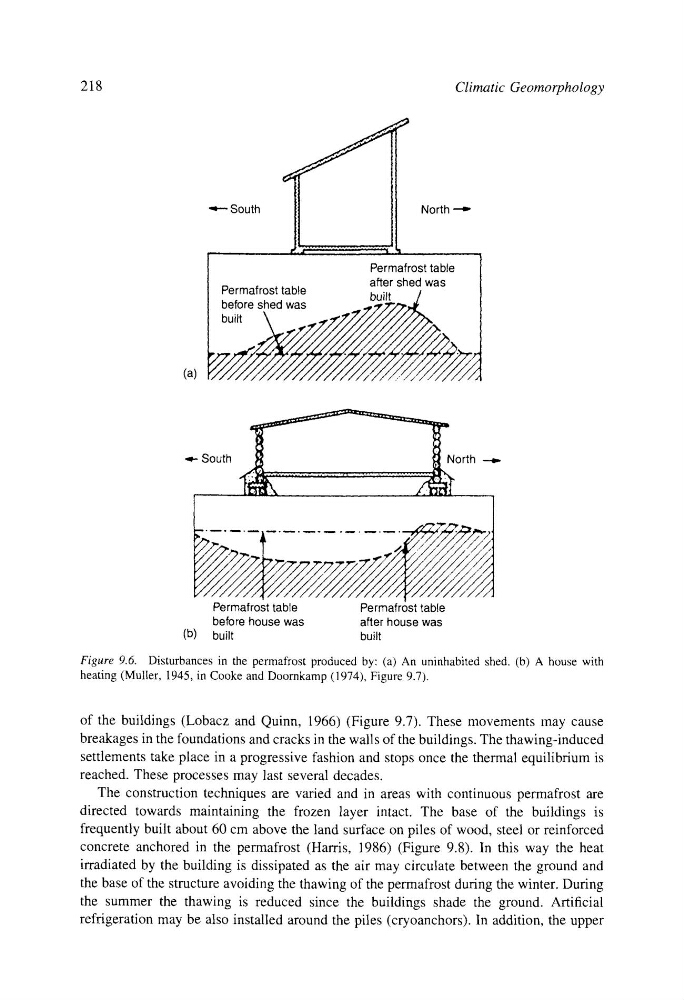
Figure 9.6. Disturbances in the permafrost produced by: (a) An uninhabited shed. (b) A house with
heating (Muller, 1945, in Cooke and Doornkamp (1974), Figure 9.7).
of the buildings (Lobacz and Quinn, 1966) (Figure 9.7). These movements may cause
breakages in the foundations and cracks in the walls of the buildings. The thawing-induced
settlements take place in a progressive fashion and stops once the thermal equilibrium is
reached. These processes may last several decades.
The construction techniques are varied and in areas with continuous permafrost are
directed towards maintaining the frozen layer intact. The base of the buildings is
frequently built about 60 cm above the land surface on piles of wood, steel or reinforced
concrete anchored in the permafrost (Harris, 1986) (Figure 9.8). In this way the heat
irradiated by the building is dissipated as the air may circulate between the ground and
the base of the structure avoiding the thawing of the permafrost during the winter. During
the summer the thawing is reduced since the buildings shade the ground. Artificial
refrigeration may be also installed around the piles (cryoanchors). In addition, the upper
Climatic Geomorphology
South
North
,
_
,
.
.
.
.
.
.
.
.
.
_
9
Permafrost table
after shed was
Permafrost table
built
/
before shed was
.,, ~ 7",,,'~,.J/,
built
(a)
,
South
North
.
.
.
.
,
.
.
.
.
.
.
.
.
.
.
Permafrost table
Permafrost table
before house was
after house was
(b) built
built
Figure 9.6. Disturbances in the permafrost produced by: (a) An uninhabited shed. (b) A house with
heating (Muller, 1945, in Cooke and Doornkamp (1974), Figure 9.7).
of the buildings (Lobacz and Quinn, 1966) (Figure 9.7). These movements may cause
breakages in the foundations and cracks in the walls of the buildings. The thawing-induced
settlements take place in a progressive fashion and stops once the thermal equilibrium is
reached. These processes may last several decades.
The construction techniques are varied and in areas with continuous permafrost are
directed towards maintaining the frozen layer intact. The base of the buildings is
frequently built about 60 cm above the land surface on piles of wood, steel or reinforced
concrete anchored in the permafrost (Harris, 1986) (Figure 9.8). In this way the heat
irradiated by the building is dissipated as the air may circulate between the ground and
the base of the structure avoiding the thawing of the permafrost during the winter. During
the summer the thawing is reduced since the buildings shade the ground. Artificial
refrigeration may be also installed around the piles (cryoanchors). In addition, the upper