

Some aspects on applied geomorphology
in periglacial regions
217
(Swinzow, 1969). The deformation of the building structures takes place during these
periods as the underlying and adjacent ground changes its strength due to natural and
human-induced temperature variations. During the freezing period the buildings may rise
and break. The thawing of the ground ice involves a reduction of the volume and strength
of the ground leading to the settlement of the structures. Flowage of sediments may take
place in low permeability clay- and silt-sized soils that retain a great part of the melting
waters. Besides, as the water cannot percolate downwards through the permafrost, the finegrained sediments of the active layer may become highly plastic causing differential
settlements in the buildings. Conversely, the coarse-grained sediments are fairly stable
since they easily drain the interstitial water. In case there is progressive warming through
the years in addition to the seasonal thawing, the deformation increase gradually together
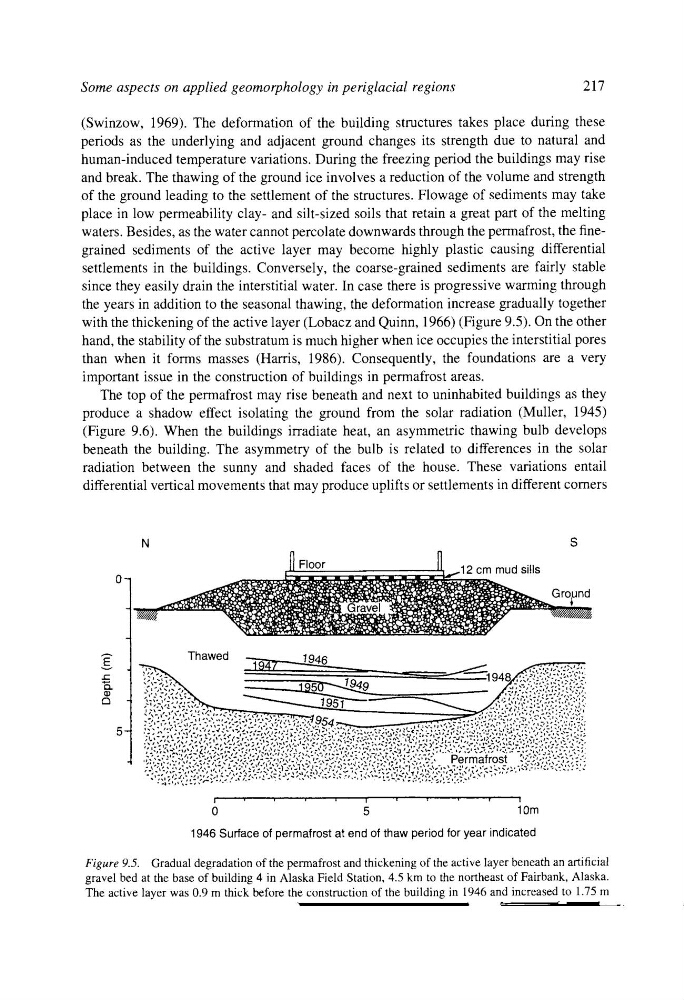
with the thickening of the active layer (Lobacz and Quinn, 1966) (Figure 9.5). On the other
hand, the stability of the substratum is much higher when ice occupies the interstitial pores
than when it forms masses (Harris, 1986). Consequently, the foundations are a very
important issue in the construction of buildings in permafrost areas.
The top of the permafrost may rise beneath and next to uninhabited buildings as they
produce a shadow effect isolating the ground from the solar radiation (Muller, 1945)
(Figure 9.6). When the buildings irradiate heat, an asymmetric thawing bulb develops
beneath the building. The asymmetry of the bulb is related to differences in the solar
radiation between the sunny and shaded faces of the house. These variations entail
differential vertical movements that may produce uplifts or settlements in different comers
E
v
c.o-,,
Q.
N
S
~ Floor
,
~...12. cm mud sills
Gro~und
Thawed
.
~-~-m.-~,~~1946
,~
~
o ,,,o,
"; '~
'
1"
1948~~--~'.-..
~-,-.~ ~-.,. ,.. ,. ,r
,-,.,-~,
." ;-s,, ;~ ,,',,.. '.,-'.',72.-'..'.','.'.".a",,.,
.,z,c,,..,,, -~ ~'..',z;I-,'-, ..... ",,',,..'..,': .... -'z,',,;
9
.q
~
i,~/lll,
i -l~,o#
` *'.,.;I o lifo
s~O,kl.os
~i'l~.%l I1~,01% ~
olo ~'| I ~
I.,o|~*ol~'lo.S%
o 1~%0--%11"~
':'
,,'~
~" "o ' ,, -, -" .." ".~- / ~''-','~
,,;,"~"',~0'.,,.:
-~'.-,
~",')-';
"','.'',-'-,'--.,,-'
....
~' ........
,, " " ~' '~.'-', :,-" ",:' .'-;r
.... ;.'r,-',T'=,-,,'.,.,':;,'-',~'~.'J','.-';, ..... ". .... ".-:," ''.." -,' .' ..' ,.,"-,-' -"...' ..~7' .:' :"' '~-"':":";",':";~-' -"; ";, '"" "',- '" .... ",'-'~ ""';.'",',""" "'-', Permafrost -"-'; .... "-';- ':.-,
"-',."- ~S,.', -'- ,".-'-'.,~ ~.,0,~(~:.,'-',-"~ ''-', -',,-,,,,-,,..r,'-,:
,, , ,.',,-,,,..,- .
......
',,,~ ';,'- ,A',,,
-,,.
:.,,,-,.'.,,,,-,,',.,,:.-,',';'. ,,-,,-~.,..,.,.,",
~.,..;"'~,
-.,,,
.,..,.,,-,.
~ .~- .,,.,.,,..,,-,,
,~ ,'.,.,.,..,,,
,.,~ .,.,., ,, .....
,.
;:. :!,:,,:~',...,:-:" ,,: ~. ..- '.,' :, ,~ ;,':, - "..,- .~ -': "".,-.='-'-',~; ;,~ .-, .'. '.,',,::'-'. '-.--?:',.,,'..i, ~; ;.-[:,.":.,."',,'- .','," .....
..
9
v
!
;
. . . .
;
'
'
10m
1946 Surface of permafrost at end of thaw period for year indicated
Figure 9.5. Gradual degradation of the permafrost and thickening of the active layer beneath an artificial
gravel bed at the base of building 4 in Alaska Field Station, 4.5 km to the northeast of Fairbank, Alaska.
The active layer was 0.9 m thick before the construction of the building in 1946 and increased to 1.75 m
later than the removal of the tree and shrub cover. The lines indicate the position of the permafrost at the
end of the thawing period on different dates (Lobacz and Quinn, 1966, in Harris (1986), Figure 4.1).
in periglacial regions
217
(Swinzow, 1969). The deformation of the building structures takes place during these
periods as the underlying and adjacent ground changes its strength due to natural and
human-induced temperature variations. During the freezing period the buildings may rise
and break. The thawing of the ground ice involves a reduction of the volume and strength
of the ground leading to the settlement of the structures. Flowage of sediments may take
place in low permeability clay- and silt-sized soils that retain a great part of the melting
waters. Besides, as the water cannot percolate downwards through the permafrost, the finegrained sediments of the active layer may become highly plastic causing differential
settlements in the buildings. Conversely, the coarse-grained sediments are fairly stable
since they easily drain the interstitial water. In case there is progressive warming through
the years in addition to the seasonal thawing, the deformation increase gradually together
with the thickening of the active layer (Lobacz and Quinn, 1966) (Figure 9.5). On the other
hand, the stability of the substratum is much higher when ice occupies the interstitial pores
than when it forms masses (Harris, 1986). Consequently, the foundations are a very
important issue in the construction of buildings in permafrost areas.
The top of the permafrost may rise beneath and next to uninhabited buildings as they
produce a shadow effect isolating the ground from the solar radiation (Muller, 1945)
(Figure 9.6). When the buildings irradiate heat, an asymmetric thawing bulb develops
beneath the building. The asymmetry of the bulb is related to differences in the solar
radiation between the sunny and shaded faces of the house. These variations entail
differential vertical movements that may produce uplifts or settlements in different comers
E
v
c.o-,,
Q.
N
S
~ Floor
,
~...12. cm mud sills
Gro~und
Thawed
.
~-~-m.-~,~~1946
,~
~
o ,,,o,
"; '~
'
1"
1948~~--~'.-..
~-,-.~ ~-.,. ,.. ,. ,r
,-,.,-~,
." ;-s,, ;~ ,,',,.. '.,-'.',72.-'..'.','.'.".a",,.,
.,z,c,,..,,, -~ ~'..',z;I-,'-, ..... ",,',,..'..,': .... -'z,',,;
9
.q
~
i,~/lll,
i -l~,o#
` *'.,.;I o lifo
s~O,kl.os
~i'l~.%l I1~,01% ~
olo ~'| I ~
I.,o|~*ol~'lo.S%
o 1~%0--%11"~
':'
,,'~
~" "o ' ,, -, -" .." ".~- / ~''-','~
,,;,"~"',~0'.,,.:
-~'.-,
~",')-';
"','.'',-'-,'--.,,-'
....
~' ........
,, " " ~' '~.'-', :,-" ",:' .'-;r
.... ;.'r,-',T'=,-,,'.,.,':;,'-',~'~.'J','.-';, ..... ". .... ".-:," ''.." -,' .' ..' ,.,"-,-' -"...' ..~7' .:' :"' '~-"':":";",':";~-' -"; ";, '"" "',- '" .... ",'-'~ ""';.'",',""" "'-', Permafrost -"-'; .... "-';- ':.-,
"-',."- ~S,.', -'- ,".-'-'.,~ ~.,0,~(~:.,'-',-"~ ''-', -',,-,,,,-,,..r,'-,:
,, , ,.',,-,,,..,- .
......
',,,~ ';,'- ,A',,,
-,,.
:.,,,-,.'.,,,,-,,',.,,:.-,',';'. ,,-,,-~.,..,.,.,",
~.,..;"'~,
-.,,,
.,..,.,,-,.
~ .~- .,,.,.,,..,,-,,
,~ ,'.,.,.,..,,,
,.,~ .,.,., ,, .....
,.
;:. :!,:,,:~',...,:-:" ,,: ~. ..- '.,' :, ,~ ;,':, - "..,- .~ -': "".,-.='-'-',~; ;,~ .-, .'. '.,',,::'-'. '-.--?:',.,,'..i, ~; ;.-[:,.":.,."',,'- .','," .....
..
9
v
!
;
. . . .
;
'
'
10m
1946 Surface of permafrost at end of thaw period for year indicated
Figure 9.5. Gradual degradation of the permafrost and thickening of the active layer beneath an artificial
gravel bed at the base of building 4 in Alaska Field Station, 4.5 km to the northeast of Fairbank, Alaska.
The active layer was 0.9 m thick before the construction of the building in 1946 and increased to 1.75 m
later than the removal of the tree and shrub cover. The lines indicate the position of the permafrost at the
end of the thawing period on different dates (Lobacz and Quinn, 1966, in Harris (1986), Figure 4.1).