

Some aspects on applied geomorphology in periglacial regions
211
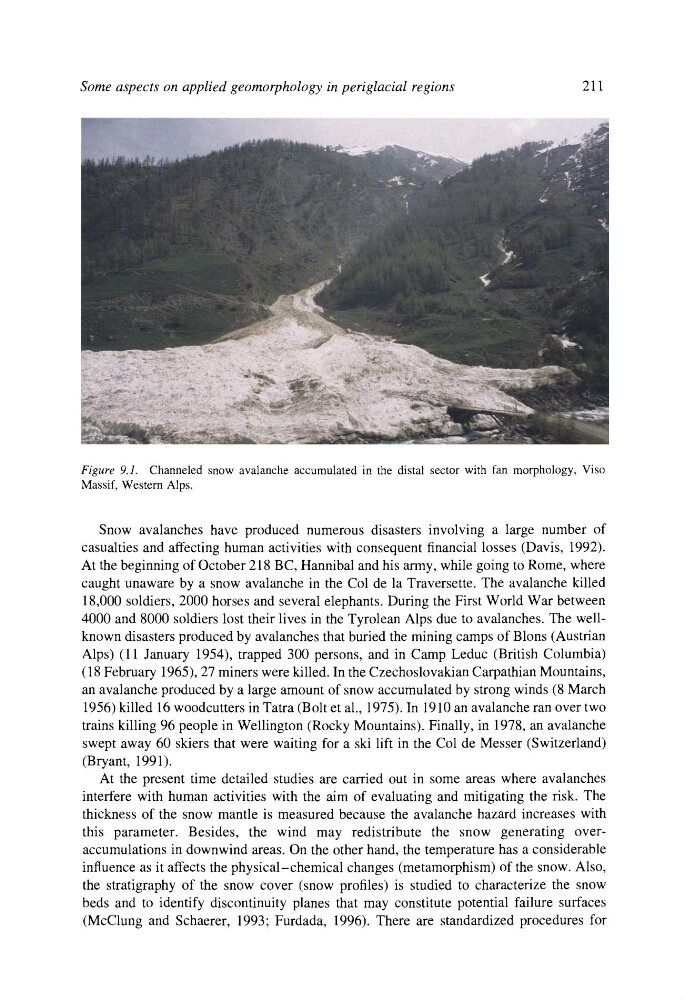
Figure 9.1. Channeled snow avalanche accumulated in the distal sector with fan morphology, Viso
Massif, Western Alps.
Snow avalanches have produced numerous disasters involving a large number of
casualties and affecting human activities with consequent financial losses (Davis, 1992).
At the beginning of October 218 BC, Hannibal and his army, while going to Rome, where
caught unaware by a snow avalanche in the Col de la Traversette. The avalanche killed
18,000 soldiers, 2000 horses and several elephants. During the First World War between
4000 and 8000 soldiers lost their lives in the Tyrolean Alps due to avalanches. The wellknown disasters produced by avalanches that buried the mining camps of Blons (Austrian
Alps) (11 January 1954), trapped 300 persons, and in Camp Leduc (British Columbia)
(18 February 1965), 27 miners were killed. In the Czechoslovakian Carpathian Mountains,
an avalanche produced by a large amount of snow accumulated by strong winds (8 March
1956) killed 16 woodcutters in Tatra (Bolt et al., 1975). In 1910 an avalanche ran over two
trains killing 96 people in Wellington (Rocky Mountains). Finally, in 1978, an avalanche
swept away 60 skiers that were waiting for a ski lift in the Col de Messer (Switzerland)
(Bryant, 1991).
At the present time detailed studies are carried out in some areas where avalanches
interfere with human activities with the aim of evaluating and mitigating the risk. The
thickness of the snow mantle is measured because the avalanche hazard increases with
this parameter. Besides, the wind may redistribute the snow generating overaccumulations in downwind areas. On the other hand, the temperature has a considerable
influence as it affects the physical-chemical changes (metamorphism) of the snow. Also,
the stratigraphy of the snow cover (snow profiles) is studied to characterize the snow
beds and to identify discontinuity planes that may constitute potential failure surfaces
(McClung and Schaerer, 1993; Furdada, 1996). There are standardized procedures for
211
Figure 9.1. Channeled snow avalanche accumulated in the distal sector with fan morphology, Viso
Massif, Western Alps.
Snow avalanches have produced numerous disasters involving a large number of
casualties and affecting human activities with consequent financial losses (Davis, 1992).
At the beginning of October 218 BC, Hannibal and his army, while going to Rome, where
caught unaware by a snow avalanche in the Col de la Traversette. The avalanche killed
18,000 soldiers, 2000 horses and several elephants. During the First World War between
4000 and 8000 soldiers lost their lives in the Tyrolean Alps due to avalanches. The wellknown disasters produced by avalanches that buried the mining camps of Blons (Austrian
Alps) (11 January 1954), trapped 300 persons, and in Camp Leduc (British Columbia)
(18 February 1965), 27 miners were killed. In the Czechoslovakian Carpathian Mountains,
an avalanche produced by a large amount of snow accumulated by strong winds (8 March
1956) killed 16 woodcutters in Tatra (Bolt et al., 1975). In 1910 an avalanche ran over two
trains killing 96 people in Wellington (Rocky Mountains). Finally, in 1978, an avalanche
swept away 60 skiers that were waiting for a ski lift in the Col de Messer (Switzerland)
(Bryant, 1991).
At the present time detailed studies are carried out in some areas where avalanches
interfere with human activities with the aim of evaluating and mitigating the risk. The
thickness of the snow mantle is measured because the avalanche hazard increases with
this parameter. Besides, the wind may redistribute the snow generating overaccumulations in downwind areas. On the other hand, the temperature has a considerable
influence as it affects the physical-chemical changes (metamorphism) of the snow. Also,
the stratigraphy of the snow cover (snow profiles) is studied to characterize the snow
beds and to identify discontinuity planes that may constitute potential failure surfaces
(McClung and Schaerer, 1993; Furdada, 1996). There are standardized procedures for