

Periglacial landforms
193
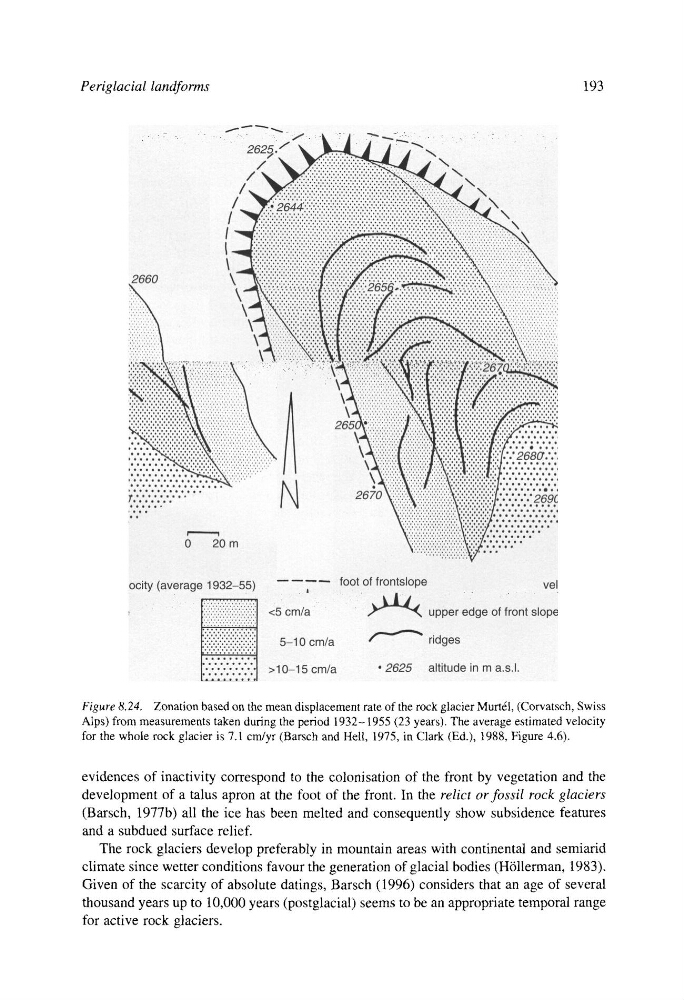
Figure 8.24. Zonation based on the mean displacement rate of the rock glacier Murt61, (Corvatsch, Swiss
Alps) from measurements taken during the period 1932-1955 (23 years). The average estimated velocity
for the whole rock glacier is 7.1 cm/yr (Barsch and Hell, 1975, in Clark (Ed.), 1988, Figure 4.6).
evidences of inactivity correspond to the colonisation of the front by vegetation and the
development of a talus apron at the foot of the front. In the relict or fossil rock glaciers
(Barsch, 1977b) all the ice has been melted and consequently show subsidence features
and a subdued surface relief.
The rock glaciers develop preferably in mountain areas with continental and semiarid
climate since wetter conditions favour the generation of glacial bodies (H611erman, 1983).
Given of the scarcity of absolute datings, Barsch (1996) considers that an age of several
thousand years up to 10,000 years (postglacial) seems to be an appropriate temporal range
for active rock glaciers.
193
Figure 8.24. Zonation based on the mean displacement rate of the rock glacier Murt61, (Corvatsch, Swiss
Alps) from measurements taken during the period 1932-1955 (23 years). The average estimated velocity
for the whole rock glacier is 7.1 cm/yr (Barsch and Hell, 1975, in Clark (Ed.), 1988, Figure 4.6).
evidences of inactivity correspond to the colonisation of the front by vegetation and the
development of a talus apron at the foot of the front. In the relict or fossil rock glaciers
(Barsch, 1977b) all the ice has been melted and consequently show subsidence features
and a subdued surface relief.
The rock glaciers develop preferably in mountain areas with continental and semiarid
climate since wetter conditions favour the generation of glacial bodies (H611erman, 1983).
Given of the scarcity of absolute datings, Barsch (1996) considers that an age of several
thousand years up to 10,000 years (postglacial) seems to be an appropriate temporal range
for active rock glaciers.